Restaurant Command Center: How AI Is Creating a New Operating System for Multi-Location QSR Brands

A restaurant group operating five locations can often manage by observation.
Leadership knows the managers.
They know the restaurants.
They know when sales feel weak.
They know when a location is struggling.
They can call someone and find out what happened.
At 50 locations, that becomes harder.
At 250 locations, it becomes a different management problem entirely.
Every day, a large quick-service restaurant organization generates information across:
POS transactions
online ordering
third-party delivery
labor
kitchen production
inventory
menu availability
discounts
refunds
loyalty
customer feedback
franchise performance
regional performance
The organization does not suffer from a shortage of data.
It suffers from a shortage of attention.
A CEO cannot review every restaurant.
A COO cannot investigate every variance.
A VP of Operations cannot open 200 dashboards every morning.
A Franchise Director cannot personally identify every location that needs support.
The traditional answer has been to add more reporting.
More dashboards.
More BI tools.
More alerts.
More spreadsheets.
That approach eventually reaches its limit.
The next evolution is not another dashboard.
It is a Restaurant Command Center.
A Restaurant Command Center brings together operational signals from across the restaurant network, identifies what matters, explains why it matters, and helps leadership decide where to act.
Artificial intelligence makes that concept significantly more powerful.
Instead of simply displaying restaurant performance, AI can help interpret it.
Instead of showing hundreds of locations, it can prioritize the few that need attention.
Instead of reporting yesterday's labor variance, it can warn that tomorrow's labor plan is likely to miss demand.
Instead of showing an inventory report, it can identify which location is likely to run out of a key ingredient before dinner.
Instead of showing kitchen ticket times, it can highlight a production bottleneck forming across several stores.
This represents a fundamental change in how multi-location restaurant organizations can be managed.
The Restaurant Command Center is not where leaders see everything. It is where they see what matters.
Executive Summary
Multi-location restaurant organizations already collect enormous amounts of operational information.
The challenge is turning that information into decisions.
A Restaurant Command Center is a centralized operating layer that helps leadership monitor restaurant performance across locations, prioritize meaningful exceptions, investigate root causes, and coordinate action.
AI expands that capability by allowing restaurant platforms to move through several stages:
Data
↓
Visibility
↓
Analysis
↓
Prediction
↓
Prioritization
↓
Recommendation
↓
Action
For QSR franchise owners, growing restaurant groups, and enterprise brands, a Restaurant Command Center could eventually bring together intelligence across:
sales
labor
inventory
kitchens
online ordering
delivery
customer experience
menu availability
franchise compliance
profitability
The concept is already emerging across restaurant technology.
Fourth launched Fourth iQ 3.0 in 2026 specifically for executives and operations teams responsible for multi-location performance. The company describes the product as an above-store intelligence layer that connects labor, sales, margin, execution, and technology adoption across locations, while linking strategic insight to operational action.
The direction is important.
Restaurant technology is moving beyond reporting systems toward operating systems for decision-making.
What Is a Restaurant Command Center?
A Restaurant Command Center is a centralized operational intelligence layer that brings together restaurant data across locations, identifies important performance exceptions, prioritizes issues by business impact, and helps leadership coordinate corrective action.
A conventional restaurant dashboard might show:
yesterday's sales
labor percentage
delivery performance
inventory levels
ticket times
A Restaurant Command Center should answer more useful questions:
Which restaurants need attention?
What changed?
Why did it change?
How important is the problem?
What is likely to happen next?
Who should take action?
Was the issue resolved?
That distinction matters.
The goal is not maximum visibility.
It is decision clarity.
This concept builds directly on the operating philosophy explored in Restaurant Management by Exception.
Management by exception defines how leadership should manage a large restaurant network.
The Restaurant Command Center defines the operational environment that makes that management model possible.
Why Traditional Restaurant Dashboards Are Reaching Their Limit
Dashboards solved an important problem.
They made restaurant data visible.
Before cloud reporting, operators often depended on:
printed reports
spreadsheets
manually consolidated files
accounting data received days later
store managers emailing results
Modern platforms changed that.
Restaurant executives can now access detailed information almost instantly.
That is a major improvement.
But visibility creates another challenge.
Too many systems now provide their own dashboards:
POS dashboard
labor dashboard
inventory dashboard
delivery dashboard
loyalty dashboard
customer feedback dashboard
accounting dashboard
kitchen dashboard
franchise dashboard
Each dashboard may be valuable.
Collectively, they force leadership to become the integration layer.
Executives must mentally connect:
Sales declined.
with:
Labor increased.
with:
Delivery completion deteriorated.
with:
Three high-volume items were unavailable.
with:
Customer reviews declined.
The information exists.
But the executive still has to assemble the story.
This is where AI can change the role of restaurant reporting.
Instead of requiring leadership to interpret every metric manually, the system can begin connecting signals automatically.
From Dashboard to Decision Engine
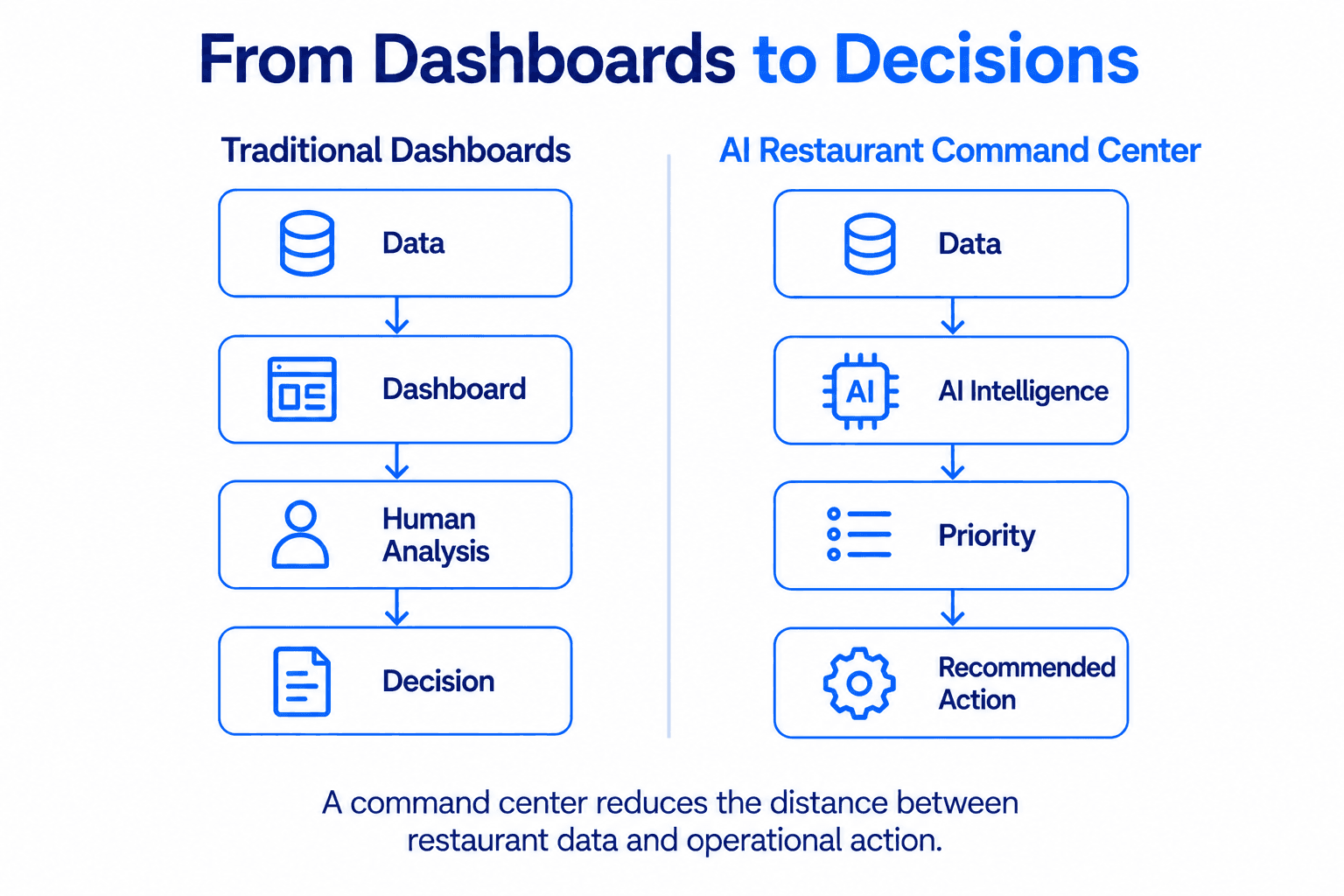
A traditional dashboard is passive.
It waits for someone to open it.
An intelligent Restaurant Command Center should be proactive.
Imagine two operating models.
Traditional dashboard
Sales: -8%
Labor: +4%
Delivery cancellations: +11%
Menu availability: 91%
Customer rating: down 0.3
Leadership must determine whether those metrics are connected.
Restaurant Command Center
Location 42 requires attention.
Sales declined 8%, primarily during digital dinner orders.
Three top-selling menu items were unavailable for 2.4 hours.
Delivery cancellations increased during the same period.
Labor remained above plan despite lower fulfilled order volume.
Recommended priority: investigate digital menu availability before adjusting staffing.
The underlying data is largely the same.
The difference is interpretation.
That is why the future of restaurant reporting is unlikely to be defined by more charts.
It will be defined by better conclusions.
One View Across the Entire Restaurant Operation
The strongest Restaurant Command Center cannot operate from POS sales alone.
Restaurant performance is interconnected.
A sales problem may actually be:
an inventory problem
a staffing problem
a kitchen problem
a menu problem
a delivery problem
The command center therefore needs visibility across several operational layers.
Sales
Questions include:
Which locations are missing forecast?
Is transaction volume changing?
Is average ticket changing?
Is the issue limited to one order channel?
Which products are driving the variance?
Labor
Questions include:
Which locations are materially over labor plan?
Which are understaffed?
Where is overtime risk increasing?
Does labor deployment match actual demand?
This connects directly to AI Restaurant Labor Optimization.
Inventory
Questions include:
Which locations face stockout risk?
Where is actual usage materially above theoretical?
Where is waste increasing?
Which restaurants are over-purchasing?
This connects to AI Inventory Management for Restaurants.
Kitchen
Questions include:
Which locations have unusual ticket-time deterioration?
Where are production bottlenecks forming?
Which menu items create recurring delays?
Are digital orders overwhelming capacity?
This connects directly to AI Kitchen Orchestration.
Demand
Questions include:
Which locations will be unusually busy tomorrow?
Which dayparts are likely to exceed normal demand?
How should staffing or preparation change?
This connects directly to AI Restaurant Demand Forecasting.
Delivery and digital ordering
Questions include:
Which marketplaces are underperforming?
Where are cancellation rates rising?
Are menus synchronized?
Which locations have preparation delays?
Is kitchen capacity affecting digital fulfillment?
Franchise performance
Questions include:
Which franchisees require support?
Which locations are consistently outside brand benchmarks?
Which best practices should be replicated across the network?
The value comes from bringing these questions into one operating context.
The Restaurant Command Center Should Prioritize, Not Just Consolidate
Simply putting ten dashboards onto one screen does not create a command center.
That creates a larger dashboard.
The intelligence layer must decide what deserves attention.
Imagine a restaurant organization operating 300 locations.
On a normal day:
271 may be operating within expected ranges
19 may have minor issues
7 may require investigation
3 may require immediate intervention
The executive should not begin by reviewing 300 stores.
They should begin with the three.
That is the principle behind management by exception.
The system might rank issues using factors such as:
financial impact
customer impact
duration
deviation from forecast
recurrence
operational risk
franchise compliance
likelihood of deterioration
The command center becomes an attention allocation system.
And executive attention is one of the most valuable resources in a large restaurant organization.
From Daily Reports to Executive Briefings
One of the clearest AI use cases is the daily operational briefing.
Instead of executives opening multiple systems every morning, the command center could generate a short summary.
For example:
Morning Network Brief
Network status
284 locations operating normally
11 locations require monitoring
5 locations require action
Priority 1
Location 117
Food cost variance has exceeded peer benchmark for 6 consecutive days.
Primary driver:
Chicken usage 12% above theoretical.
Recommended action:
Review portion control, waste records, recipe configuration, and receiving accuracy.
Priority 2
Location 82
Lunch ticket time is forecast to exceed service target today.
Primary driver:
Expected 21% increase in digital orders between 11:45 a.m. and 1:15 p.m.
Recommended action:
Reposition one cross-trained employee to assembly before 11:30 a.m.
Priority 3
Location 204
Top-selling menu item unavailable on two delivery platforms yesterday for 3.1 hours.
Estimated missed demand:
Material relative to normal Monday digital volume.
Recommended action:
Review menu synchronization.
That is much more useful than:
Here are your reports.
Leadership begins with:
Here are today's decisions.
Why Predictions Belong Inside the Command Center
Historical performance is useful.
But restaurant leaders cannot change yesterday.
The biggest operational value comes from identifying what is likely to happen next.
This is why demand forecasting becomes one of the core intelligence engines behind the Restaurant Command Center.
The forecast might say:
Tomorrow's lunch demand will be 18% above baseline.
But the Command Center goes further.
It connects the prediction to other operating systems.
Labor
Do we have enough employees scheduled?
Inventory
Do we have enough product?
Kitchen
Can production handle the expected order mix?
Delivery
Will digital capacity become constrained?
Management
Does leadership need to intervene?
One prediction can therefore create several operational decisions.
This is why your previously published AI articles are not separate topics.
They are parts of the same operating model.
Restaurant Intelligence Should Connect Cause and Effect
The most valuable restaurant insights often appear across different systems.
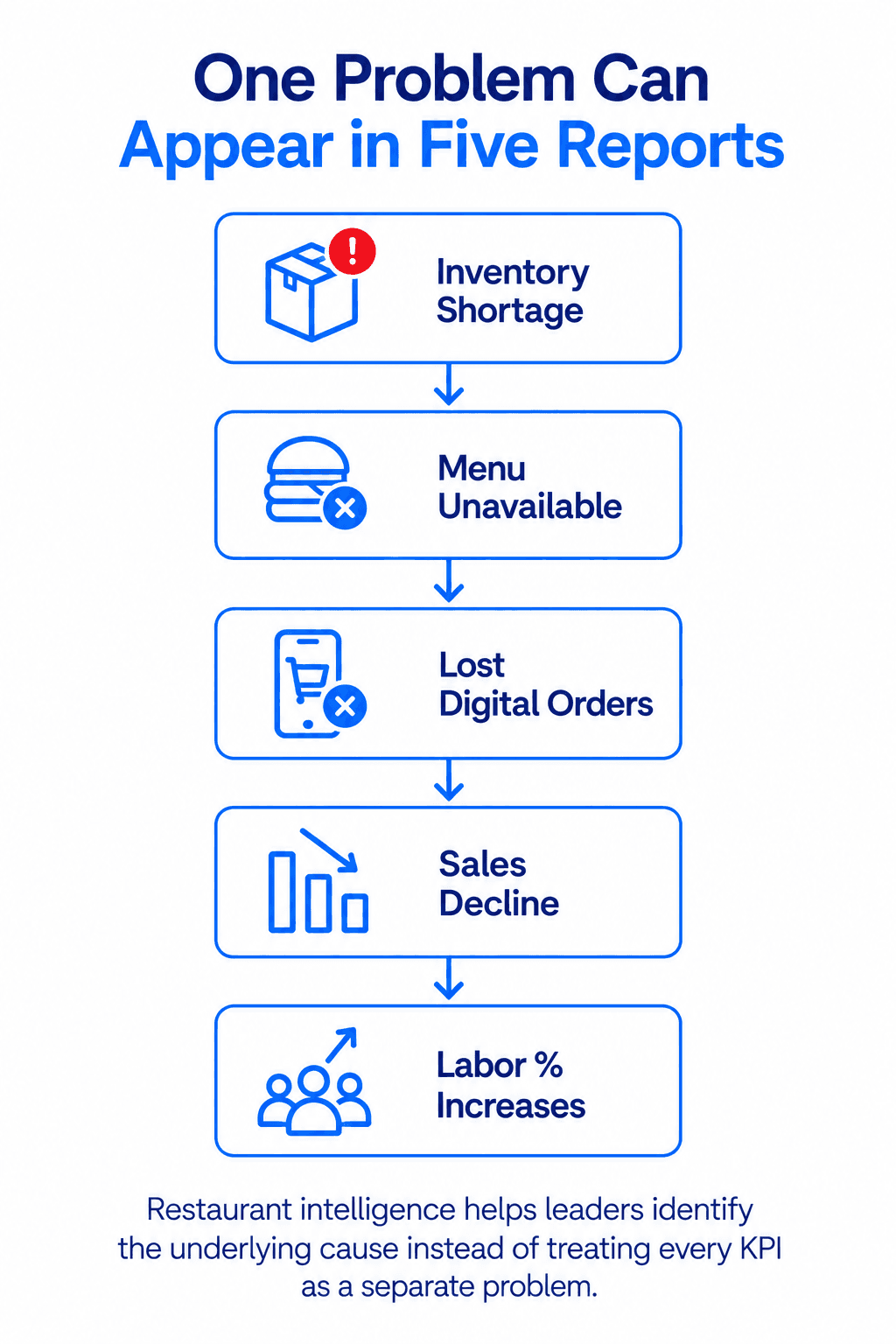
Consider this sequence:
Inventory shortage
↓
Menu item unavailable
↓
Digital conversion declines
↓
Sales decline
↓
Labor percentage increases
A traditional reporting environment may display five separate problems.
An intelligent command center recognizes one chain of cause and effect.
That matters because otherwise leadership may solve the wrong problem.
A manager looking only at the labor dashboard might conclude:
Labor is too high. Cut staffing.
But if labor percentage increased because a menu availability problem reduced sales, cutting staff does not solve the underlying issue.
It may make operations worse.
Restaurant intelligence should therefore help leadership move from:
What metric changed?
to:
What caused the business outcome?
That is a significantly more valuable use of AI.
From Location Benchmarking to Intelligent Peer Groups
Multi-location reporting often compares restaurants against the network average.
That can be misleading.
A suburban drive-thru restaurant may operate very differently from:
a downtown location
an airport restaurant
a mall food-court unit
a delivery-heavy urban location
a newly opened restaurant
An intelligent Command Center can create more meaningful peer groups.
Locations could be compared using factors such as:
sales volume
restaurant format
operating hours
market
location maturity
delivery penetration
channel mix
menu mix
seasonality
Instead of telling a franchisee:
Your labor cost is above the company average.
The system can say:
Your lunch labor cost is 7% above comparable high-volume drive-thru restaurants with similar order mix.
That is more credible.
And more actionable.
For franchise brands, this matters because benchmarking is not simply an analytical exercise.
It influences franchisee trust.
Turning Best Restaurants Into Operating Models
A Command Center should not only identify weak performance.
It should identify why top-performing restaurants perform well.
Imagine AI discovers that the top 15 comparable locations consistently:
deploy line-busting 20 minutes before peak queues
maintain higher digital menu availability
schedule a specific skill mix at lunch
prepare certain items earlier
use less overtime
produce lower inventory variance
The system can identify patterns across these locations.
Leadership can then investigate whether those behaviors should become broader operating standards.
This changes benchmarking from:
Rank the restaurants.
to:
Learn from the restaurants.
That is much more valuable for enterprise operations.
The Command Center Should Support Every Leadership Level
A CEO and a restaurant manager should not see the same information.
The intelligence layer should adapt to the role.
CEO
The CEO needs:
network performance
major risks
growth trends
profitability trends
systemic problems
The CEO should not receive alerts about every late order.
COO
The COO needs:
operating consistency
throughput
labor
food cost
service performance
recurring network problems
CFO
The CFO needs:
margin
labor variance
food cost
revenue leakage
purchasing
ROI
profitability by location
VP Operations
The VP Operations needs:
which stores require intervention
why performance changed
district-level trends
corrective actions
recurring execution problems
Franchise Director
The Franchise Director needs:
franchisee performance
brand-standard exceptions
benchmarking
coaching opportunities
recurring support needs
District or Regional Manager
The field leader needs:
locations requiring visits
managers requiring support
operational exceptions
unresolved tasks
Restaurant Manager
The restaurant manager needs:
today's demand
today's staffing
today's inventory risk
today's kitchen issues
today's priorities
One operational intelligence layer can therefore produce different views of the same business.
From Alerts to Next Best Actions
Alerts are useful.
Too many alerts recreate the original problem.
An intelligent Command Center should move beyond:
Something is wrong.
toward:
Here is the most appropriate next step.
Fourth's 2026 release illustrates this direction. Fourth iQ combines forecasting and "Next Best Actions" with above-store intelligence intended to help multi-location leadership understand both what is happening and what operational action may improve performance.
A restaurant alert might say:
Labor forecast variance exceeds threshold.
A next-best-action system might say:
Dinner demand is now forecast 11% below plan. Move two breaks forward and review whether the 5:00 p.m. start is still required.
The manager retains control.
But the system has shortened the path from detection to decision.
Human Approval Still Matters
A Restaurant Command Center should not become an autonomous corporate manager.
AI recommendations can be wrong.
Data can be incomplete.
Local managers may know something the model does not.
A recommendation may fail to account for:
a broken piece of equipment
employee training
a local event change
a weather disruption
construction
food-quality issues
a temporary supplier problem
That is why AI should generally progress through stages.
Detect
↓
Explain
↓
Recommend
↓
Human Approves
↓
Execute
Low-risk actions may eventually become automated.
High-impact decisions should retain clear accountability.
Examples requiring stronger governance include:
employee discipline
major schedule changes
purchasing commitments
pricing changes
franchise enforcement
customer-data decisions
The goal is intelligent management.
Not invisible algorithmic management.
The Restaurant Command Center Is an Architecture, Not a Single Screen
This distinction is important.
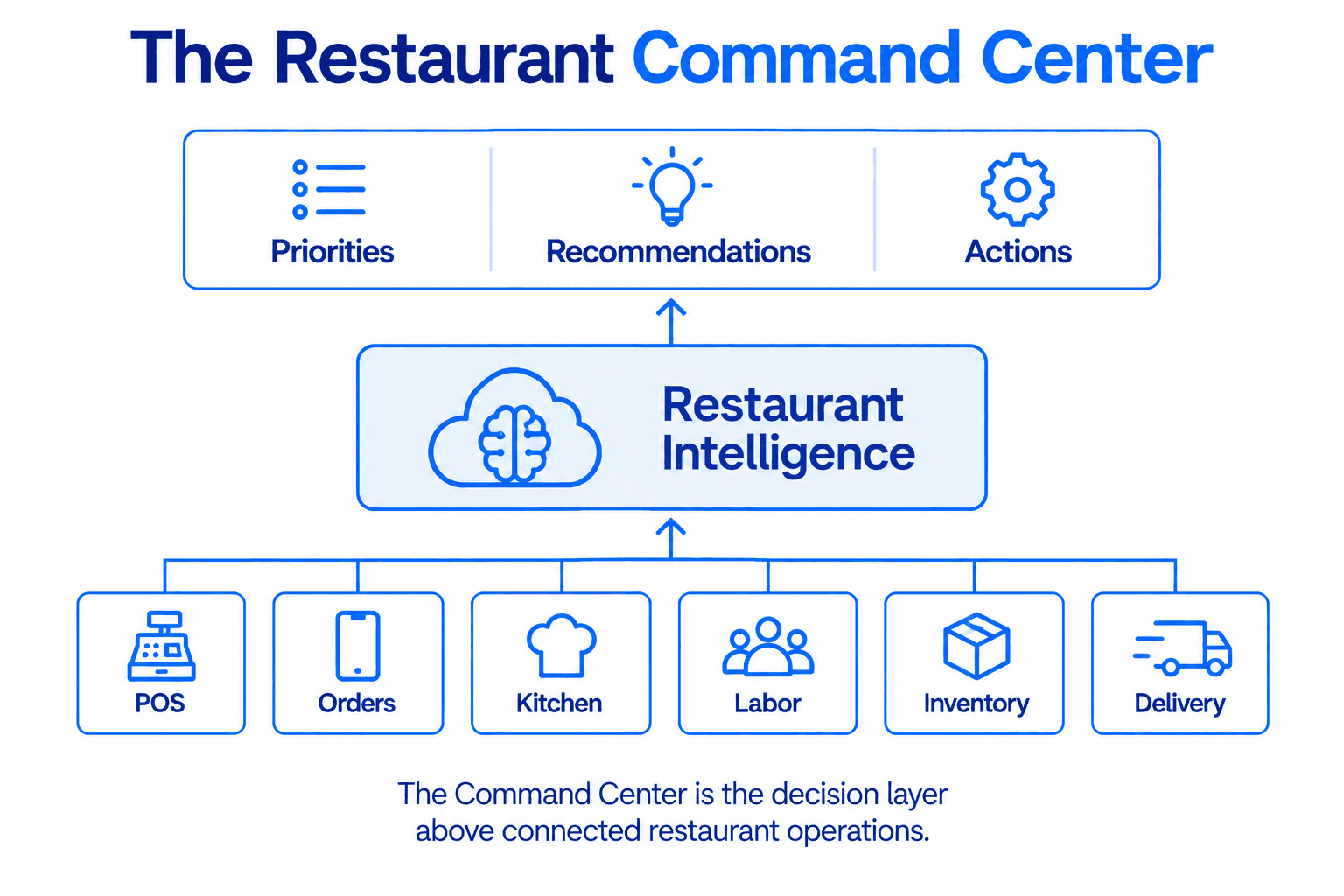
A Command Center is not primarily a visual design.
It is a data and decision architecture.
Behind the interface sit:
POS data
ordering data
delivery data
menu data
kitchen data
labor data
inventory data
customer data
franchise data
Above that sits:
Operational intelligence
Then:
Predictions
Exceptions
Recommendations
Actions
The dashboard is simply how humans interact with that system.
This means the most difficult part of building a powerful Restaurant Command Center is usually not designing the interface.
It is connecting the underlying operation.
Why Connected Restaurant Data Matters
AI cannot manage what it cannot see.
Imagine a restaurant where:
counter sales are in the POS
DoorDash orders live elsewhere
Uber Eats uses another tablet
kitchen information sits in a separate system
labor sits in scheduling software
inventory is maintained in spreadsheets
Each system understands one part of the restaurant.
None understands the complete operation.
This creates fragmented intelligence.
The stronger model is a connected data foundation.
This principle has appeared throughout the MYR AI series, starting with AI for Restaurant Operations.
The AI layer becomes more useful as the operational foundation becomes more complete.
Where MYR Fits Into the Restaurant Command Center
MYR already provides several foundational capabilities required for multi-location operational visibility.
For QSR franchise organizations, MYR provides real-time reporting across locations, centralized menu management, location-specific pricing and promotions, ordering capabilities, kitchen tools, delivery integrations, and franchise-level controls.
The MYR franchise platform currently includes capabilities such as:
multi-location sales reporting
centralized menu management
pricing by location, platform, and order type
Kitchen Display System
online ordering
third-party ordering integrations
delivery integrations
inventory management
recipe tracking
loyalty
punch-clock functionality
franchise controls
MYR's broader platform positioning also emphasizes centralized management, KPI visibility, and increased order-fulfillment capacity across restaurant locations.
This does not mean MYR should claim that every concept described in this article is an existing autonomous AI feature.
The more credible positioning is:
MYR provides the connected QSR operating foundation upon which increasingly intelligent multi-location management can be built.
That position is both accurate and strategically powerful.
From POS Platform to Restaurant Operating System
This is the larger transformation happening in restaurant technology.
The POS began as a transaction system.
Its primary responsibility was:
Record the sale.
Cloud POS expanded that role.
It connected:
payments
online ordering
delivery
reporting
menus
kitchens
AI expands the role again.
The platform begins to answer:
What does all this operational information mean?
The evolution looks like this:
Cash Register
↓
POS
↓
Cloud Restaurant Platform
↓
Connected Operations Platform
↓
Restaurant Intelligence Platform
↓
Restaurant Command Center
The transaction remains important.
But the strategic value moves upward toward decision-making.
The Command Center Creates a Closed Operating Loop
When all of the pieces come together, restaurant management begins to function as a continuous loop.
Predict
Demand forecasting identifies what is likely to happen.
Prepare
Labor and inventory intelligence recommend appropriate resources.
Execute
Kitchen orchestration coordinates fulfillment.
Monitor
The Command Center watches actual performance.
Detect
Management by exception identifies meaningful variance.
Recommend
AI suggests corrective action.
Learn
Results improve future forecasts and recommendations.
Then the cycle repeats.
This is a much more sophisticated operating model than:
Run restaurants today and review reports tomorrow.
It is increasingly:
Predict, prepare, execute, monitor, correct, learn.
Restaurant Management Becomes More Proactive
Traditional restaurant operations are heavily reactive.
A location runs out of food.
Then someone investigates.
Labor exceeds budget.
Then the manager explains.
Ticket times deteriorate.
Then operations intervenes.
Sales fall.
Then leadership reviews the report.
AI-supported command-center thinking moves intervention earlier.
Before the stockout.
Before labor finishes above target.
Before the kitchen becomes overwhelmed.
Before the guest experience deteriorates.
This does not eliminate operational problems.
It changes when the organization sees them.
And earlier visibility often creates more options.
What QSR Brands Should Look for in a Future Restaurant Command Center
Restaurant leadership should evaluate platforms according to several principles.
Connected operational data
Can the platform see activity across ordering, kitchens, delivery, menus, locations, and other major restaurant systems?
Real-time visibility
How quickly does operational information become available?
Multi-location architecture
Was the system designed to manage one location or hundreds?
Role-based access
Can franchisees, managers, executives, and corporate teams see the appropriate information?
Intelligent exception management
Does the system identify meaningful deviations or simply provide reports?
Explainability
Can managers understand why an alert or recommendation was generated?
Benchmarking
Can locations be compared against appropriate peer groups?
Drill-down capability
Can executives move from network-level insight into the underlying transaction or operational data?
Open integrations
Can the platform connect with the wider restaurant technology stack?
Governance
Which recommendations can the system make?
Which actions require approval?
Who is accountable?
These questions become increasingly important as restaurants move from reporting toward AI-supported operations.
The Future Is Not One Giant Dashboard
It is tempting to imagine the Restaurant Command Center as a massive screen filled with:
charts
heatmaps
KPIs
alerts
rankings
That misses the point.
The best command center may ultimately become surprisingly simple.
A CEO might open it and see:
Network health: strong.
Three risks require attention.
One opportunity could materially improve margin.
Two franchise locations require operational support.
That's it.
The complexity exists underneath.
The interface becomes simpler because the intelligence becomes better.
More intelligence should create less information overload, not more.
The Future of Multi-Location Restaurant Management
Restaurant organizations will continue to grow more complex.
More locations.
More channels.
More customer data.
More ordering platforms.
More delivery.
More operational systems.
Leadership cannot solve that complexity by manually reviewing more information.
The organization needs technology that filters complexity.
That is the long-term role of the Restaurant Command Center.
It connects the intelligence already developing across:
demand forecasting
labor optimization
inventory management
kitchen orchestration
digital ordering
delivery
franchise reporting
and converts it into one management question:
Where should we focus today?
For an organization operating hundreds of restaurants, that question may ultimately be more valuable than any individual dashboard.
Conclusion
Restaurant technology has spent decades helping operators capture more data.
The next phase will focus on helping them understand what to do with it.
Multi-location restaurant leaders do not need to personally monitor every transaction, employee hour, ingredient, delivery order, and kitchen ticket.
They need to understand:
which locations require attention
what is changing
why it is changing
what is likely to happen next
which action creates the greatest value
That is the purpose of the Restaurant Command Center.
Demand forecasting predicts what is coming.
Labor optimization determines the people required.
Inventory intelligence determines the ingredients required.
Kitchen orchestration manages fulfillment.
Management by exception identifies where performance is deviating.
The Command Center brings those signals together.
The result is not simply another restaurant dashboard.
It is the beginning of a new management architecture for multi-location QSR brands.
Don't manage 250 restaurants. Manage the 5 that need you today.
Build a Stronger Foundation for Multi-Location QSR Operations
A Restaurant Command Center begins with connected restaurant data.
MYR helps QSR franchise owners, growing restaurant groups, and enterprise brands centralize ordering, menus, kitchen workflows, third-party delivery, reporting, and multi-location management through one cloud-based platform. MYR already provides real-time reporting and centralized operational controls across franchise locations.
Explore MYR for QSR Franchises
Frequently Asked Questions
What is a Restaurant Command Center?
A Restaurant Command Center is a centralized operational intelligence layer that brings together restaurant data across locations, identifies important performance exceptions, prioritizes issues, and helps leadership coordinate action.
How is a Restaurant Command Center different from a restaurant dashboard?
A traditional dashboard primarily displays KPIs and reports. A Restaurant Command Center adds intelligence by identifying what requires attention, connecting related operational signals, prioritizing issues, and eventually recommending actions.
How can AI improve multi-location restaurant management?
AI can analyze operational information across restaurant locations, identify unusual performance, forecast future risks, compare similar restaurants, prioritize interventions, and recommend appropriate next steps.
What data should a Restaurant Command Center include?
Useful data can include POS transactions, online ordering, delivery, labor, inventory, menu availability, kitchen performance, customer feedback, promotions, loyalty, and franchise reporting.
How does management by exception connect to a Restaurant Command Center?
Management by exception is the operating philosophy of focusing leadership attention on significant deviations rather than reviewing every location equally. The Restaurant Command Center is the technology layer that can identify and prioritize those exceptions.
Can a Restaurant Command Center predict problems before they happen?
Potentially, yes. When forecasting and operational data are connected, the system can identify risks such as staffing gaps, inventory shortages, kitchen-capacity problems, or demand changes before they become operational failures.
Can AI automatically manage restaurant locations?
AI can assist with monitoring, forecasting, recommendations, and selected low-risk automated actions. Restaurant managers and executives should retain responsibility for high-impact decisions involving employees, purchasing, pricing, franchise compliance, and other sensitive areas.
Why is connected data important for a Restaurant Command Center?
A Command Center needs information across multiple operational systems to understand cause and effect. If ordering, labor, inventory, kitchen, and delivery data remain disconnected, the intelligence layer sees only part of the restaurant.
How can restaurant franchises use a Command Center?
Franchise organizations can use a Command Center to compare locations, identify franchisees requiring support, detect brand-standard exceptions, benchmark similar stores, prioritize field-team activity, and surface network-wide operating patterns.
Is a Restaurant Command Center the same as restaurant operations software?
Not exactly. Restaurant operations software can manage individual workflows. A Restaurant Command Center sits above connected operational systems and focuses on network-wide visibility, intelligence, prioritization, and decision support.