AI Restaurant Demand Forecasting: How Predictive Intelligence Improves Labor, Inventory, and Sales

Every restaurant manager has experienced it.
One Friday evening the restaurant is overwhelmed.
The following Friday the team is overstaffed.
One week ingredients run out before dinner.
The next week expensive inventory is thrown away.
Labor costs fluctuate.
Kitchen throughput changes.
Delivery demand spikes unexpectedly.
Customer traffic shifts from dine-in to digital ordering.
Despite having years of sales history, forecasting remains one of the most difficult operational challenges in the restaurant industry.
For decades, forecasting has relied on historical averages, spreadsheets, and manager experience.
Those methods worked reasonably well when restaurants operated through one ordering channel with relatively stable customer behavior.
Today's quick-service restaurants operate in a completely different environment.
Demand is influenced by dozens of constantly changing variables:
weather
sporting events
local festivals
school schedules
holidays
promotions
digital marketing
delivery platforms
social media
competitor activity
traffic patterns
consumer spending
seasonality
Trying to predict tomorrow's business using only last year's numbers is becoming increasingly unreliable.
Artificial intelligence changes that equation.
Instead of looking only at historical sales, AI continuously analyzes operational signals from across the restaurant ecosystem, identifies patterns that humans cannot easily detect, and predicts future demand with far greater precision.
That prediction becomes the foundation for better staffing, smarter purchasing, improved kitchen planning, stronger profitability, and ultimately a better guest experience.
As discussed in our guide to AI for Restaurant Operations, predictive intelligence is one of the most valuable capabilities AI brings to modern restaurant technology because it enables operators to act before problems occur rather than reacting afterward.
For multi-location restaurant groups and franchise brands, the opportunity is even greater.
Rather than forecasting each restaurant independently, AI can learn from hundreds of locations simultaneously, identify patterns across the network, and generate increasingly accurate predictions for every restaurant.
Forecasting is no longer about guessing tomorrow.
It is about preparing for it.
Executive Summary
Restaurant demand forecasting has traditionally relied on historical sales, manager experience, and simple trend analysis.
While these methods remain useful, they struggle to account for the growing complexity of modern restaurant operations.
Artificial intelligence introduces a fundamentally different approach.
Instead of asking,
What happened last year?
AI asks,
What is likely to happen tomorrow?
By combining operational data with external variables such as weather, local events, promotions, ordering behavior, and seasonal trends, AI continuously predicts future demand and recommends operational adjustments before service begins.
For restaurant operators, this means:
more accurate staffing
fewer inventory shortages
less food waste
improved kitchen preparation
better delivery planning
stronger sales forecasting
improved profitability
Throughout this article you'll learn:
How AI restaurant demand forecasting works
Why traditional forecasting methods fall short
How predictive intelligence improves labor planning
How AI reduces inventory waste
Why forecasting is becoming essential for multi-location restaurant operations
Which forecasting metrics restaurant executives should monitor
How connected restaurant platforms create more accurate predictions
You'll also discover why demand forecasting is rapidly becoming one of the foundational capabilities of AI-powered restaurant operations.
What Is AI Restaurant Demand Forecasting?
AI restaurant demand forecasting uses artificial intelligence to predict future customer demand by analyzing restaurant data together with external factors such as weather, events, promotions, seasonality, and ordering behavior. These predictions help restaurants optimize staffing, inventory, kitchen production, and operational planning before demand occurs.
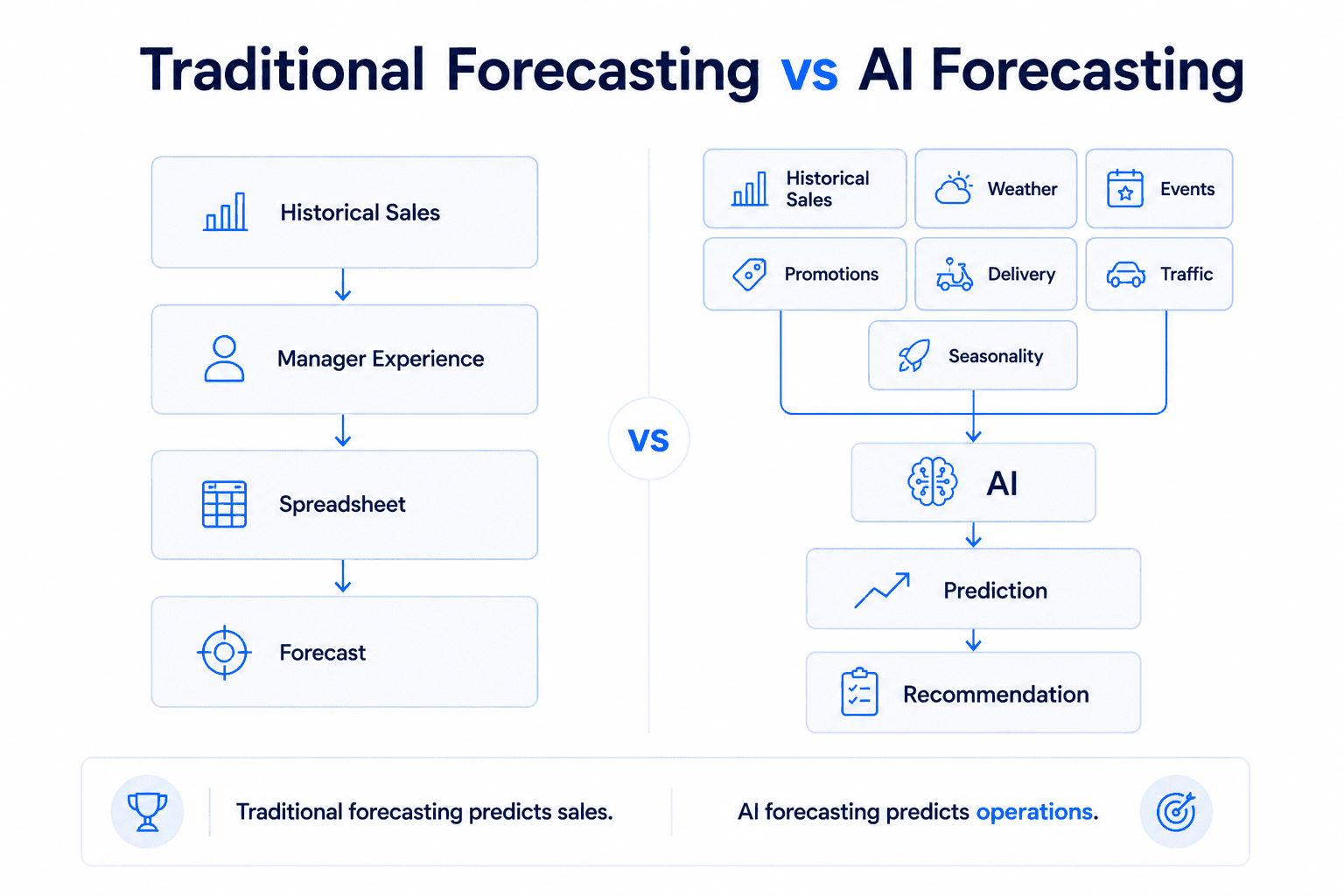
Traditional forecasting focuses primarily on historical performance.
AI forecasting combines historical performance with real-time operational intelligence.
Instead of relying on last year's Friday sales, AI continuously evaluates dozens of variables simultaneously to determine what tomorrow is likely to look like.
Those variables may include:
historical sales
transaction patterns
product mix
weather forecasts
local events
holidays
school calendars
delivery demand
digital marketing campaigns
promotions
customer behavior
seasonal trends
inventory levels
labor availability
Rather than producing a single sales estimate, AI generates operational forecasts that influence nearly every area of restaurant management.
For example:
Instead of predicting
Tomorrow's sales will be $18,700.
AI might recommend:
Lunch demand is expected to increase by 14%.
Schedule one additional cashier between 11:30 a.m. and 1:30 p.m.
Increase preparation of chicken sandwiches by 18%.
Delay receiving inventory until after lunch.
Increase digital pickup estimates by three minutes during peak demand.
Forecasting therefore becomes operational rather than purely financial.
Why Traditional Restaurant Forecasting Falls Short
Restaurant forecasting has historically depended on three primary methods:
Historical averages
Managers compare sales with:
last week
last month
last year
While useful, historical comparisons assume future demand will resemble the past.
Today's restaurant environment changes too quickly for that assumption to remain consistently accurate.
Manager intuition
Experienced managers often develop an excellent understanding of local demand.
They know:
which Fridays are busy
when nearby schools close
how weather affects traffic
how sporting events influence sales
Their experience is valuable.
However, intuition becomes difficult to scale across dozens or hundreds of restaurants.
Knowledge remains local rather than organizational.
Spreadsheet forecasting
Many restaurant organizations still rely on spreadsheets that combine historical sales with manual adjustments.
Although effective for smaller operations, spreadsheets struggle to incorporate:
changing weather forecasts
delivery demand
multiple ordering channels
digital marketing campaigns
local events
inventory availability
labor constraints
rapidly changing customer behavior
As restaurants become increasingly digital, manual forecasting becomes increasingly complex.
Why historical data is no longer enough
Imagine two Fridays.
Both occurred during the second week of October.
Historically, they appear almost identical.
Yet one Friday experiences:
heavy rain
a major concert nearby
a successful digital marketing campaign
increased Uber Eats demand
reduced downtown traffic
The other Friday experiences none of those conditions.
Although historical sales appear similar, customer demand is completely different.
Traditional forecasting cannot easily account for these differences.
AI can.
According to Deloitte, AI enables organizations to improve forecasting by combining operational data with external signals, allowing businesses to make more informed decisions while responding more quickly to changing market conditions.
Why Forecasting Has Become a Competitive Advantage
The restaurant industry has become significantly more dynamic over the past decade.
Customers now order through:
in-store POS
mobile apps
online ordering
kiosks
drive-thru
Uber Eats
DoorDash
Skip
Ritual
direct delivery
Each channel behaves differently.
Each creates unique demand patterns.
Forecasting therefore extends far beyond predicting total sales.
Modern restaurant forecasting must estimate:
transaction volume
channel mix
kitchen workload
staffing requirements
ingredient demand
delivery capacity
preparation times
customer arrival patterns
This complexity explains why predictive forecasting is becoming a foundational capability of intelligent restaurant platforms.
Restaurant organizations that forecast more accurately are able to:
reduce food waste
improve labor efficiency
increase throughput
improve customer satisfaction
reduce stockouts
improve profitability
Forecasting is no longer simply a planning exercise.
It is becoming a competitive advantage.
How AI Predicts Restaurant Demand
Traditional forecasting asks one simple question:
What happened before?
Artificial intelligence asks a far more powerful question:
What is most likely to happen next?
That difference changes everything.
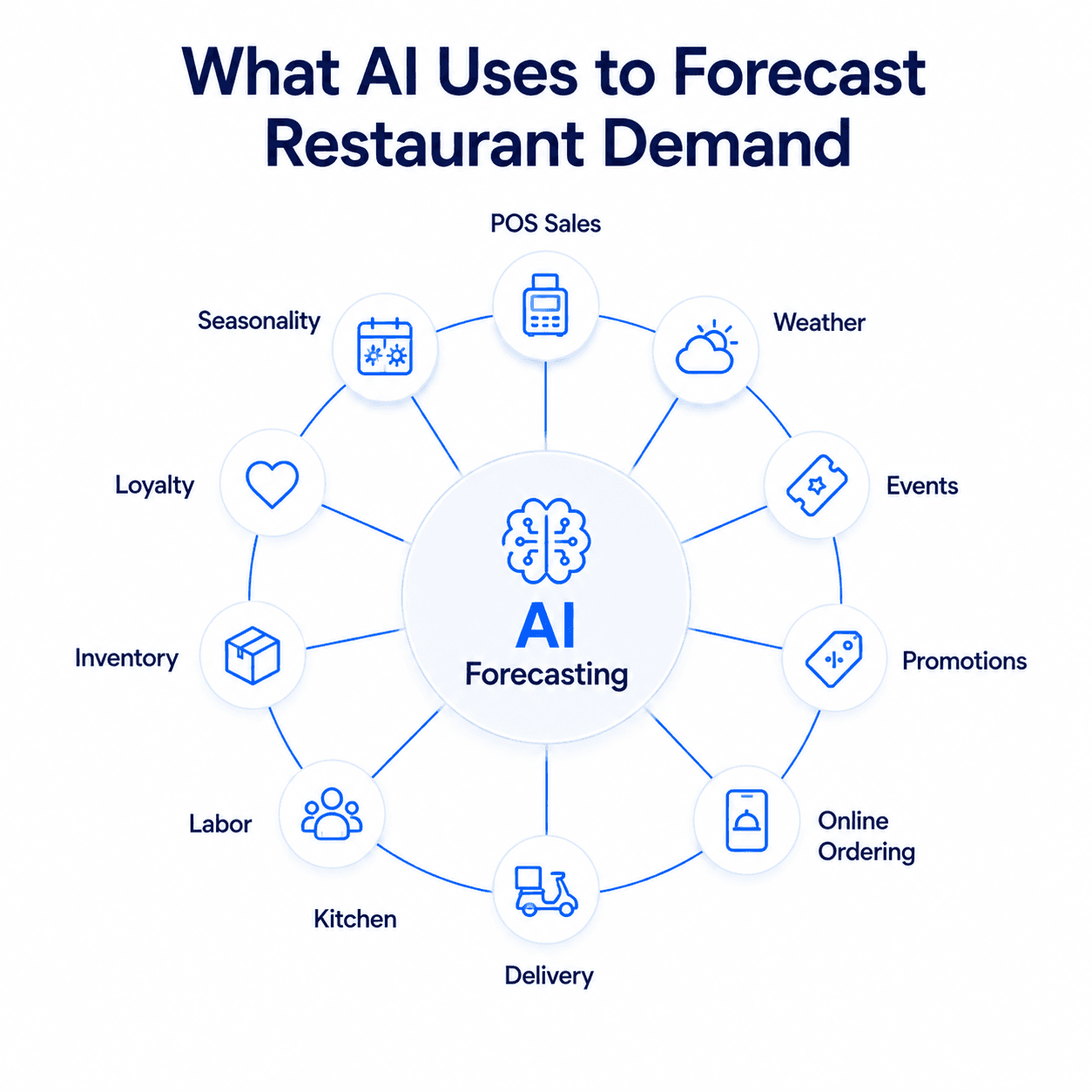
Rather than relying primarily on historical sales, AI continuously analyzes hundreds of operational signals that influence restaurant demand.
Each signal contributes a small piece of the overall picture.
Combined together, they create a much more accurate prediction than any spreadsheet or manual forecast could produce.
Instead of producing one daily sales estimate, AI continuously updates forecasts throughout the day as new information becomes available.
A sudden weather change.
An unexpected delivery surge.
A nearby sporting event running late.
A viral social media post.
Every new signal improves the prediction.
This allows restaurant operations to adapt before customer demand changes instead of reacting afterward.
According to Deloitte, organizations that combine operational data with AI-powered forecasting improve planning accuracy while making faster operational decisions in rapidly changing environments.
The Building Blocks of AI Forecasting
Modern forecasting models combine dozens of operational variables simultaneously.
Examples include:
Historical sales
Historical sales remain the foundation.
Patterns such as:
day of week
daypart
seasonality
holidays
school schedules
still provide valuable context.
However, they represent only one input among many.
Weather
Weather significantly influences restaurant demand.
AI can recognize patterns such as:
hot weather increasing beverage sales
rain increasing delivery demand
snow reducing walk-in traffic
temperature affecting patio occupancy
storms reducing evening transactions
Instead of reacting after weather changes demand, restaurants can prepare in advance.
Local events
Concerts.
Sporting events.
Festivals.
Conferences.
School graduations.
Community celebrations.
These events often generate demand patterns that historical averages alone cannot predict.
AI continuously incorporates event calendars into forecasting models.
Promotions and marketing
Forecasting should also consider planned business activity.
Examples include:
digital campaigns
loyalty promotions
coupon campaigns
new menu launches
limited-time offers
influencer campaigns
Rather than treating promotions as isolated marketing activities, AI evaluates how they affect staffing, inventory and kitchen capacity.
Ordering channels
Today's restaurant demand comes from multiple channels.
Each behaves differently.
For example:
Drive-thru peaks earlier than dine-in.
Delivery often increases during bad weather.
Mobile ordering may spike during lunch.
Third-party marketplaces frequently behave differently from direct online ordering.
Forecasting each channel independently produces much more accurate operational plans.
This is one reason why connected ordering data is so important.
Restaurants that centralize their ordering channels create a much stronger forecasting foundation.
Learn more about MYR's Order Processing
Operational performance
Modern AI also learns from restaurant operations themselves.
Examples include:
kitchen throughput
preparation times
order completion speed
menu availability
employee productivity
customer wait times
Operational bottlenecks influence future demand.
If online ordering repeatedly experiences long delays, customer behavior eventually changes.
Forecasting therefore becomes a continuous feedback system rather than a one-time calculation.
Why Connected Data Produces Better Forecasts
Forecast accuracy depends less on the sophistication of the AI model than on the quality of the underlying data.
A forecasting engine operating on incomplete information can only produce limited recommendations.
Consider two restaurants.
Restaurant A stores information in separate systems:
POS
Delivery
Labor
Inventory
Loyalty
Kitchen
Reporting
None communicate effectively.
Restaurant B operates from one connected operational platform where every transaction, menu update, inventory adjustment and digital order contributes to the same data foundation.
Restaurant B will almost always produce more accurate forecasts.
This is why the future of restaurant AI depends on connected restaurant operations rather than isolated AI features.
As discussed in our guide to AI for Restaurant Operations, AI becomes increasingly valuable as more operational systems contribute real-time information to a unified platform.
Forecasting Labor Requirements
Labor represents one of the largest controllable expenses for most restaurants.
Scheduling too many employees increases operating costs.
Scheduling too few affects customer experience, employee morale and revenue.
Traditional scheduling often follows predictable patterns.
Managers review last week's schedule.
Estimate tomorrow's traffic.
Make manual adjustments.
AI introduces a completely different approach.
Instead of asking:
How many employees did we schedule last Friday?
AI asks:
How many employees will we need tomorrow between 11:30 a.m. and 1:30 p.m., based on expected customer demand?
That distinction dramatically improves workforce planning.
AI continuously predicts staffing requirements using variables such as:
forecast transactions
order channel mix
kitchen workload
preparation complexity
weather
local events
employee availability
historical productivity
delivery demand
Rather than producing one staffing recommendation for the entire day, AI forecasts labor requirements throughout each operating period.
For example:
11:00 a.m.
Open one register.
Two kitchen staff.
12:15 p.m.
Increase production staffing.
Activate line busting.
Prepare additional cold beverages.
2:00 p.m.
Reduce staffing.
Schedule employee breaks.
Forecasting therefore becomes operational rather than administrative.
Instead of creating schedules once each week, restaurants continuously optimize staffing as demand evolves.
This approach improves:
labor efficiency
guest experience
employee utilization
profitability
service consistency
For multi-location restaurant groups, AI also identifies staffing patterns associated with high-performing restaurants and recommends similar deployment strategies across comparable locations.
Forecasting Inventory Before Stockouts Occur
Restaurant inventory is one of the most difficult operational areas to forecast accurately.
Too little inventory results in:
stockouts
disappointed guests
lost revenue
unavailable menu items
Too much inventory leads to:
spoilage
waste
unnecessary purchasing
lower profitability
Traditional inventory planning relies heavily on historical consumption.
AI continuously predicts future ingredient demand using:
expected transactions
menu mix
weather
promotions
delivery demand
historical consumption
supplier lead times
seasonal trends
Instead of simply reporting inventory levels, AI recommends purchasing decisions before shortages occur.
Example:
Tomorrow's forecast indicates chicken sandwich demand will increase by 22 percent due to a local sporting event.
Current inventory will likely be insufficient after 6:00 p.m.
Recommended action:
Increase tomorrow morning's order by 18 kilograms.
Review freezer capacity.
This proactive approach reduces emergency purchasing while improving menu availability.
According to Deloitte, predictive inventory planning supported by AI helps organizations reduce waste while improving supply chain efficiency.
Forecasting Kitchen Capacity
Forecasting demand is valuable only if the kitchen can fulfill it.
Restaurant AI therefore extends beyond predicting sales.
It predicts operational capacity.
Examples include:
expected production volume
kitchen station utilization
preparation bottlenecks
drive-thru throughput
delivery congestion
order completion times
Rather than forecasting only customer demand, AI forecasts the restaurant's ability to satisfy that demand.
Imagine receiving this recommendation before lunch service:
Online ordering demand is expected to increase by 17 percent between noon and 1:00 p.m.
Fry station utilization will likely exceed optimal capacity.
Recommended action:
Prepare additional fries before peak demand.
Assign one additional employee to the fry station.
Increase digital pickup estimates by two minutes between 12:00 and 12:45 p.m.
Forecasting therefore improves both operational efficiency and customer experience.
Restaurants move from reacting to kitchen congestion toward preventing it.
Connected order routing also strengthens forecasting because the kitchen receives orders from every ordering channel through one operational workflow.
Forecasting Sales Beyond Revenue
Most restaurant forecasts end with one number.
Projected sales.
AI continues much further.
Instead of forecasting revenue alone, modern restaurant intelligence predicts:
transactions
average ticket
product mix
channel performance
labor requirements
ingredient consumption
kitchen workload
profitability
delivery volume
Revenue becomes only one outcome of a much larger operational forecast.
This allows restaurant executives to prepare the business rather than simply measure it.
As discussed in Restaurant Management by Exception, the objective is not generating more reports.
It is helping leadership focus on operational decisions before customer demand arrives.
Forecasting Across Multi-Location Restaurant Groups
Demand forecasting becomes exponentially more valuable as restaurant organizations grow.
Forecasting a single restaurant is difficult.
Forecasting 300 restaurants independently is nearly impossible using traditional methods.
Every location has its own characteristics:
customer demographics
traffic patterns
weather
local events
ordering behavior
staffing availability
delivery penetration
menu mix
seasonality
Traditional forecasting treats each restaurant largely as an isolated business.
Artificial intelligence treats the restaurant network as a learning system.
Patterns discovered at one location can improve predictions across similar restaurants while still respecting each location's unique characteristics.
For example, AI may identify that suburban drive-thru locations consistently experience:
earlier breakfast peaks
stronger weekend family traffic
higher beverage attachment rates
lower third-party delivery demand
Urban locations may show completely different behaviors.
Instead of applying one forecasting model across every restaurant, AI continuously adapts predictions using the characteristics of comparable restaurants.
This dramatically improves forecast accuracy while allowing enterprise operators to scale forecasting across hundreds of locations.
For franchise organizations, this also creates opportunities to benchmark operational performance more intelligently.
Rather than comparing every restaurant against the network average, AI compares restaurants against meaningful peer groups with similar operating conditions.
This creates more useful coaching, fairer benchmarking, and better operational decisions.
For organizations managing multiple brands, forecasting can even identify operational similarities across concepts, helping corporate teams transfer successful practices throughout the portfolio.
Forecast Accuracy Improves Every Day
One of the biggest differences between traditional forecasting and AI forecasting is that AI continuously learns.
Traditional forecasts often remain static until someone manually updates the spreadsheet.
AI evaluates every prediction after service concludes.
Questions include:
Was demand higher than expected?
Which assumptions proved inaccurate?
Which external variables had the greatest influence?
Which recommendations produced better outcomes?
Which restaurants behaved differently from similar locations?
Each day becomes additional training data.
Over time, the forecasting system continuously improves.
This feedback loop enables restaurant organizations to become more accurate without increasing manual effort.
Forecasting evolves from an annual planning exercise into a continuously improving operational capability.
Prediction Is Only the Beginning
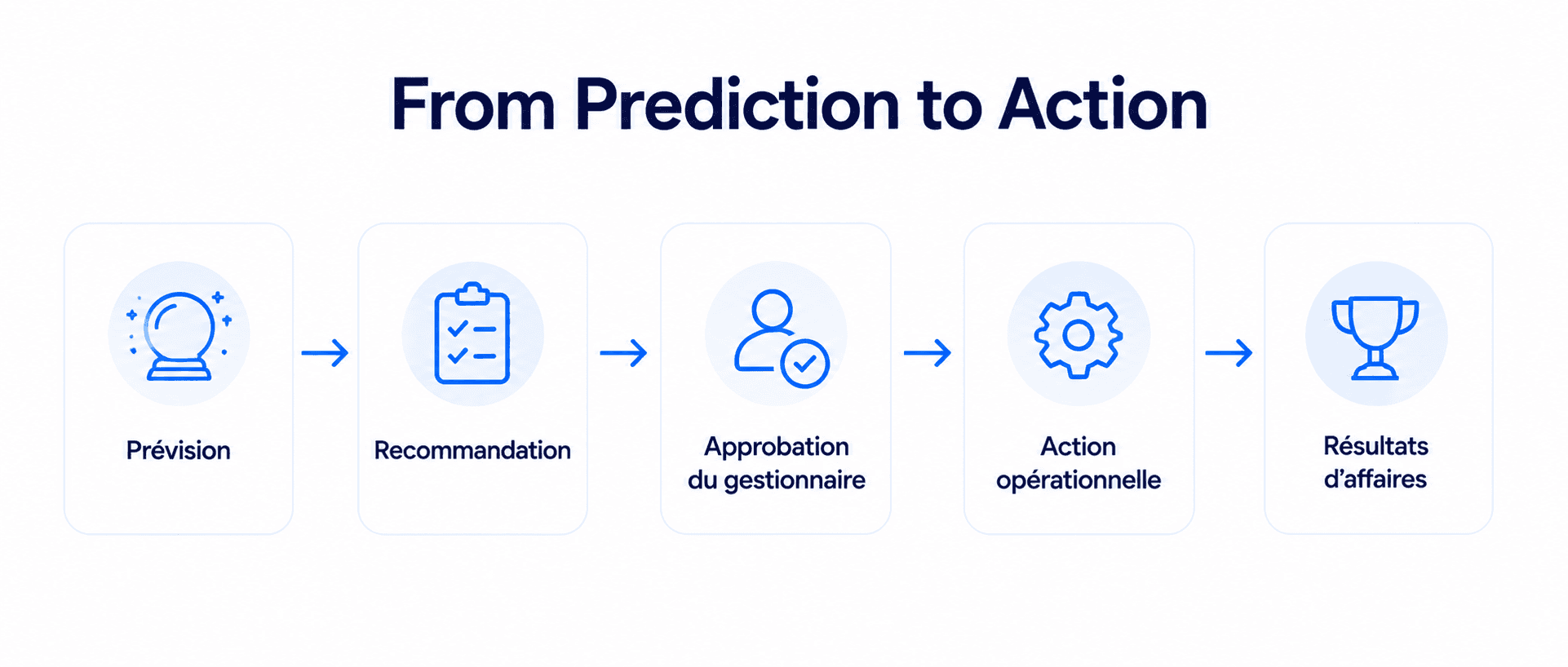
Forecasting alone does not improve restaurant performance.
The value comes from what happens next.
This is an important distinction.
Many organizations invest heavily in analytics that produce accurate predictions but fail to connect those predictions to operational decisions.
Artificial intelligence should not stop at forecasting demand.
It should recommend actions.
For example:
Prediction
Lunch traffic tomorrow will increase by 18%.
Recommendation
Schedule one additional cashier between 11:30 a.m. and 1:30 p.m.
Increase preparation of beverages before 11:45 a.m.
Delay supplier delivery until after lunch.
Review online pickup estimates.
The recommendation becomes significantly more valuable than the prediction itself.
Eventually, selected low-risk actions may even become automated.
Examples include:
updating estimated pickup times
adjusting digital menu availability
notifying restaurant managers
creating operational tasks
generating executive summaries
Human approval remains essential for high-impact decisions, but repetitive operational adjustments can increasingly be handled automatically within approved business rules.
This progression mirrors the maturity model introduced in our AI for Restaurant Operations guide.
Real-World Forecasting in Action
Imagine a quick-service restaurant group operating 175 locations.
On Thursday evening, AI evaluates every restaurant across the network.
The forecast identifies:
unusually warm weather
a regional music festival
increased hotel occupancy
strong online ordering trends
elevated delivery demand
Instead of producing a generic sales forecast, AI generates operational recommendations for every location.
Restaurant 42
Expected increase in beverage demand.
Recommendation:
Increase beverage preparation before lunch.
Restaurant 87
Kitchen capacity likely to become constrained between 12:00 p.m. and 1:00 p.m.
Recommendation:
Assign one additional employee to assembly.
Restaurant 131
Forecast inventory shortage after 6:00 p.m.
Recommendation:
Increase morning ingredient order.
Restaurant 155
No operational adjustments required.
Demand expected to remain within normal operating range.
Leadership now begins Friday with a clear operational plan rather than reacting throughout the day.
Forecasting becomes an operational advantage rather than simply a planning exercise.
The Future of Predictive Restaurant Operations
Forecasting will continue evolving far beyond sales predictions.
Future restaurant platforms will increasingly forecast:
labor deployment
inventory replenishment
kitchen bottlenecks
equipment maintenance
customer wait times
employee scheduling
menu optimization
delivery capacity
customer lifetime value
franchise performance
Artificial intelligence will become the operational intelligence layer connecting every function within the restaurant.
Instead of asking managers to interpret dozens of reports, AI will continuously evaluate operational performance and recommend the next best action.
Forecasting therefore becomes the foundation of a much broader concept.
Predictive restaurant operations.
This evolution aligns closely with Management by Exception, where AI continuously identifies which restaurants require attention before operational issues become expensive business problems.
Building Better Forecasts Starts With Better Data
The quality of restaurant forecasting depends directly on the quality of operational data.
Artificial intelligence cannot accurately predict demand when information is fragmented across disconnected systems.
Reliable forecasting requires connected visibility across:
POS
online ordering
kitchen operations
inventory
labor
loyalty
delivery
menu management
The more complete the operational picture becomes, the more valuable predictive intelligence becomes.
This is why connected restaurant platforms represent the foundation for future AI capabilities.
How MYR Helps Build the Foundation for Predictive Restaurant Operations
Reliable forecasting begins long before AI generates its first prediction.
It begins by connecting the operational systems that restaurants already rely on every day.
MYR helps quick-service restaurants centralize critical operational workflows, including:
point of sale
online ordering
third-party delivery integration
kitchen workflows
menu management
multi-location reporting
franchise operations
By bringing these systems together into one cloud-based platform, restaurant operators create a stronger data foundation for future forecasting, operational intelligence, and AI-driven decision making.
Rather than replacing existing operational expertise, MYR helps unify the information required to make faster and more informed decisions.
Learn more about:
Conclusion
Restaurant forecasting is entering a new era.
Historical averages and spreadsheets will continue to play an important role, but they are no longer sufficient for the complexity of modern quick-service restaurant operations.
Artificial intelligence allows restaurants to move beyond historical reporting and begin preparing for future demand before customers arrive.
More accurate forecasting leads to:
better staffing
improved inventory planning
stronger kitchen operations
reduced waste
better customer experiences
higher profitability
Most importantly, forecasting becomes proactive rather than reactive.
Restaurant leaders no longer ask:
What happened yesterday?
They ask:
What should we prepare for tomorrow?
Organizations that build connected operational foundations today will be best positioned to benefit from increasingly intelligent forecasting capabilities over the coming years.
The future of restaurant operations belongs to businesses that can anticipate demand before it happens.
Build a Stronger Foundation for Predictive Restaurant Operations
Accurate forecasting begins with connected operational data.
MYR helps QSR franchise brands, growing restaurant groups, and enterprise operators centralize ordering, POS, kitchen workflows, delivery platforms, menus, and multi-location reporting into one cloud-based platform.
Book a personalized MYR demonstration
Or explore how MYR supports growing restaurant organizations.
Frequently Asked Questions
What is AI restaurant demand forecasting?
AI restaurant demand forecasting uses artificial intelligence to predict future customer demand by analyzing historical sales together with operational and external data such as weather, events, promotions, delivery trends, and seasonality.
Why is restaurant demand forecasting important?
Accurate forecasting helps restaurants improve staffing, inventory planning, kitchen preparation, purchasing decisions, and overall profitability while reducing waste and stockouts.
How does AI improve restaurant forecasting?
AI continuously evaluates dozens of variables simultaneously, identifies hidden patterns, and updates predictions as new information becomes available, making forecasts significantly more accurate than historical averages alone.
Can AI forecast labor requirements?
Yes. AI forecasts expected customer demand and recommends staffing levels, shift adjustments, break timing, and labor deployment throughout the day.
Can AI reduce food waste?
Yes. More accurate demand forecasting allows restaurants to purchase, prepare, and replenish inventory more efficiently, reducing spoilage and unnecessary purchasing.
How does forecasting help franchise restaurants?
AI allows franchise organizations to forecast demand across hundreds of restaurants while adapting recommendations to each location's operating conditions. This improves planning, benchmarking, and operational consistency across the network.