Restaurant Management by Exception: How AI Is Transforming Multi-Location Restaurant Operations

Every restaurant executive has the same problem.
More information.
More reports.
More dashboards.
More notifications.
More meetings.
More spreadsheets.
What they have less of is clarity.
A restaurant group operating five locations can often manage performance through direct involvement. Leadership knows every manager, reviews reports personally, and quickly notices when something feels wrong.
At fifty locations, that becomes difficult.
At two hundred restaurants, it becomes impossible.
Every day, restaurant leadership teams are expected to understand what is happening across:
sales
labor
inventory
food cost
online ordering
third-party delivery
drive-thru
customer satisfaction
menu availability
staffing
promotions
franchise compliance
operational execution
The problem is rarely a lack of data.
The problem is knowing where to look.
A CEO does not need to know what happened in every restaurant yesterday.
A COO does not need another dashboard.
A Franchise Director does not need fifty pages of reports before deciding which locations require support.
What they need is something much simpler.
Which restaurants require attention today, why do they require attention, and what should we do about it?
That is the foundation of management by exception.
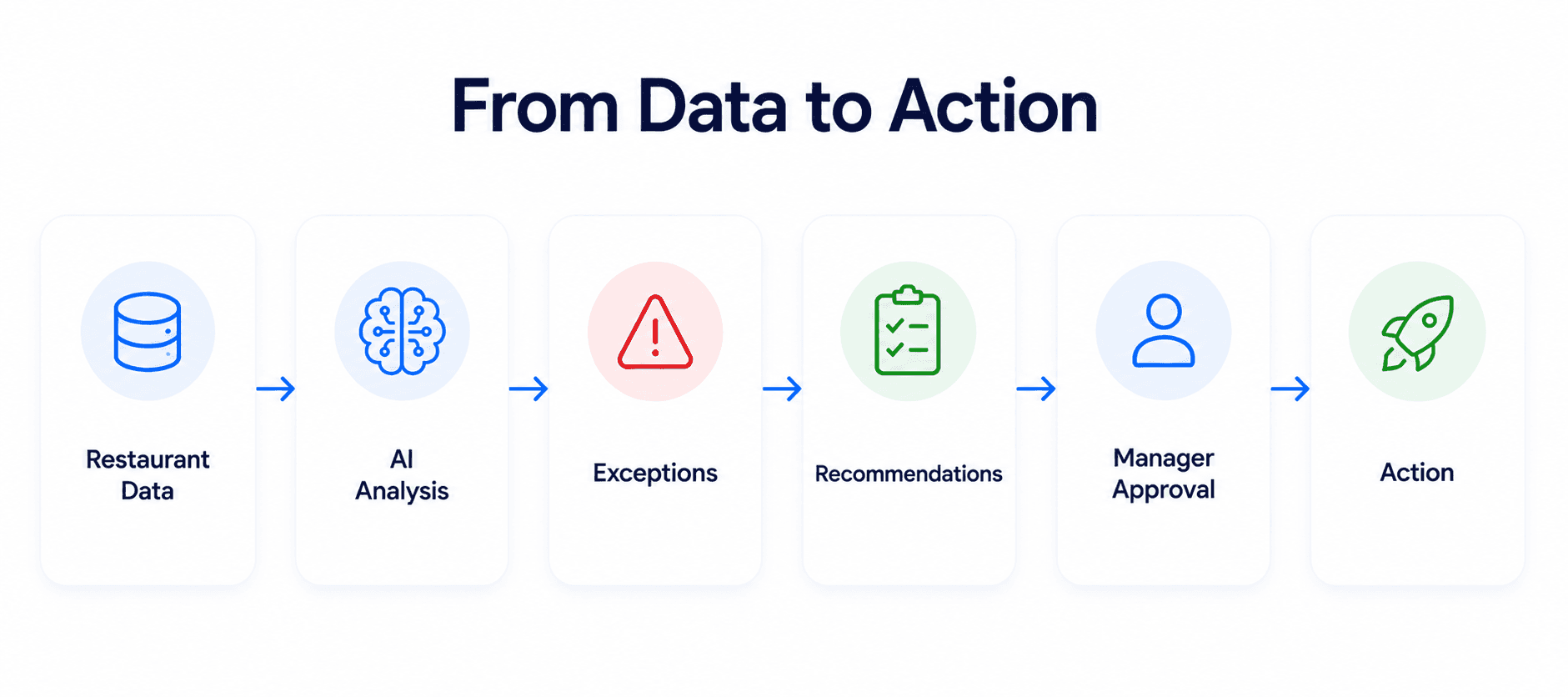
Instead of asking leaders to review every operational metric across every restaurant, AI continuously analyzes the network, detects meaningful operational anomalies, prioritizes the issues that matter most, and recommends where management should focus its attention.
This represents one of the most significant shifts in restaurant operations since the introduction of cloud-based POS systems.
The future of restaurant management is not more dashboards.
It is fewer dashboards with far better intelligence.
Executive Summary
Modern restaurant organizations already collect enormous amounts of operational data through POS systems, online ordering, delivery platforms, kitchen display systems, labor management software, loyalty programs, and franchise reporting.
Yet most leadership teams continue to spend hours reviewing reports before they can identify where action is actually needed.
Management by Exception changes this model.
Instead of expecting executives to monitor every location manually, AI continuously evaluates restaurant performance across the network and highlights only the restaurants, operational metrics, and business risks that require attention.
This allows restaurant leaders to spend less time searching for problems and more time solving them.
In this article you'll learn:
What management by exception means in restaurant operations.
Why traditional reporting breaks down as restaurant brands grow.
How AI identifies operational anomalies before they become major problems.
How restaurant executives can prioritize locations instead of reviewing endless reports.
What a modern Restaurant Command Center should look like.
Which KPIs AI should monitor automatically.
How franchise brands can implement management by exception using connected operational data.
Why connected restaurant platforms are becoming the foundation for AI-powered decision making.
For organizations operating dozens, or hundreds of restaurants, management by exception is rapidly becoming one of the most valuable applications of AI in restaurant operations.
What Is Management by Exception?
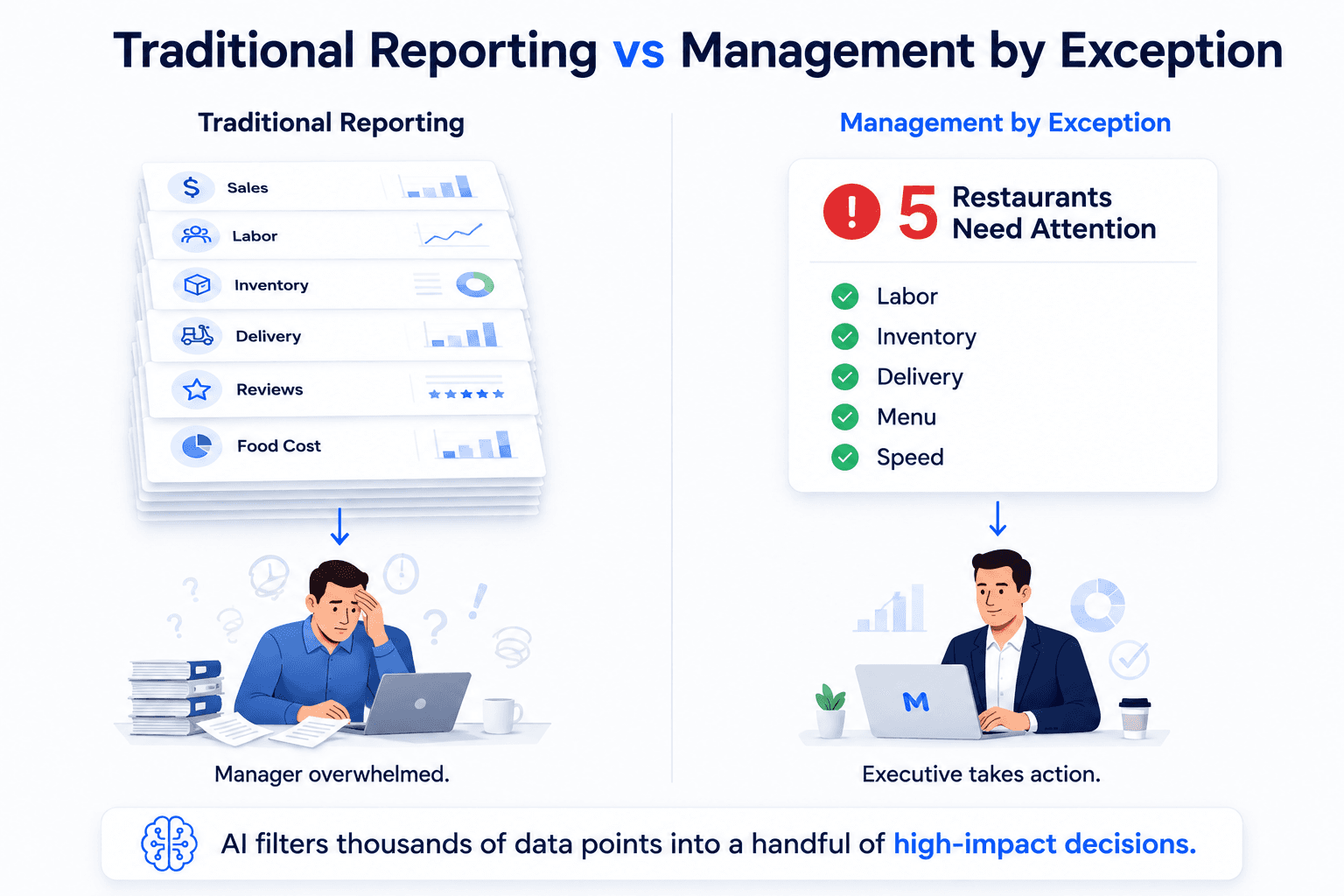
Management by Exception is an operating approach where AI continuously monitors restaurant performance, identifies meaningful operational anomalies, prioritizes issues based on business impact, and directs leadership attention only to the locations and metrics that require action.
Instead of reviewing every report every morning, restaurant executives review only the exceptions.
Examples include:
Labor costs significantly above forecast.
A sudden increase in delivery cancellations.
Menu items repeatedly becoming unavailable.
A location consistently underperforming comparable restaurants.
Unusual void or discount activity.
Speed-of-service deteriorating during lunch.
Food cost increasing faster than expected.
Customer sentiment dropping sharply.
Everything operating normally fades into the background.
Only meaningful exceptions rise to the surface.
Think of it this way:
Traditional restaurant reporting asks:
What happened yesterday?
Management by exception asks:
What requires attention today?
That distinction fundamentally changes how restaurant leadership works.
A district manager responsible for twenty restaurants doesn't need twenty detailed reports every morning.
They need to know:
Which three restaurants need a call today.
Which manager requires coaching.
Which operational issue could affect guest experience.
Which problem is likely to become more expensive if ignored.
AI doesn't replace the manager's judgment.
It improves where that judgment is applied.
Why Traditional Restaurant Reporting Breaks Down
Restaurant technology has improved dramatically over the last decade.
Most QSR brands now have access to:
Cloud POS systems.
Online ordering.
Third-party delivery integrations.
Kitchen display systems.
Labor management software.
Loyalty platforms.
Inventory systems.
Franchise reporting tools.
Business intelligence dashboards.
Ironically, these improvements have created a new challenge.
Too much information.
A typical restaurant executive might receive:
Daily sales reports.
Weekly labor summaries.
Delivery performance dashboards.
Food cost analysis.
Inventory variance reports.
Customer satisfaction metrics.
Loyalty reports.
Marketing performance updates.
Franchise compliance reports.
Financial statements.
Each report may be useful individually.
Collectively, they create information overload.
Leadership teams begin spending more time reviewing reports than improving operations.
The challenge becomes even greater in franchise organizations where each additional restaurant increases:
transaction volume;
operational complexity;
reporting requirements;
regional differences;
menu variations;
staffing variables;
delivery channels;
local market conditions.
The organization reaches a point where adding more dashboards no longer creates more visibility.
It creates more noise.
This is one of the reasons why connected restaurant platforms and the AI capabilities built on top of them, are becoming increasingly important. As explored in our AI for Restaurant Operations guide, the competitive advantage doesn't come from collecting more data. It comes from turning operational data into clear, prioritized decisions.
How AI Detects Operational Anomalies
Every restaurant generates thousands of data points each day.
Sales transactions, labor hours, inventory movements, online orders, delivery times, kitchen throughput, refunds, discounts, customer feedback, loyalty activity, and menu availability all contribute to an increasingly complex operational picture.
For a single restaurant, a manager can often identify problems through experience and observation.
Across 50, 200, or 1,000 locations, that approach no longer scales.
The challenge isn't collecting more data it is identifying which changes actually matter.
As explained in our guide to AI for Restaurant Operations, the next generation of restaurant technology is shifting from descriptive reporting toward predictive operational intelligence. AI continuously monitors data across the entire restaurant ecosystem, helping operators identify issues before they become expensive problems.
Related reading: AI for Restaurant Operations: The Executive Guide for Quick-Service Restaurants
Instead of waiting for someone to discover a problem in yesterday's reports, AI continuously monitors operational patterns, compares them against historical performance, benchmarks similar locations, and highlights anomalies that deserve immediate attention.
AI doesn't simply tell you what happened. It tells you what is unusual—and why it matters.
Unlike traditional rule-based alerts, modern AI evaluates multiple variables before determining whether something is truly abnormal.
For example, a sudden increase in labor costs may not indicate poor scheduling if the restaurant also experienced unusually high sales due to a sporting event or local festival.
Likewise, lower sales may not represent an operational issue if severe weather affected the entire region.
By understanding operational context, AI dramatically reduces false alarms and helps leadership focus on issues with genuine business impact.
According to Toast's analysis of AI usage across more than 125,000 restaurant locations, operators most frequently ask AI questions related to sales, menu performance, inventory, operations, and labor—showing that restaurants increasingly use AI to interpret operational performance rather than simply automate customer interactions.
Operational anomalies AI can detect
Sales anomalies
Examples include:
Unexpected revenue declines
Significant changes in average ticket size
Reduced transaction counts
Sudden shifts in product mix
Channel-specific sales drops
Underperforming promotions
Revenue trends inconsistent with comparable locations
Instead of simply reporting lower sales, AI investigates potential contributing factors before surfacing the issue.
Labor anomalies
AI continuously evaluates labor efficiency against expected operating conditions.
It can identify:
Excessive labor costs
Understaffed shifts
Overtime trends
Scheduling inconsistencies
Unusual productivity declines
Locations operating outside established labor benchmarks
More importantly, AI considers demand forecasts, transaction volume, and historical staffing patterns before determining whether intervention is required.
Inventory anomalies
Inventory issues often become visible only after they begin affecting operations.
AI can detect:
Unusual ingredient consumption
Inventory shrinkage
Unexpected waste
Abnormal purchasing behavior
Potential stockouts
Repeated over-ordering
Supplier inconsistencies
Instead of waiting until a restaurant runs out of a key ingredient, predictive models can identify increasing risk several days in advance.
Menu anomalies
Menu performance can change quickly.
AI can identify:
High-margin products losing popularity
Frequently unavailable items
Menu configuration errors
Channel-specific pricing inconsistencies
Products causing operational bottlenecks
Modifier combinations creating kitchen delays
These insights allow restaurant teams to resolve issues before they affect customer satisfaction.
Delivery anomalies
Digital ordering introduces another layer of operational complexity.
AI can detect:
Rising cancellation rates
Longer delivery preparation times
Marketplace availability issues
Courier delays
Increased refund requests
Channel-specific operational problems
Instead of monitoring each delivery platform independently, AI evaluates overall fulfillment performance across every ordering channel.
Customer experience anomalies
Customer feedback often reveals operational issues before internal metrics do.
AI can identify:
Sudden declines in review sentiment
Recurring complaint themes
Service consistency problems
Location-specific guest experience issues
Product quality concerns
Operational failures affecting loyalty
Natural language processing can also summarize thousands of customer reviews into actionable operational themes.
Why anomaly detection matters
Most restaurant problems don't appear overnight.
They develop gradually.
A small increase in preparation time becomes longer customer waits.
Longer waits reduce online ratings.
Lower ratings reduce conversion.
Lower conversion reduces revenue.
Revenue pressure leads to cost-cutting.
Service quality declines further.
By the time traditional reporting identifies the issue, the operational damage has already occurred.
AI helps leadership intervene earlier, when problems are still relatively inexpensive to solve.
From Dashboards to Daily Executive Briefings
Restaurant technology has become exceptionally good at producing dashboards.
Almost every software platform provides:
Sales dashboards
Labor dashboards
Delivery dashboards
Marketing dashboards
Inventory dashboards
Franchise dashboards
Financial dashboards
The problem isn't dashboard quality.
The problem is interpretation.
A CEO operating 300 restaurants cannot spend two hours every morning reviewing reports.
Nor should they.
Their responsibility is making strategic decisions, not searching for operational issues.
The next generation of restaurant intelligence replaces passive dashboards with proactive executive briefings.
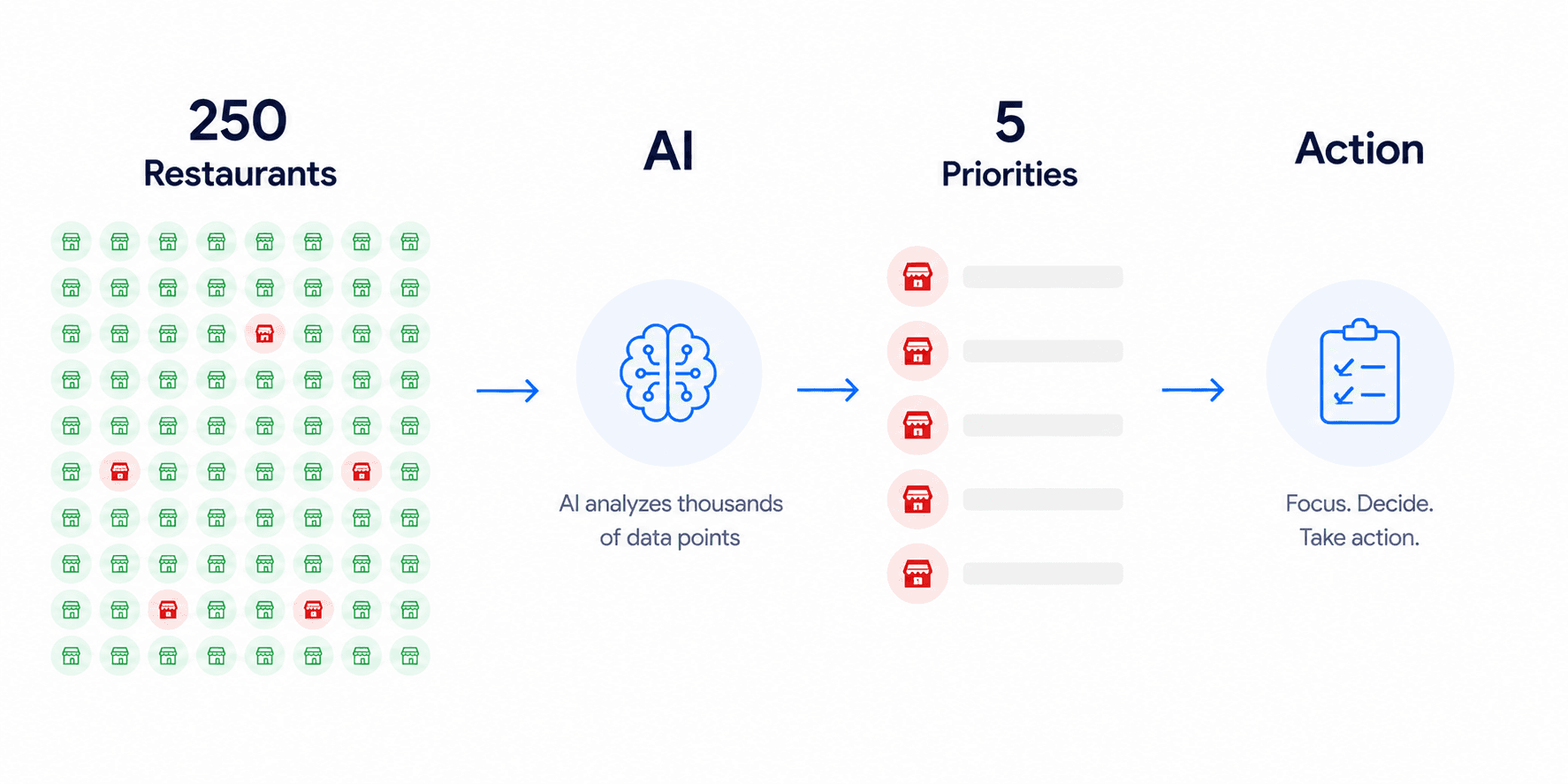
Instead of asking executives to navigate dozens of reports, AI delivers a concise operational summary highlighting only the issues requiring immediate attention.
Imagine opening your Restaurant Command Center every morning and seeing this.
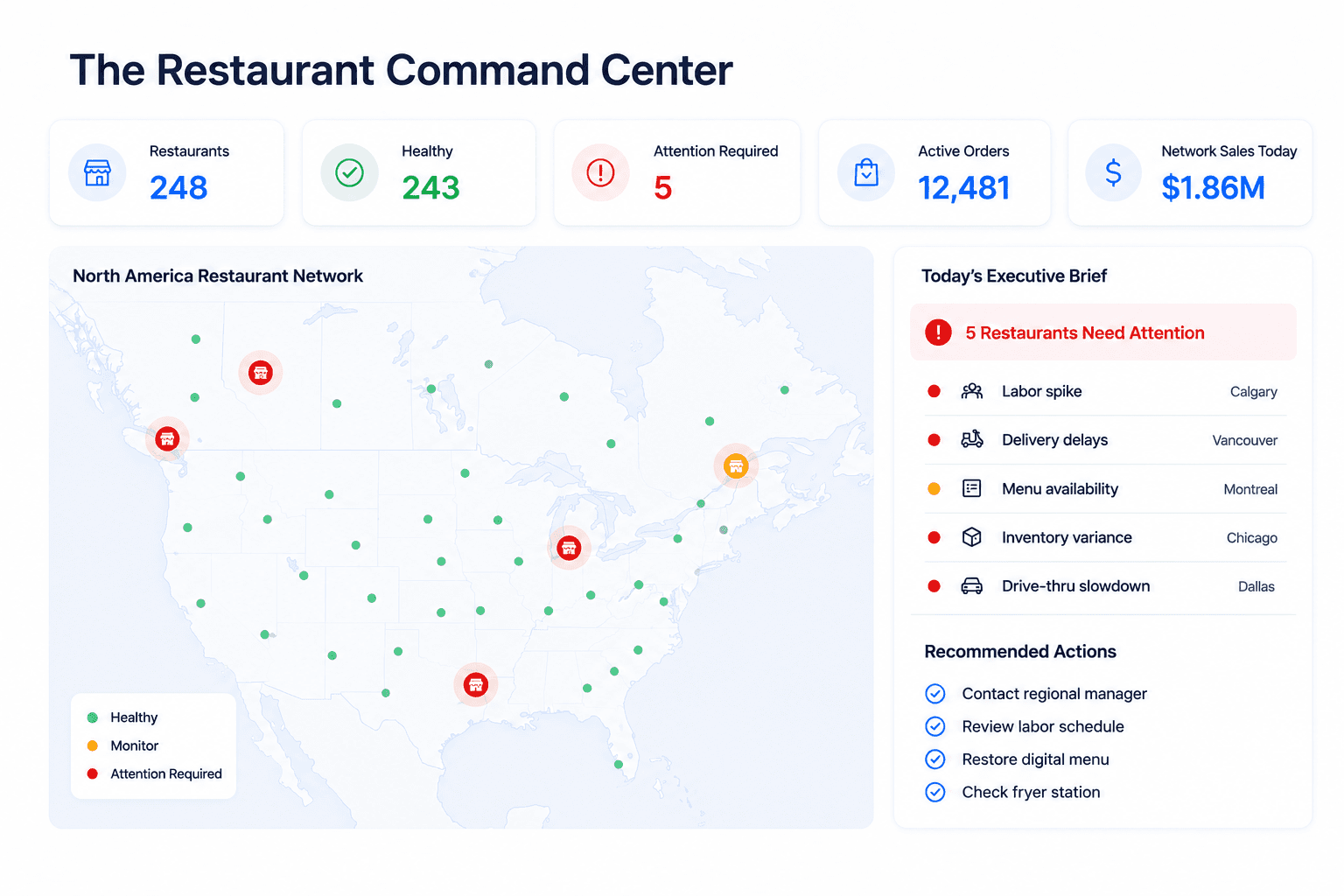
Today's Executive Brief
Overall Network Status
🟢 243 restaurants operating normally
🟡 7 locations require monitoring
🔴 5 locations require immediate attention
Highest Priority Issues
🔴 Calgary
Labor costs trending 18% above forecast.
Recommendation:
Review staffing schedule before dinner service.
🔴 Chicago
Top-selling burger unavailable across delivery channels for 2.5 hours yesterday.
Estimated revenue impact:
$3,900
Recommendation:
Restore digital menu availability.
🟡 Montreal
Average drive-thru service time increased by 27 seconds during lunch.
Recommendation:
Review kitchen staffing between 11:30 a.m. and 1:30 p.m.
Instead of searching through reports, executives immediately understand:
which restaurants require attention;
why the issue matters;
likely root causes;
recommended next steps.
This transition—from dashboards to operational intelligence—is rapidly becoming one of AI's most valuable contributions to restaurant management.
Why executive briefings outperform dashboards
Traditional dashboards require leaders to:
decide which reports to open;
identify unusual metrics;
compare locations;
determine operational significance;
prioritize next steps.
AI performs those analytical tasks automatically.
Leadership starts the day with decisions rather than data.
That saves time.
More importantly, it improves consistency across large organizations where executive attention is often the most limited resource.
The Restaurant Command Center
As restaurant organizations grow, operational complexity increases exponentially.
New restaurants introduce:
additional managers;
additional employees;
additional transactions;
more delivery channels;
larger inventories;
regional differences;
franchise relationships;
reporting requirements.
Most software responds by adding more dashboards.
The Restaurant Command Center takes the opposite approach.
Instead of presenting every operational metric, it continuously evaluates the health of the entire restaurant network and surfaces only the information requiring executive attention.
Think of it as an air traffic control tower for restaurant operations.
Air traffic controllers don't monitor every aircraft equally.
They focus on exceptions.
Restaurant executives should do the same.
A modern Restaurant Command Center continuously monitors:
sales
labor
kitchen throughput
delivery
inventory
menu availability
customer experience
franchise compliance
financial performance
When everything operates within expected parameters, leadership doesn't need another dashboard.
When something deviates from expected performance, the platform elevates the issue based on business impact.
This philosophy enables restaurant brands to scale without overwhelming leadership with information.
Characteristics of an effective Restaurant Command Center
A modern Restaurant Command Center should provide:
Network-wide visibility
One operational view across every restaurant.
Intelligent prioritization
Issues ranked by business impact.
Explainable recommendations
Every recommendation supported by operational evidence.
Real-time monitoring
Continuous evaluation instead of end-of-day reporting.
Executive summaries
Concise daily operational briefings.
Drill-down capability
Immediate access to detailed operational data when required.
Cross-functional intelligence
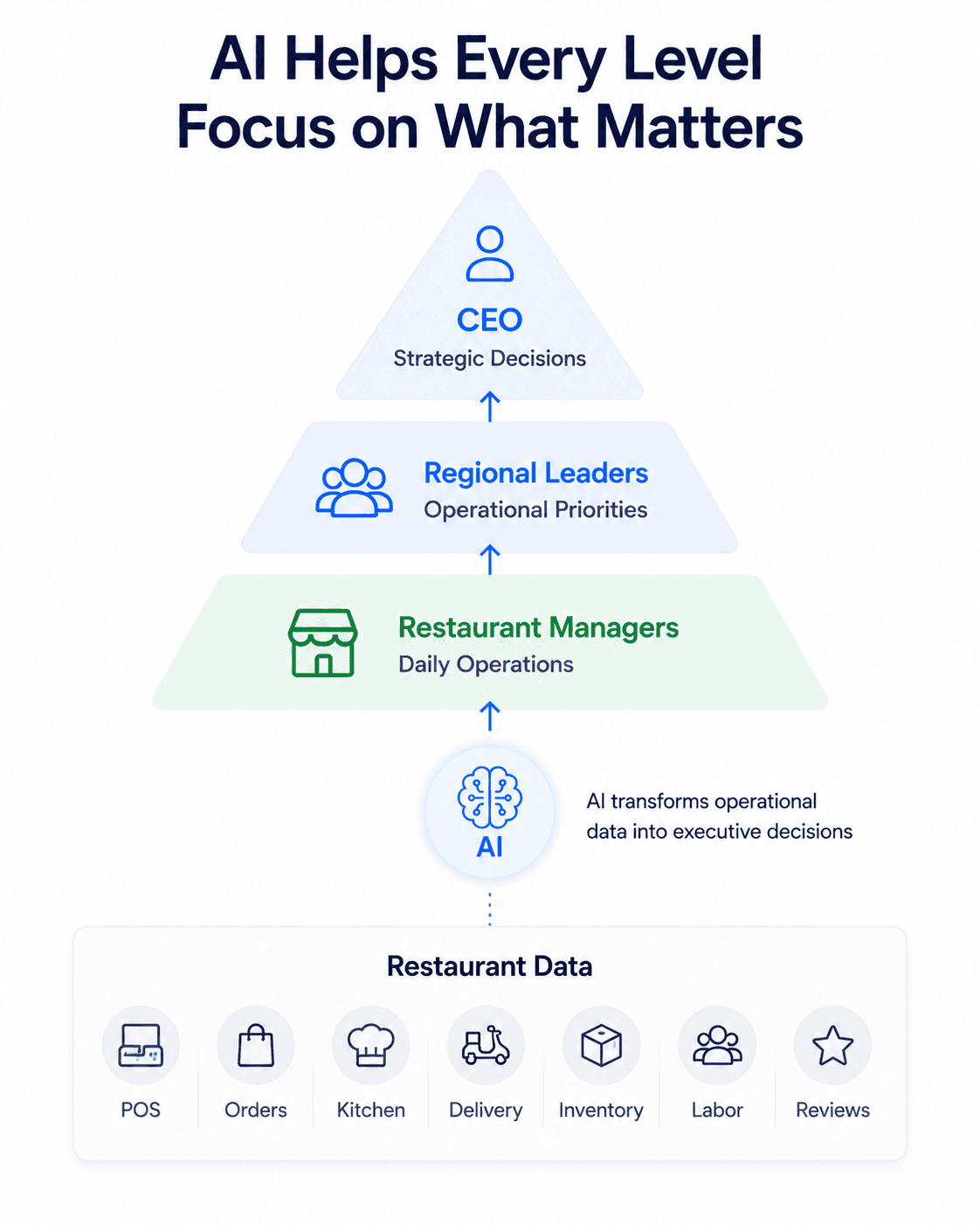
One connected platform evaluating:
POS
Online Ordering
Kitchen Display System
Delivery
Labor
Inventory
Loyalty
Franchise Reporting
rather than isolated departmental dashboards.
How AI Prioritizes Restaurants Instead of Reports
One of AI's greatest strengths is prioritization.
Imagine operating 420 restaurants.
Traditional reporting expects leadership to review all 420.
AI asks a different question.
Which five restaurants deserve attention today?
To answer that question, AI evaluates:
historical performance;
forecast demand;
operational trends;
peer benchmarking;
financial impact;
customer experience;
franchise standards;
operational risk.
Each restaurant receives an operational priority score.
A location operating normally requires no executive attention.
A location experiencing declining sales, increasing labor costs, negative reviews, menu availability issues, and delivery failures rises immediately to the top of the priority list.
Leadership spends time where intervention creates the greatest business value.
That is the practical definition of Management by Exception.