The first generation of restaurant technology recorded transactions.
The next generation will interpret operations.
Artificial intelligence is beginning to change how quick-service restaurant brands forecast demand, deploy labor, manage menus, prioritize kitchen production, coordinate delivery, evaluate franchise performance, and decide where leadership should focus its attention.
For a single restaurant, that may mean faster access to information and better daily planning.
For QSR franchise owners, growing restaurant groups, and enterprise franchise brands, the opportunity is much larger: using AI to scale the restaurant network without allowing operational complexity, inconsistency, and corporate overhead to increase at the same rate.
That possibility is attracting serious investment. Deloitte found that 82% of surveyed restaurant executives expected to increase their AI spending in the following fiscal year. Yet only about 26% of restaurant operators currently use AI tools, according to 2026 National Restaurant Association research. The industry is therefore moving quickly, but adoption remains early enough for brands to build a meaningful advantage.
This transformation is taking place inside a restaurant industry projected to generate approximately $1.55 trillion in U.S. sales during 2026. The National Restaurant Association says advances in ordering, AI, and data analytics are helping operators streamline operations, manage costs, and improve the guest experience.
But restaurant AI is often misunderstood.
It is not simply:
a voice bot at the drive-thru;
a robot preparing food;
a chatbot added to the POS;
a tool that writes promotional emails;
a system designed to replace restaurant employees.
The larger opportunity is to create an intelligence layer across the restaurant operation, one that can combine data, detect patterns, predict what is likely to happen, recommend an appropriate response, and eventually execute selected actions within clearly defined rules.
The traditional POS tells leadership:
Here is what the restaurant sold.
AI for restaurant operations can help answer:
What is changing, why is it happening, what will probably happen next, and which action should we take?
Executive summary
AI for restaurant operations refers to the use of artificial intelligence to interpret restaurant data, forecast operational conditions, recommend decisions, and automate approved activities across ordering, POS, kitchens, labor, inventory, delivery, customer engagement, and multi-location management.
For QSR and franchise organizations, its most important potential benefits include:
Forecasting demand before it arrives;
Identifying locations that require intervention;
Reducing time spent reviewing reports;
Improving labor and production planning;
Coordinating orders across multiple channels;
Finding operational and financial anomalies;
Standardizing decisions across a restaurant network;
Helping franchisees and field teams act faster;
Scaling the organization without proportionally scaling administrative work.
However, AI cannot compensate for unreliable infrastructure, inconsistent data, disconnected systems, weak restaurant processes, or unclear accountability.
The most successful restaurant AI strategies will begin by connecting the operation, not by buying the most visible AI feature.
What is AI for restaurant operations?
AI for restaurant operations is the use of artificial intelligence to analyze restaurant data, predict demand and operating conditions, recommend decisions, and automate approved work across ordering, kitchens, labor, inventory, delivery, customers, and multi-location management.
AI is a broad category. In restaurant technology, it commonly includes:
machine-learning forecasting;
anomaly detection;
natural-language reporting;
recommendation systems;
computer vision;
voice recognition;
generative AI;
intelligent workflow automation;
autonomous or “agentic” software.
Not every automated restaurant function is AI.
A system that sends the same low-inventory alert whenever stock reaches a fixed quantity is conventional automation. It follows a predefined rule.
An AI-supported system may consider:
expected demand;
recent sales velocity;
local events;
weather;
supplier lead time;
item substitution options;
inventory at nearby locations.
It can then estimate when the restaurant is likely to run out and recommend the most appropriate response.
Restaurant automation, analytics, and AI are not the same
Restaurant automation executes a predefined process.
Restaurant analytics organizes and explains performance data.
Restaurant AI identifies patterns, forecasts outcomes, generates recommendations, and adapts its response as conditions change.
A mature restaurant platform may combine all three.
For example:
Analytics shows that preparation times increased.
AI identifies the likely kitchen station causing the delay.
AI predicts the problem will worsen during dinner.
The system recommends moving one employee to that station.
An approved automation sends the manager an alert or updates an operating task.
This progression—from information to intervention—is what makes AI strategically important for restaurant operations.
Why AI in quick-service restaurants is different
AI can support almost every type of restaurant, but its role in quick-service restaurants is particularly important.
QSR operations typically involve:
High transaction volume;
Short service expectations;
Narrow production windows;
Complex modifiers;
Perishable ingredients;
Multiple ordering channels;
Simultaneous kitchen queues;
Limited staffing;
Tight operating margins;
Standardized brand requirements;
Franchisor and franchisee governance.
A full-service restaurant may use AI to improve reservations, personalize marketing, or analyze menu performance.
In a QSR, AI can influence the complete operating cycle:
Forecast the next rush.
Recommend preparation levels.
Help schedule and deploy employees.
Accept or interpret the order.
Suggest an appropriate add-on.
Route the order to the kitchen.
Prioritize production.
Estimate completion time.
Coordinate pickup or delivery.
Analyze the financial and operational result.
This makes AI in quick-service restaurants less about one isolated feature and more about the coordination of the entire operation.
Why restaurant AI is moving beyond the front counter
Much of the public attention around AI for restaurants has focused on customer-facing technology:
automated drive-thru ordering;
voice assistants;
kiosks;
delivery robots;
personalized recommendations.
These are highly visible, but many of the most valuable AI use cases happen behind the scenes.
Restaurant operators are already using AI to investigate core business questions. Toast analyzed anonymized activity from more than 125,000 restaurant locations using its AI assistant during the first quarter of 2026. Sales and revenue questions were raised by 47% of locations, menu and inventory by 34%, guest and marketing topics by 32%, and operations and reporting by 29%.
This tells us something important:
Restaurant operators are not primarily asking AI to explain artificial intelligence. They are asking it to help run the business.
The highest-value questions are practical:
Why did sales decline?
Which menu items are underperforming?
Where are labor costs increasing?
What should we prepare for tomorrow?
Which locations require attention?
Are we likely to run out of an ingredient?
Which promotion is producing profitable growth?
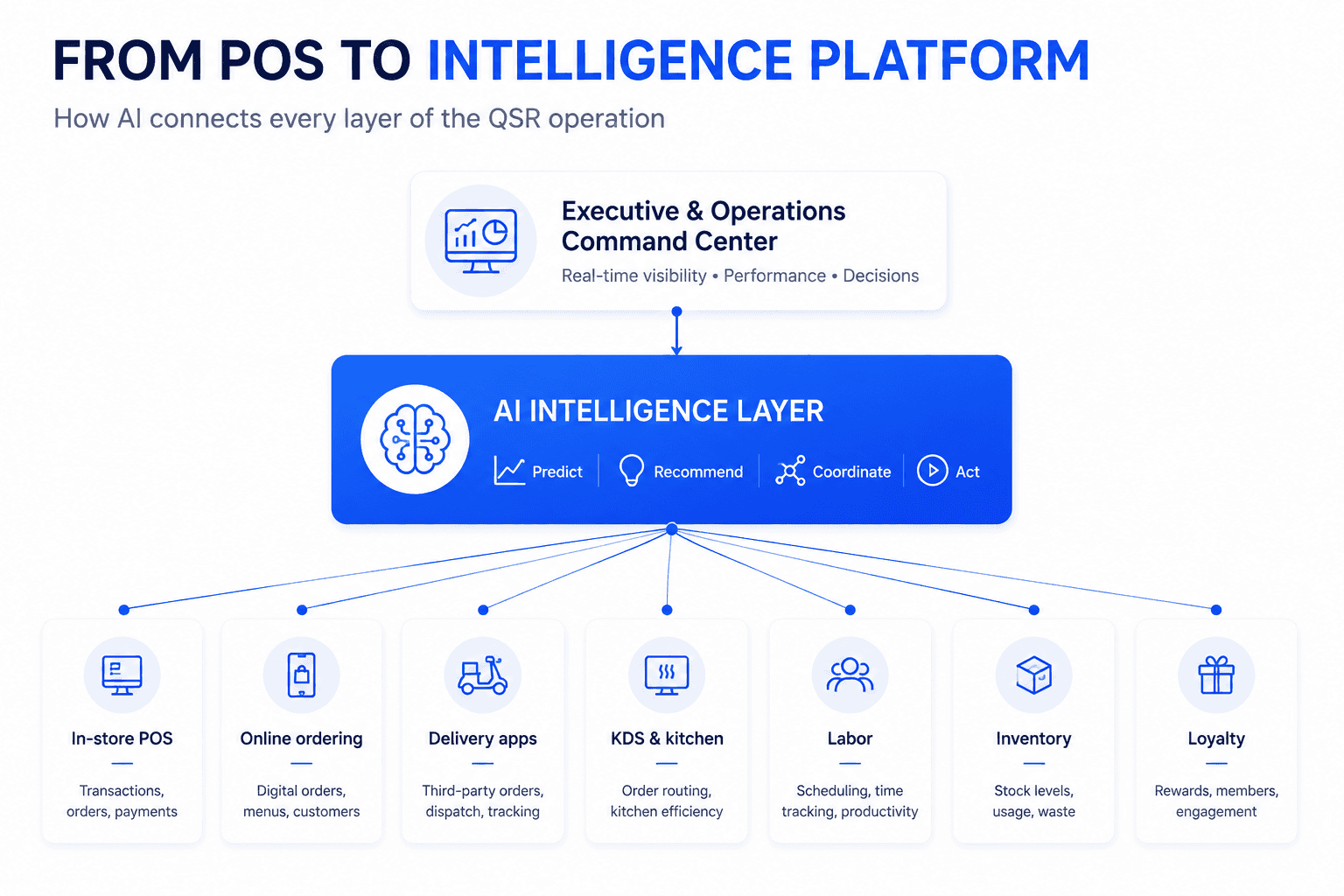
This is why AI is moving from an isolated customer-experience feature toward an operational intelligence layer.
How AI will reshape the QSR POS and technology stack
For decades, the POS occupied the center of restaurant technology because it recorded the transaction.
Other systems connected to it:
payments;
online ordering;
kiosks;
delivery platforms;
kitchen displays;
loyalty;
inventory;
accounting;
reporting.
The traditional flow looked approximately like this:
Orders → POS → reports → human review
That structure made sense when the principal purpose of restaurant technology was to process and document sales.
AI changes the center of gravity.
The emerging model looks more like this:
POS + online ordering + kitchen + delivery + labor + inventory + customer data → intelligence layer → prediction, recommendation, and controlled action
The POS remains essential. It will continue to process orders, manage payments, route items, and record transactions.
But it increasingly becomes the execution engine beneath a broader decision layer.
The POS will record what happened; AI will interpret what it means
A conventional POS can report that a location sold fewer chicken sandwiches yesterday.
An intelligent operating layer can investigate:
whether customer demand declined;
whether the item was unavailable online;
whether delivery platforms suppressed the restaurant;
whether kitchen delays reduced conversion;
whether a promotion ended;
whether the result was normal for comparable locations;
whether the issue is likely to continue.
It may then recommend:
restoring digital availability;
changing production quantities;
reviewing a menu configuration;
contacting a delivery platform;
adjusting staffing for the next comparable period.
That is a fundamentally different role.
Connected data matters more than a visible chatbot
The quality of restaurant AI depends less on the chatbot interface than on the completeness, consistency, and speed of the operational data beneath it.
An AI assistant that can only see POS sales is useful, but limited.
A restaurant intelligence platform becomes more valuable when it can connect:
item-level transactions;
modifiers;
order channel;
kitchen preparation time;
digital availability;
delivery performance;
labor;
inventory;
discounts and voids;
loyalty activity;
local conditions;
peer-location benchmarks.
Large restaurant companies are already moving toward more connected architectures. Byte by Yum brings digital ordering, POS, kitchen and delivery optimization, menu management, inventory, labor, and employee tools into a common technology ecosystem. Yum says elements of Byte are used across more than 25,000 restaurants and process more than 300 million annual digital transactions in the United States.
PAR’s 2026 QSR Operational Index is based on aggregated data from more than 30,000 QSR locations, 149 million loyalty guests, and $26 billion in loyalty sales. The scale of these datasets illustrates why connected restaurant platforms are becoming strategically important: larger, cleaner operational datasets can support better benchmarking and more useful intelligence.
10 ways AI can improve restaurant operations
1. AI restaurant demand forecasting
Forecasting is one of the clearest uses of AI for restaurant operations.
Traditional forecasts often rely on:
recent sales averages;
last year’s results;
manager experience;
broad daypart assumptions.
AI can analyze more variables at once:
historical sales;
weekday and daypart;
seasonality;
weather;
local events;
promotions;
holidays;
school schedules;
order channels;
delivery patterns;
location-specific behavior.
Instead of forecasting only daily revenue, the system may estimate:
transactions by 15- or 30-minute interval;
demand by item;
sales by channel;
likely kitchen load;
ingredient requirements;
staffing needs.
Square AI, for example, combines business data with external signals such as weather, events, news, and reviews to support menu, staffing, and inventory decisions.
For a store manager, the result may be a more useful daily plan.
For a growing restaurant group, it can improve consistency between locations.
For an enterprise franchise brand, it can support network-wide forecasting while still accounting for local operating conditions.
The real value comes when the forecast connects to action:
Friday evening demand is expected to be 18% higher because of a nearby event and warmer weather. Increase cold-beverage preparation, deploy an additional order taker from 5:30 to 7:30 p.m., and review delivery capacity before the rush.
2. AI-powered restaurant POS
An AI restaurant POS should not simply place a generic chatbot beside the sales dashboard.
Its real value comes from helping operators understand and act on restaurant data without manually opening multiple reports.
A manager might ask:
What caused yesterday’s sales decline?
Which products increased average ticket?
How did labor perform against comparable Fridays?
Which discounts were used most frequently?
Which item is losing popularity?
What changed after the latest menu update?
Toast IQ illustrates this emerging model by working across sales, labor, guest, and menu data and allowing operators to ask questions in plain language. It can also proactively surface areas that may require attention.
The future AI restaurant POS will progress through several stages:
Explain: Sales were down 8%.
Diagnose: The decline was concentrated in digital dinner orders.
Predict: The pattern is likely to continue this weekend.
Recommend: Review evening item availability and delivery preparation times.
Act with approval: Restore approved items and notify the location manager.
The POS does not disappear.
It becomes part of a larger restaurant intelligence platform.
Internal link placement: Link “restaurant POS” to MYR’s Restaurant POS System.
Related article link: What Enterprise QSR Operators Should Expect From a Modern POS Platform.
3. AI for online ordering and drive-thru operations
AI can improve order-taking by helping systems understand natural language, modifiers, accents, substitutions, and customer intent.
Potential applications include:
Automated phone ordering;
Voice-assisted drive-thru ordering;
Multilingual ordering;
Personalized recommendations;
Modifier clarification;
Customer-service escalation;
Order-status communication.
But the most sophisticated application is not simply recognizing what a customer says.
It is making recommendations that respect the operation.
A static upsell asks every guest:
Would you like fries?
A more intelligent system may consider:
What the customer ordered;
Previous purchase behavior;
Time of day;
Current inventory;
Item contribution margin;
Kitchen capacity;
Delivery suitability;
Current promotions.
It may promote a high-margin beverage during warm weather but avoid recommending an item when the associated kitchen station is overloaded.
This is an important principle:
AI should optimize the entire transaction, not only the average ticket.
A recommendation that increases the order value but slows service, creates waste, or causes a delivery failure may reduce the restaurant’s total profitability.
4. AI kitchen management and order orchestration
Modern QSR kitchens no longer serve one queue.
They may simultaneously process:
Front-counter orders;
Drive-thru orders;
Kiosk orders;
Direct online orders;
Mobile pickup;
Delivery marketplace orders;
Call-in orders.
A conventional kitchen display system shows the orders and applies predefined routing rules.
An AI-powered kitchen system could help determine:
What should be prepared next;
Which items can be batched;
Which station is falling behind;
Which order is at risk of being late;
Whether the quoted completion time remains realistic;
Whether an item should be temporarily unavailable;
How dine-in, pickup, drive-thru, and delivery orders should be balanced.
The KDS therefore evolves from a display system into a production-orchestration system.
For example, AI may detect that:
Delivery volume has increased unexpectedly;
The fryer station is becoming a bottleneck;
Two large pickup orders are due at the same time;
Drive-thru service is approaching its target threshold.
It can then recommend:
Changing the production sequence;
Moving an employee temporarily;
Extending digital pickup estimates;
Pausing a difficult delivery item;
Deploying line-busting support.
MYR already centralizes in-store and online orders and sends connected orders into restaurant workflows. Its order-processing platform is designed to bring third-party orders into one place and route them toward the kitchen, reducing the need to move between separate delivery systems.
5. AI restaurant labor forecasting
Labor planning is difficult because demand changes constantly.
An accurate schedule created a week in advance may no longer match:
Actual weather;
Local events;
Employee availability;
Delivery demand;
Promotional activity;
Unexpected sales patterns.
AI can support labor decisions before, during, and after the shift.
Before the shift
It can forecast:
Required employees by interval;
Expected workload by station;
Possible overtime;
Appropriate break windows;
Skill requirements;
The impact of alternative schedules.
During the shift
It can identify:
An understaffed production area;
A queue developing faster than expected;
A period when an employee can take a break;
An opportunity to send someone home early;
A need to activate a mobile order taker.
After the shift
It can analyze:
Forecast accuracy;
Labor-to-sales performance;
Recurring understaffing;
Excessive overtime;
Location and manager patterns.
PAR describes AI-supported operational decision-making as a way to give managers real-time signals that may help prevent overstaffing and understaffing rather than reacting after the shift has already deteriorated.
AI should nevertheless support human managers, not become an unaccountable algorithmic supervisor.
Restaurants need safeguards against:
Opaque employee scoring;
Intrusive surveillance;
Unrealistic productivity expectations;
Automatically generated schedules that employees cannot question;
Recommendations based on incomplete context.
National Restaurant Association research found that 94% of operators said recent technology investments had not eliminated permanent jobs. That suggests the near-term value of restaurant AI is more likely to be employee and manager augmentation than complete workforce replacement.
6. AI inventory management and food-waste reduction
Restaurant inventory is particularly suited to predictive technology because ingredients are perishable and demand is volatile.
AI can help estimate:
Expected ingredient use;
Likely stockouts;
Spoilage risk;
Reorder timing;
Purchase quantities;
Abnormal product variance;
Transfer opportunities between locations.
A conventional inventory system may report that a product reached its minimum quantity.
An intelligent system may determine that the restaurant will probably run out before the next delivery because:
Demand is trending above forecast;
A promotion is driving item sales;
The weekend is expected to be busier;
The supplier lead time has increased.
It may recommend:
Increasing the purchase order;
Moving inventory from a nearby location;
Substituting an ingredient;
Temporarily changing digital availability.
The National Restaurant Association identifies inventory tracking, demand prediction, supply monitoring, and purchase-order generation as restaurant AI applications. Deloitte also notes that AI can support real-time inventory tracking and demand forecasting to reduce unnecessary cost and waste.
AI may also detect abnormal usage, but that information must be handled responsibly.
A variance does not automatically mean employee theft. It may result from:
over-portioning;
an incorrect recipe;
waste;
a receiving error;
a configuration problem;
an inaccurate count.
The system should identify an operational anomaly for investigation, not make an unsupported accusation.
7. AI menu optimization
Menus influence revenue, margin, production complexity, and customer experience.
AI can analyze menu performance across:
Sales volume;
Contribution margin;
Modifiers;
Dayparts;
Channels;
Locations;
Customer segments;
Preparation time;
Ingredient usage;
Waste.
It can then identify:
Strong sellers with weak margins;
Profitable items receiving low visibility;
Modifiers that create unnecessary complexity;
Bundles likely to increase contribution;
Products that perform better in specific locations;
Items that should differ between dine-in and delivery;
Products that create kitchen delays during peak periods.
This changes the menu from a static list into a more dynamic operational asset.
The future digital menu may adapt within approved brand rules according to:
Customer context;
Local demand;
Current availability;
Kitchen capacity;
Fulfillment channel;
Promotion strategy.
For franchise brands, the difficult part is governance.
Corporate leadership may define:
approved products;
pricing ranges;
visual standards;
nutritional rules;
promotional constraints.
Franchisees may retain permitted local flexibility.
The AI layer must understand and respect both.
MYR’s franchise platform supports centralized menu control while allowing pricing to be managed by location, platform, and order type.
8. AI for restaurant delivery operations
Delivery aggregation solves a major integration problem:
Bring Uber Eats, DoorDash, and other marketplace orders into one operational system.
AI can address the next problem:
Decide how each order should be accepted, promised, prepared, and fulfilled.
An intelligent delivery layer can consider:
Kitchen capacity;
Estimated preparation time;
Courier availability;
Delivery distance;
Item travel quality;
Stock availability;
Order profitability;
Current in-store volume;
Refund or cancellation risk.
It may then recommend or execute approved actions such as:
Adjusting order-ready estimates;
Pausing a delivery channel;
Removing an unavailable item;
Changing the sequence of production;
Prioritizing direct online orders;
Routing an order to an appropriate fulfillment service.
This represents a shift from delivery aggregation to delivery orchestration.
MYR’s order-processing capabilities centralize on-site and online orders from third-party platforms. MYR Online also supports direct takeout, dine-in, and delivery ordering, allowing restaurants to manage more of the customer relationship directly.
9. AI loyalty and restaurant personalization
Traditional loyalty programs frequently rely on broad discounts:
Spend a fixed amount;
Receive points;
Redeem a coupon;
Send the same promotion to everyone.
AI can make loyalty more selective and economically useful.
It may identify:
Customers at risk of lapsing;
Likely next purchases;
Preferred ordering channels;
High-value customer groups;
Guests responsive to convenience rather than discounts;
The most appropriate time and channel for outreach.
The objective should not be to issue more offers.
It should be to find the minimum effective incentive that improves customer value without unnecessarily reducing margin.
An intelligent loyalty platform might recommend:
a relevant bundle;
earlier access to a new item;
an ordering reminder;
a personalized product suggestion;
loyalty recognition without a discount.
Deloitte found that restaurant executives expected AI to support customer experience, restaurant operations, and loyalty.
For restaurant groups, this depends on first-party customer data being connected to transaction and ordering behavior.
Without that connection, personalization remains superficial.
10. AI franchise reporting and management by exception
This may become the most valuable AI application for multi-location and franchise organizations.
Most restaurant networks do not suffer from a lack of reports.
They suffer from an inability to determine which information matters most.
A CEO, COO, Franchise Director, or VP of Operations cannot manually review every location, every metric, and every operating period.
AI can continuously monitor the network and identify material exceptions such as:
Unusual sales deterioration;
Excessive labor variance;
Declining digital availability;
Delivery cancellations;
Abnormal voids or discounts;
Recurring kitchen delays;
Low-performing promotions;
Franchise-standard deviations;
locations behaving differently from comparable peers.
Instead of giving leadership another dashboard, the system can produce a prioritized briefing:
Five locations require attention today. Two have repeated digital-menu availability problems, one has an abnormal discount pattern, and two are experiencing kitchen delays during delivery-heavy periods.
It can also explain why the issue matters:
Location 42’s sales decline appears to be operational rather than demand-driven. Customer traffic remained stable, but the location disabled three top-selling digital items during the dinner period.
This is management by exception.
Management by exception uses technology to continuously monitor restaurant performance and alert leadership only when a location, metric, or operating condition falls outside an expected range.
For franchise brands, AI can also improve benchmarking by comparing structurally similar restaurants instead of placing every location in one generic ranking.
A food-court unit should not necessarily be compared directly with a suburban drive-thru.
A better peer model may account for:
Format;
Market;
Operating hours;
Maturity;
Order-channel mix;
Delivery penetration;
Sales volume;
Seasonality.
PAR’s 2026 QSR data highlighted a substantial performance gap between top- and bottom-performing locations among major QSR brands, reinforcing the value of better benchmarking and network-wide operational intelligence.
Related article: Franchise Reporting Dashboards: The Operational Command Center Modern QSR Brands Need to Scale
What AI for restaurant operations means for each executive role
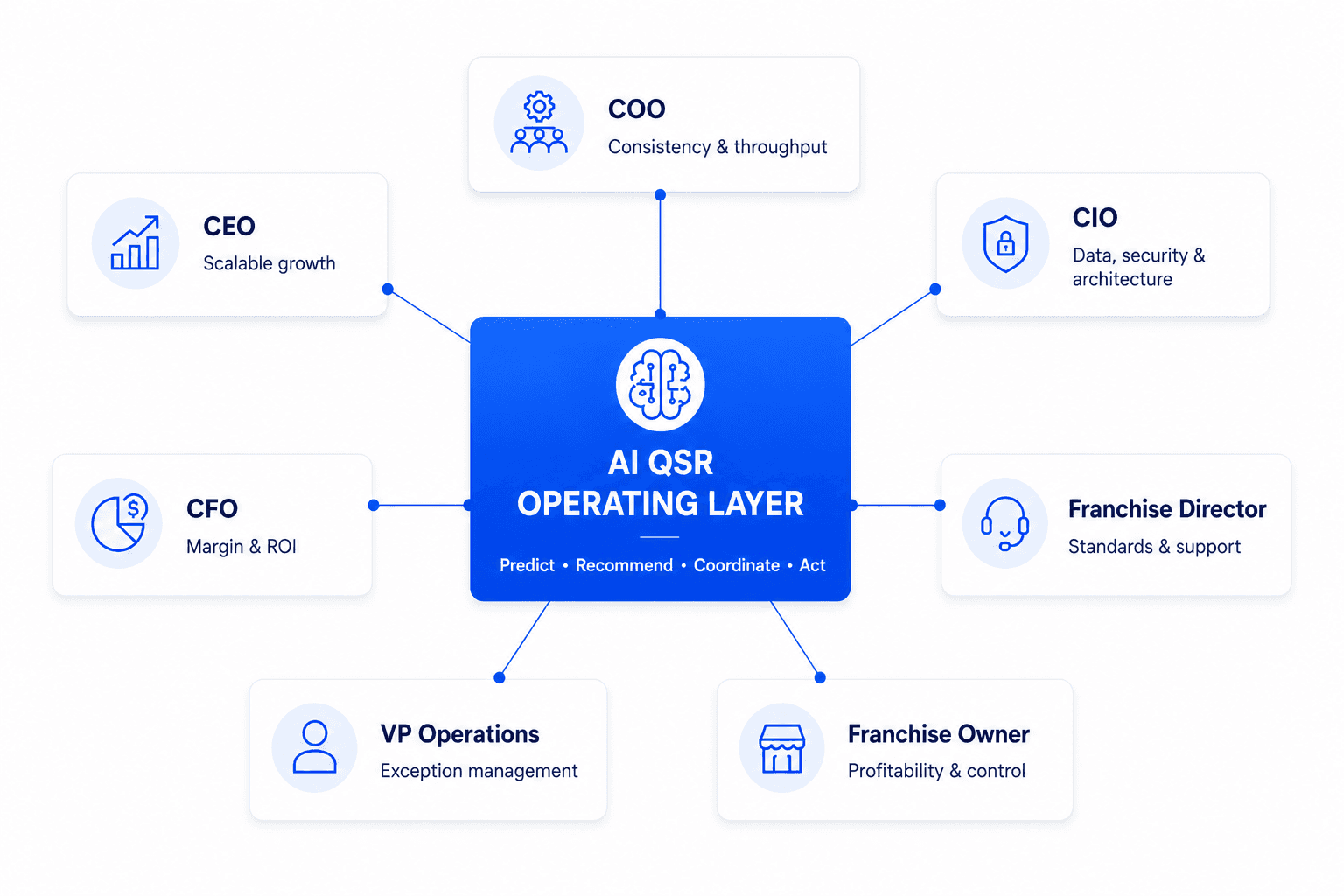
CEO: scalable growth and competitive advantage
The CEO needs to understand whether AI can help the restaurant brand:
Open more locations;
Support more franchisees;
Preserve brand consistency;
Reduce corporate complexity;
Make faster strategic decisions;
Increase system-wide revenue;
Strengthen enterprise value.
The relevant question is not:
Does the platform use AI?
It is:
Can the platform help the organization grow without requiring the same proportional increase in oversight, reporting, and administrative resources?
COO: operational consistency
The COO is responsible for reducing the performance gap between the strongest and weakest locations.
AI can help identify:
Recurring execution problems;
Locations deviating from standards;
Operational practices associated with stronger results;
Areas where field teams should intervene;
Bottlenecks affecting multiple stores.
Its greatest value is converting network data into consistent action.
CIO: architecture, integration, and governance
The CIO must prevent AI from becoming another fragmented technology layer.
Key questions include:
Can the AI access the required operational data?
Are APIs available?
Who owns the data and generated insights?
Can recommendations be audited?
Are permissions controlled by brand, franchisee, role, and location?
How is sensitive customer and employee information protected?
What happens if internet connectivity fails?
Can the organization change providers without losing its historical intelligence?
AI readiness is primarily an architecture and governance challenge before it becomes an algorithm challenge.
CFO: measurable financial return
The CFO should evaluate AI according to measurable business outcomes:
Increased transactions;
Higher contribution margin;
Lower waste;
improved labor deployment;
Reduced overtime;
Fewer refunds;
Better product mix;
Reduced administrative work;
Software consolidation.
Every AI initiative should define:
The operational problem;
The baseline;
Expected financial impact;
Implementation cost;
Measurement period;
Responsible owner.
AI investment is not justified because the technology is impressive.
It is justified when it produces repeatable economic value.
VP Operations: faster intervention
The VP of Operations should spend less time collecting information and more time improving execution.
An effective AI platform can help answer:
Which stores need attention?
What changed?
Why does it matter?
What should the field team investigate?
Was the issue resolved?
This can improve district-manager productivity and reduce the delay between a problem beginning and leadership responding.
Franchise Director: better support and transparent compliance
A Franchise Director can use AI to identify:
Franchisees requiring support;
Locations missing brand standards;
Recurring operational problems;
Network-wide training needs;
Strong practices worth sharing.
But the platform should not feel like hidden surveillance.
Franchisees need clarity around:
What data is collected;
How it is used;
How benchmarks are calculated;
Which recommendations are mandatory;
Which decisions remain local.
Trust is a prerequisite for adoption.
Franchise owner: profitability and control
A multi-unit franchise owner may not need another report.
The owner needs to know:
Which restaurant requires my attention?
Where am I losing margin?
Which manager needs support?
Are my stores prepared for tomorrow?
What happened while I was away?
Which location is behaving differently from the others?
AI can function as an operating assistant across the portfolio, helping the owner manage more locations without losing visibility.
The five levels of restaurant AI maturity
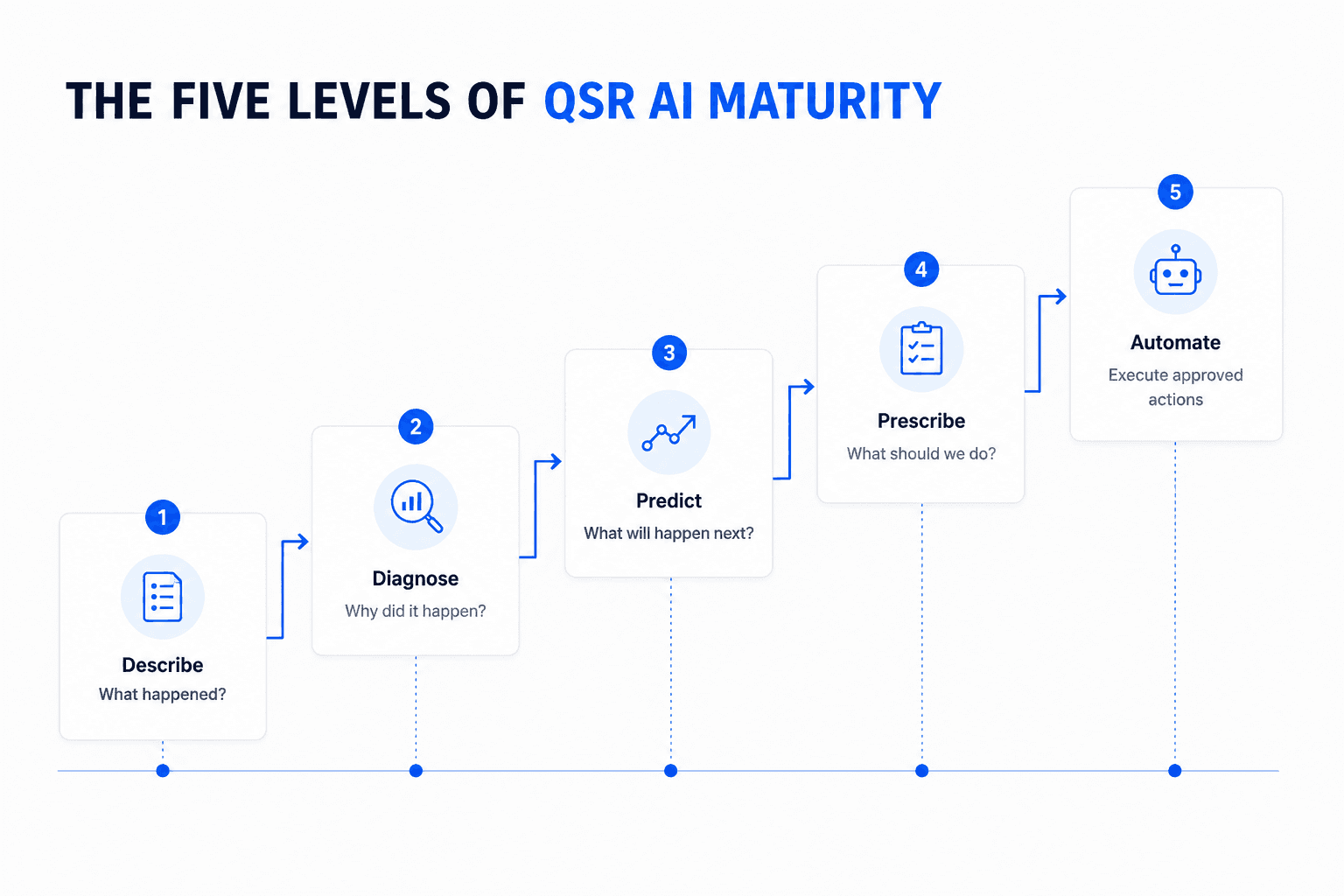
Level 1: Descriptive intelligence
Question: What happened?
Examples:
Sales declined 8%.
Labor exceeded budget.
Preparation time increased.
Three menu items were unavailable.
This is improved reporting.
Level 2: Diagnostic intelligence
Question: Why did it happen?
Examples:
Sales declined because evening online availability fell.
Labor exceeded plan because demand was below forecast.
Preparation time increased at the fryer station.
Discounts rose after an incorrect promotion configuration.
Level 3: Predictive intelligence
Question: What is likely to happen?
Examples:
A location is likely to run out of an ingredient.
Delivery demand will exceed kitchen capacity.
Labor is likely to finish above target.
One restaurant may miss its monthly sales plan.
Level 4: Prescriptive intelligence
Question: What should the restaurant do?
Examples:
Add one employee during the dinner rush.
Increase preparation of a high-demand item.
Extend digital pickup estimates.
Deploy a mobile order taker before the queue develops.
Review a location’s discount configuration.
Level 5: Controlled automation
Question: Which approved action can the platform execute?
Examples:
Update digital availability.
Notify a manager.
Create an operational task.
Adjust an approved preparation estimate.
Generate an executive briefing.
Escalate an exception to the field team.
The word controlled is essential.
Restaurants should not immediately give AI unrestricted authority over pricing, labor, purchasing, customer data, or franchise compliance.
Automation should be:
Permission-based;
Explainable;
Reversible;
Logged;
Monitored;
Limited to approved thresholds.
What AI cannot fix in a restaurant operation
AI is not a shortcut around restaurant fundamentals.
It cannot compensate for:
Unreliable connectivity;
Unstable POS infrastructure;
Inconsistent menu data;
Broken integrations;
Incomplete inventory information;
Poor employee training;
Unclear responsibility;
Weak operating procedures;
Inaccurate location reporting.
A forecasting model built on incomplete transactions will produce an unreliable forecast.
An inventory system with inconsistent recipes will recommend incorrect purchases.
A delivery AI that cannot see kitchen capacity may generate demand the restaurant cannot fulfill.
The correct sequence is:
Stabilize the restaurant infrastructure.
Connect the operational systems.
Standardize the data.
Establish reliable reporting.
Introduce predictive intelligence.
Automate selected actions carefully.
Restaurants should fix infrastructure, integration, data quality, and operational processes before attempting advanced AI automation.
Risks restaurant and franchise leaders must manage
Inaccurate recommendations
AI may reach the wrong conclusion when data is missing, delayed, or incorrectly configured.
Recommendations should show the evidence behind them.
Lack of explainability
A useful system should say:
Add one employee from 11:30 a.m. to 1:30 p.m. because forecast volume is 20% above baseline and average assembly time has increased.
It should not simply say:
Add labor.
Excessive automation
Pricing, scheduling, purchasing, and franchise compliance can have significant financial and legal consequences.
Human approval should remain part of high-impact decisions.
Customer and employee privacy
Restaurant AI may access:
Purchase histories;
Customer identities;
Employee schedules;
Time records;
Performance data;
Payment-related information.
Access must be limited according to legitimate business need.
Cybersecurity
Connecting more operational data can increase the potential impact of a breach.
Security must be part of the architecture, not an afterthought.
Employee resistance
Employees may resist AI that feels like surveillance or a hidden performance evaluator.
Adoption is more likely when tools reduce repetitive work, answer operational questions, and make difficult shifts easier.
Franchisee distrust
Franchisees may resist AI if it appears to transfer excessive control to the franchisor or compare locations unfairly.
Transparency and appropriate local control are critical.
Vendor lock-in and data ownership
Restaurant organizations should understand:
who owns their data;
whether insights can be exported;
how the model uses their information;
what happens when the contract ends;
whether integrations remain portable.
What to look for in an AI-ready restaurant platform
Featured-snippet checklist: An AI-ready restaurant platform should provide real-time data, connected ordering channels, centralized menus, kitchen and delivery integrations, multi-location controls, secure permissions, open APIs, explainable recommendations, approval workflows, auditability, and reliable offline operation.
Connected order channels
The platform should connect:
In-store POS;
Online ordering;
Drive-thru;
Kiosks;
Mobile ordering;
Call-in orders;
Third-party delivery.
Centralized menu architecture
Items, modifiers, pricing, availability, and channel rules should use consistent definitions.
Real-time operational data
AI recommendations lose value when data arrives hours or days late.
Multi-location and franchise controls
The system should distinguish among:
Corporate;
Franchisor;
Franchisee;
Region;
Location;
Employee role.
Kitchen integration
The platform should connect the decision layer to the place where orders are actually produced.
Open integrations and APIs
An enterprise QSR should not be forced to use one vendor for every function.
The core platform should support an integrated ecosystem.
Explainable recommendations
Managers need to know why a recommendation was generated.
Approval workflows
Leadership should control which actions AI can recommend and which it can execute.
Audit trails
Every significant recommendation and automated change should be recorded.
Resilient restaurant operation
Core ordering and payment functionality should remain dependable even when external AI services or connectivity fail.
Compliance
The platform must account for local payment, tax, privacy, and operating requirements.
Internal links:
The Hidden Cost of Keeping an Outdated POS in a Multi-Location QSR
How to Roll Out Technology Changes Across Franchise Locations Without Disruption
A practical AI roadmap for QSR franchise brands
Phase 1: Connect the restaurant operation
Integrate:
POS;
Online ordering;
Delivery platforms;
Kitchen workflows;
Menus;
Location reporting.
The first objective is not sophisticated AI.
It is establishing one dependable operational foundation.
Phase 2: Standardize data and KPIs
Create consistent definitions for:
Items;
Modifiers;
Discounts;
Voids;
Order channels;
Dayparts;
Service times;
Locations;
Labor;
Franchise KPIs.
Without standardization, the platform cannot compare locations accurately.
Phase 3: Establish network-wide visibility
Build trusted reporting across:
Sales;
Labor;
Order channels;
Kitchen performance;
Promotions;
Delivery;
Location trends.
Leadership must trust the underlying information before it will trust an AI recommendation.
Phase 4: Introduce low-risk AI insights
Begin with applications such as:
Daily summaries;
Natural-language reporting;
Demand forecasts;
Anomaly detection;
Menu analysis;
Location alerts.
These use cases help the organization learn without immediately automating high-impact decisions.
Phase 5: Add operational recommendations
Introduce recommendations for:
Staffing;
Preparation;
Inventory;
Menu availability;
Delivery estimates;
Field-team priorities.
Managers should be able to accept, reject, and evaluate recommendations.
Phase 6: Automate approved actions
Start with actions that are:
Low risk;
Reversible;
Clearly governed;
Permission-controlled;
Fully logged.
Examples may include:
Sending alerts;
Producing reports;
Creating tasks;
Updating approved availability settings;
Adjusting limited operational estimates.
Phase 7: Measure and expand
Track:
Adoption;
Recommendation acceptance;
Forecast accuracy;
Time saved;
Revenue impact;
Labor impact;
Waste reduction;
Operational consistency.
Expand only when the data shows measurable value.
Building the connected foundation for AI-powered restaurant operations
Reliable AI for restaurant operations begins with connected systems and trusted data.
MYR helps quick-service restaurants bring key operational workflows into one cloud-based platform, including:
In-store POS;
Online ordering;
Third-party delivery orders;
Kitchen display workflows;
Menu and availability management;
Mobile line busting;
Multi-location reporting;
Franchise controls.
MYR’s order-processing platform centralizes on-site and online orders from third-party channels, helping restaurants reduce switching between separate systems and move orders into connected kitchen workflows.
For franchise brands, MYR supports multi-location sales reporting, advanced menu management, mobile ordering, delivery integrations, and centralized visibility through one dashboard.
These capabilities create value today through:
Faster order processing;
Centralized management;
Fewer manual steps;
Better location visibility;
More consistent menu control;
Connected delivery operations.
They also create the operational foundation required for future restaurant intelligence.
MYR does not need to position AI as a promise that every restaurant will become autonomous.
The stronger, more credible position is:
MYR connects the QSR operation so restaurant brands can make faster, better-informed, and more scalable decisions.
The future of restaurant AI is operational
The future of AI for restaurants is not a robot replacing every employee or a chatbot being added to every screen.
It is a connected intelligence layer that helps restaurant teams:
Anticipate demand;
Prepare more accurately;
Coordinate ordering channels;
Manage kitchens;
Deploy labor;
Reduce waste;
Identify weak locations;
Support franchisees;
Prioritize leadership attention.
The POS will remain essential.
But it will become part of a broader platform that moves the restaurant organization from:
Transactions to intelligence;
Dashboards to decisions;
Historical reporting to prediction;
Isolated tools to coordinated operations;
Manual review to management by exception;
Recommendations to controlled action.
The restaurant brands that gain the most value will not necessarily be those that adopt the most AI tools.
They will be the brands that:
Connect their operating systems;
Standardize their data;
Focus on measurable business problems;
Maintain human accountability;
Introduce automation gradually;
Turn intelligence into action inside every location.
The future of restaurant POS is not simply a smarter register. It is an intelligent operating platform that helps every location make better decisions before the rush begins.
Build a stronger foundation for intelligent QSR operations
MYR helps QSR franchise owners, growing restaurant groups, and enterprise franchise brands connect ordering channels, delivery platforms, kitchen workflows, menus, and multi-location reporting through one cloud-based restaurant platform.
Explore MYR for QSR franchise brands
See how MYR centralizes restaurant order processing
Frequently asked questions
What is AI for restaurant operations?
AI for restaurant operations uses artificial intelligence to analyze restaurant data, forecast demand and operating conditions, recommend decisions, and automate approved activities across ordering, kitchens, labor, inventory, delivery, customers, and multi-location management.
How is AI used in quick-service restaurants?
Quick-service restaurants can use AI for order-taking, demand forecasting, labor planning, kitchen prioritization, menu optimization, inventory prediction, delivery coordination, loyalty personalization, and franchise performance analysis.
Can AI improve restaurant profitability?
AI may improve profitability by increasing throughput, supporting better labor deployment, reducing waste and stockouts, improving product mix, reducing refunds, and helping managers intervene earlier. Results depend on data quality, implementation, employee adoption, and whether insights are connected to real operational actions.
Will AI replace restaurant POS systems?
AI is unlikely to replace restaurant POS systems. The POS will remain the transaction and execution layer, while AI increasingly interprets information and coordinates decisions across the wider restaurant technology stack.
What makes a restaurant POS system AI-ready?
An AI-ready restaurant POS provides clean real-time data, centralized menus, connected ordering channels, kitchen integrations, multi-location controls, secure permissions, open APIs, reliable infrastructure, and auditable workflows.
Will AI replace restaurant managers and employees?
In the near term, AI is more likely to assist managers and employees by reducing repetitive work, improving forecasts, and making information easier to access. National Restaurant Association research found that 94% of operators said their recent technology investments had not eliminated permanent jobs.
How can AI help restaurant franchises?
AI can help franchise brands identify underperforming locations, explain operational differences, compare similar restaurants, forecast demand, detect compliance risks, and prioritize franchisee support.
How should a franchise brand begin implementing AI?
A franchise brand should begin by connecting its operational systems, standardizing data and KPIs, and establishing trusted multi-location reporting. It can then introduce lower-risk AI applications such as summaries, forecasting, anomaly detection, and conversational reporting before automating operational decisions.
What are the main risks of restaurant AI?
The principal risks include inaccurate data, unexplainable recommendations, employee and franchisee distrust, privacy and cybersecurity problems, excessive automation, vendor lock-in, and unclear ownership of data and generated insights.
What is the difference between restaurant automation and restaurant AI?
Restaurant automation follows predefined rules to complete repetitive tasks. Restaurant AI analyzes patterns, predicts outcomes, and recommends or adapts actions according to changing operational conditions.