A restaurant kitchen used to manage one primary flow of orders.
A customer approached the counter.
The cashier entered the order.
The kitchen received the ticket.
The team prepared the food.
The customer received the order.
That operating model has changed dramatically.
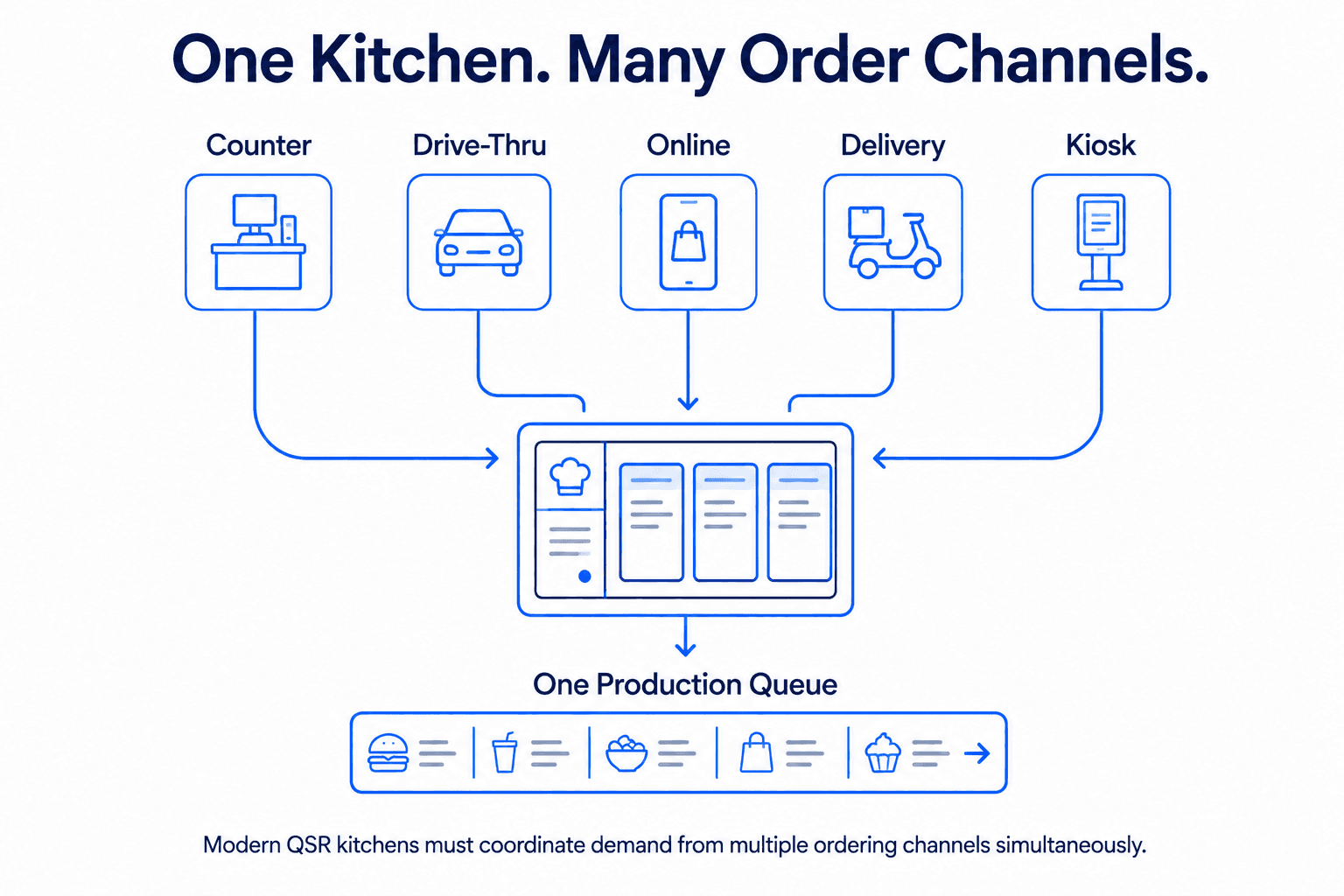
Today's quick-service restaurant may receive orders simultaneously from:
the front counter
drive-thru
self-service kiosks
mobile ordering
direct online ordering
third-party delivery platforms
QR ordering
call-in orders
line-busting devices
Every channel competes for the same kitchen capacity.
And every customer expects their order on time.
The result is a new operational challenge.
Restaurants have become very good at accepting digital orders.
The next challenge is determining how to fulfill all those orders intelligently.
That is where AI kitchen orchestration could fundamentally change QSR operations.
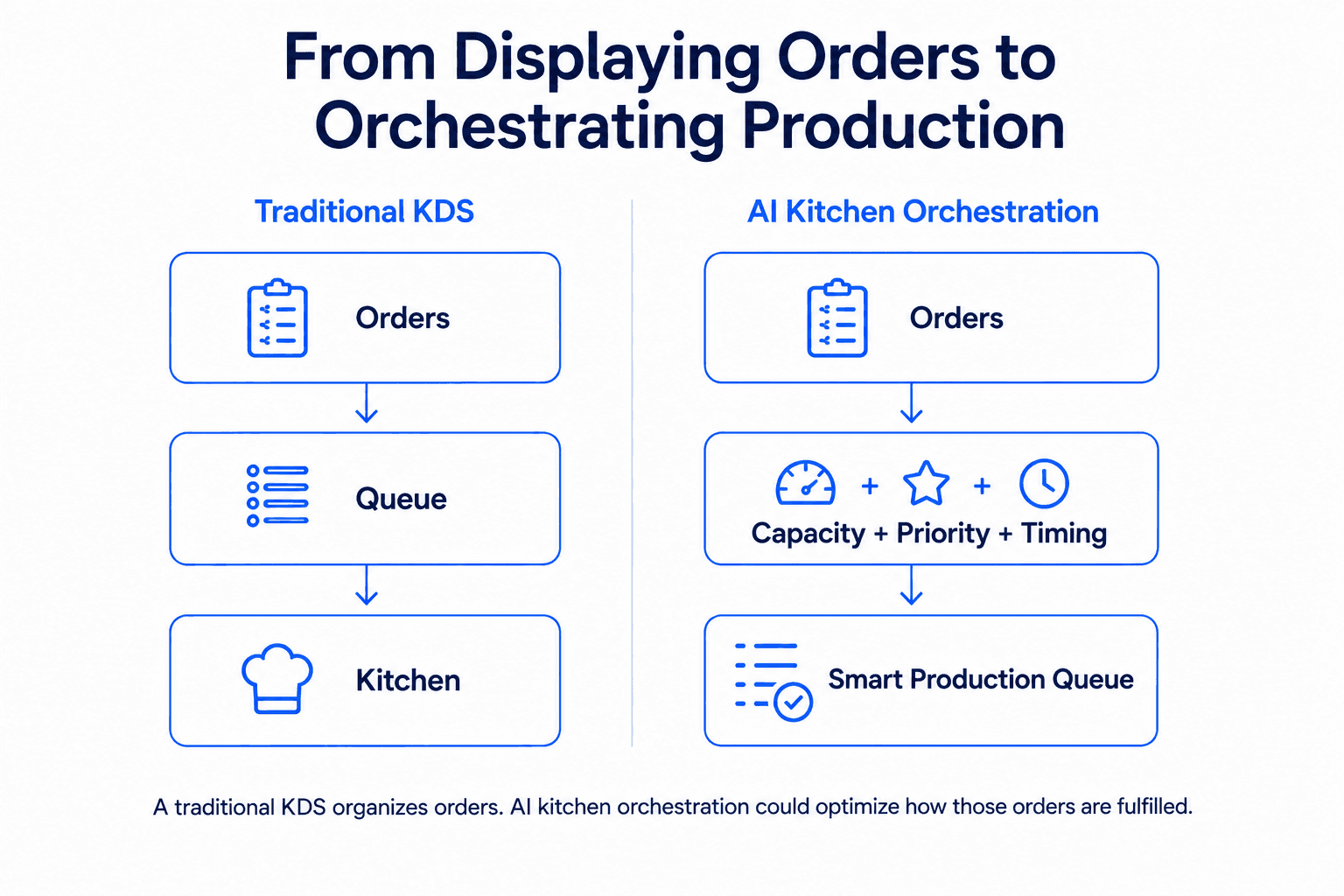
A traditional Kitchen Display System, or KDS, answers:
What orders does the kitchen need to prepare?
The next generation of intelligent kitchen technology could answer:
What should we prepare next, where should we prepare it, and how do we keep every ordering channel moving without overwhelming the kitchen?
That distinction is the foundation of AI kitchen orchestration.
Executive Summary
Quick-service restaurant kitchens have evolved into complex fulfillment environments.
Counter, drive-thru, mobile, online, kiosk, and delivery orders can arrive simultaneously, while the kitchen still has finite employees, equipment, preparation stations, and production capacity.
Traditional Kitchen Display Systems help restaurants digitize this workflow by routing orders from the POS to kitchen stations and tracking fulfillment.
The next evolution is potentially much more significant.
AI kitchen orchestration could continuously evaluate incoming demand, kitchen capacity, order priority, preparation times, station workload, and fulfillment promises to determine the best way to sequence restaurant production.
Instead of simply displaying orders chronologically, an intelligent kitchen system could help restaurants:
prioritize orders dynamically
predict bottlenecks
balance ordering channels
optimize production sequencing
improve batching
identify overloaded stations
adjust pickup estimates
manage digital ordering capacity
coordinate delivery handoffs
anticipate operational problems before service deteriorates
This evolution is already beginning.
Olo, for example, provides capacity-management rules that allow restaurant brands to extend lead times or restrict orders when volume, basket size, or other conditions exceed configured thresholds. In its 2026 outlook, Olo described restaurants gaining better visibility into capacity so they can determine when to accept additional orders and when to throttle demand.
Yum! Brands is taking the concept further. Its Byte by Yum! technology platform integrates POS, digital ordering, kitchen and delivery optimization, menu management, inventory, labor, and team tools. In 2026, Yum described AI as a core capability behind the platform and specifically referenced optimizing kitchen workflows with AI.
The direction is becoming clear.
The KDS is evolving from a screen that displays orders into a potential decision layer for restaurant production.
What Is AI Kitchen Orchestration?
AI kitchen orchestration is the use of artificial intelligence to analyze incoming orders, preparation requirements, kitchen capacity, timing, fulfillment channels, and operational conditions to recommend or automate how restaurant production should be prioritized and coordinated.
The distinction between a traditional KDS and kitchen orchestration is important.
A conventional KDS digitizes kitchen tickets.
When an order enters the POS, items are routed to the appropriate preparation station.
Employees can see:
what needs to be prepared
modifiers
order age
fulfillment status
production counts
completed items
This is already a major improvement over paper tickets.
For example, current KDS platforms can route items to different preparation stations, track individual item completion, manage expediter workflows, and communicate when an order is ready. Toast describes its KDS as connecting front-of-house and kitchen teams while routing orders digitally from POS to preparation stations.
AI kitchen orchestration adds another layer.
Instead of simply asking:
Which ticket came first?
The system can potentially ask:
Which production sequence gives us the best operational outcome?
That decision might depend on:
promised pickup time
drive-thru service target
delivery driver arrival
item preparation time
station workload
order size
current kitchen capacity
other items already being prepared
expected incoming demand
The objective changes from displaying orders to coordinating production.
Why the Modern QSR Kitchen Needs Orchestration
Digital ordering solved an important restaurant problem.
It made ordering more convenient.
But it also created another problem.
Demand can now reach the kitchen faster than the kitchen can physically fulfill it.
A restaurant may have virtually unlimited digital ordering capacity while still having:
one grill
two fryers
one assembly line
six employees
finite preparation space
This creates a fundamental mismatch between digital demand and physical production capacity.
A customer ordering through an app does not see that:
the drive-thru has 12 cars
the fryer station is overloaded
three large delivery orders just arrived
one employee called in sick
a catering order is due in 20 minutes
The ordering interface may still happily accept another order.
The kitchen absorbs the consequences.
Olo describes this problem directly in its research on kitchen capacity. Accepting too many orders or setting lead times too aggressively can overwhelm the kitchen and affect both quality and the guest experience. Its capacity-management technology lets restaurants control demand using factors including order volume and basket size.
This is why the next major restaurant technology challenge is not simply:
How do we accept more orders?
It is:
How do we intelligently match incoming demand with available fulfillment capacity?
From Order Aggregation to Order Orchestration
The first stage of digital restaurant transformation was channel expansion.
Restaurants added:
online ordering
delivery marketplaces
mobile apps
kiosks
drive-thru technology
The second stage was aggregation.
Instead of operating separate tablets for every marketplace, restaurants began bringing digital orders into the POS and kitchen workflow.
That is already a significant operational improvement.
MYR Order Processing, for example, centralizes on-site and online orders from third-party platforms and sends orders into the restaurant's operational workflow. MYR also integrates platforms including Uber Eats, DoorDash, Grubhub, Postmates, Skip, and Ritual.
The next stage is orchestration.
Aggregation asks:
How do we get every order into one system?
Orchestration asks:
Now that every order is visible, what is the smartest way to fulfill them?
That is a much more sophisticated operational problem.
It requires the restaurant platform to understand not only the order, but also the condition of the kitchen.
Traditional KDS vs AI Kitchen Orchestration
A traditional KDS is primarily a workflow system.
An intelligent kitchen orchestration layer would be a decision system.
Consider five orders entering simultaneously:
Order A
Counter order
2 items
Customer waiting
Order B
Delivery
8 items
Driver expected in 12 minutes
Order C
Drive-thru
3 items
Vehicle already at the restaurant
Order D
Mobile pickup
5 items
Customer arriving in 18 minutes
Order E
Kiosk
4 items
Customer waiting
A simple chronological queue may prepare them approximately in the order received.
But chronological order is not necessarily optimal.
An intelligent system could consider preparation time, promised completion, station utilization, item overlap, customer arrival, and fulfillment channel.
It might determine that:
Order C should begin immediately because the drive-thru guest is already waiting.
Items from Orders A and E can be batched.
Order B should begin at the grill but wait before final assembly.
Order D should not be completed too early because the customer will not arrive for another 18 minutes.
The kitchen still prepares exactly the same food.
What changes is the intelligence behind the sequence.
How AI Could Prioritize Restaurant Orders
Not every restaurant order has the same operational urgency.
AI can potentially evaluate multiple factors simultaneously.
Promised completion time
A mobile customer arriving in 15 minutes should not necessarily be treated the same as a drive-thru customer already waiting.
Preparation time
A burger requiring six minutes on the grill needs to begin before an item requiring 90 seconds of assembly.
Fulfillment channel
Drive-thru, dine-in, delivery, and scheduled pickup have different service expectations.
Customer or courier arrival
Where reliable arrival information is available, production can potentially be synchronized more closely with handoff.
Kitchen workload
An overloaded fryer station may change the optimal sequence of production.
Order composition
Multiple orders containing identical items may create batching opportunities.
Order size
A 25-item catering order should not unexpectedly block ten smaller transactions.
Service-level commitments
The restaurant may have different fulfillment targets for different channels.
AI can combine these variables to recommend a production sequence designed around the desired outcome.
That outcome might be:
shortest overall wait time
highest throughput
on-time delivery
drive-thru speed
food freshness
balanced station workload
Different restaurants may optimize for different objectives.
That is why kitchen orchestration should not be a black box.
Operators must define the rules and priorities.
Predicting Kitchen Bottlenecks Before They Happen
The most powerful application of AI may not be deciding what to prepare next.
It may be identifying what is about to go wrong.
Consider a restaurant approaching lunch.
Current operations look normal.
But the system knows:
digital orders are accelerating
drive-thru traffic is increasing
chicken sandwich demand is above forecast
the fryer station is already operating near capacity
a large mobile order is scheduled for 12:20 p.m.
A traditional KDS may not identify a problem until tickets begin turning red.
Predictive kitchen intelligence could identify the likely bottleneck 15 or 20 minutes earlier.
The system might warn:
Fryer capacity is expected to exceed target utilization between 12:10 and 12:35.
Then recommend:
Begin additional preparation.
Move one employee to the fry station.
Increase digital pickup estimates temporarily.
Avoid promoting fryer-intensive products during the peak.
This connects directly to the predictive operating model explored in AI Restaurant Demand Forecasting.
Forecasting tells the restaurant:
What demand is coming?
Kitchen orchestration answers:
How should we respond?
Balancing Digital Demand With Kitchen Capacity
One of the most important concepts in future restaurant operations is capacity-aware ordering.
Most digital ordering systems begin from the customer side.
Can the customer order?
Kitchen orchestration begins from the operational side.
Can the restaurant fulfill the order at the promised level of service?
These are different questions.
Olo's current capacity-management tools illustrate the direction of travel. Its rules engine can use criteria such as order volume, basket size, and subtotal to trigger actions including extending lead times, setting minimums, or temporarily preventing additional orders. Its Spring 2026 release also exposes available and unavailable pickup windows based on lead times and throttling capacity.
This is largely rules-based capacity management today.
AI could make the model dynamic.
Instead of:
Maximum 20 digital orders every 15 minutes.
The system could eventually determine:
Current staffing, product mix, station capacity, drive-thru demand, and scheduled orders indicate that the kitchen can safely accept six additional digital orders during the next 15 minutes.
Capacity becomes contextual rather than fixed.
That could help restaurants protect service quality without unnecessarily turning away revenue.
AI and Dynamic Pickup Times
Static pickup estimates create another common problem.
A restaurant may promise every digital customer:
Ready in 15 minutes.
But 15 minutes may be accurate at 3:00 p.m. and impossible at 12:15 p.m.
An intelligent fulfillment system could continuously estimate completion time based on:
active orders
preparation requirements
station workload
staffing
historical production speed
incoming scheduled orders
The result is a more realistic promise.
Instead of accepting unlimited demand and disappointing customers later, the restaurant sets expectations before the order is placed.
This can also improve the relationship between restaurants and delivery drivers.
If the kitchen accurately predicts when an order will be ready, courier arrival can potentially be better synchronized with production.
Less waiting.
Less congestion.
Fresher food.
Better throughput.
Current restaurant systems are already connecting kitchen fulfillment to downstream order status. Toast, for example, supports automatically marking eligible delivery orders as ready when they are fulfilled through the KDS, helping synchronize kitchen completion with the next stage of fulfillment.
AI could make that coordination increasingly predictive rather than simply reactive.
Smarter Production Sequencing and Batching
Fast kitchens do not simply work harder.
They sequence work efficiently.
Imagine six orders requiring fries arriving within 90 seconds.
Preparing each order completely independently may be inefficient.
An intelligent system could identify the shared production requirement and recommend batching while still respecting:
food freshness
order timing
promised pickup
kitchen capacity
The same logic could apply to:
burgers
pizza
bowls
beverages
bakery products
fried items
assembly ingredients
This becomes particularly valuable in high-volume QSR operations where seconds matter.
The system is no longer simply organizing tickets.
It is helping optimize the production plan behind those tickets.
Connecting Demand Forecasting to Kitchen Execution
This is where the broader AI restaurant technology stack begins to become powerful.
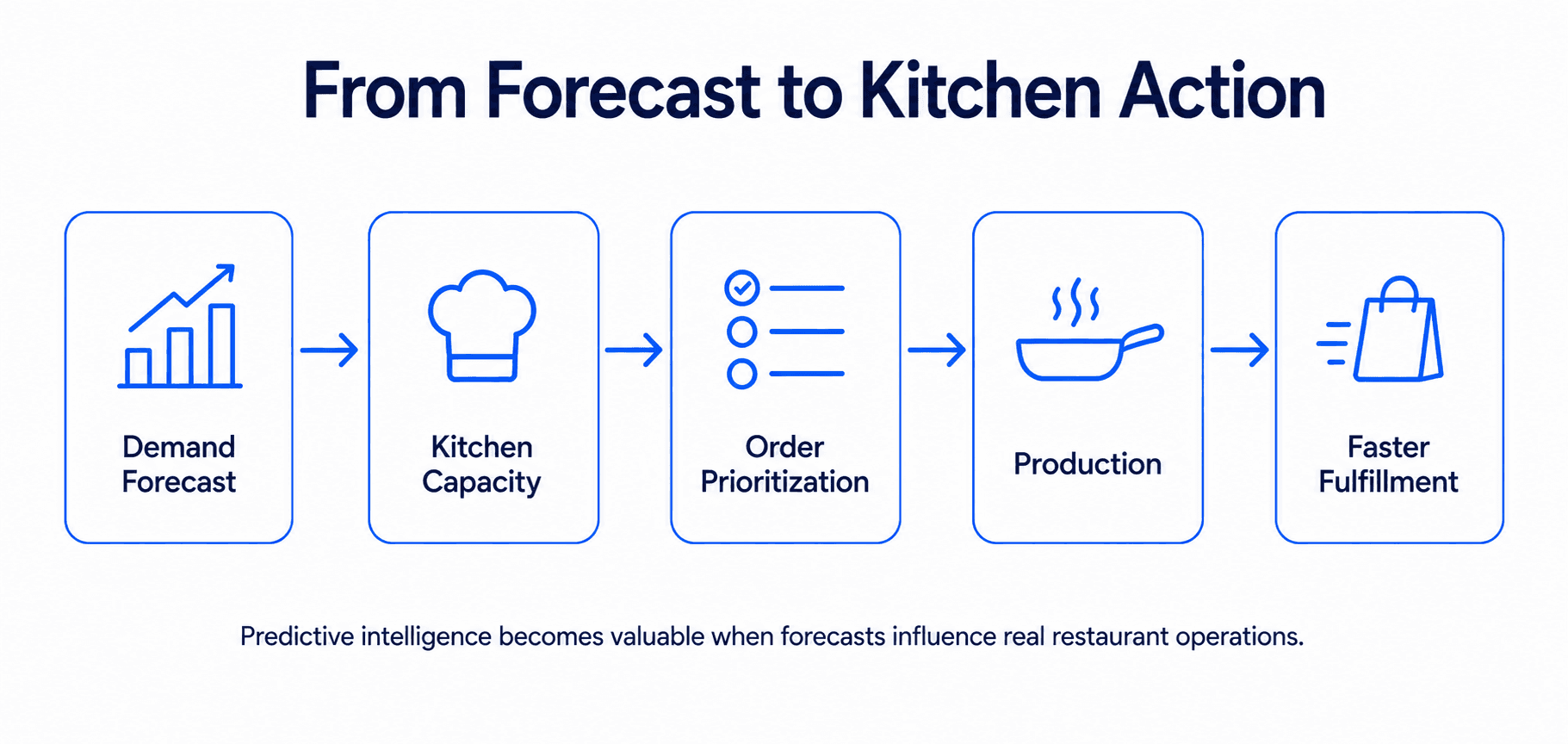
The forecasting system predicts:
Lunch demand will be 19% higher than normal.
That information alone has limited value.
Kitchen orchestration converts the forecast into preparation.
For example:
Forecast
19% higher lunch volume expected.
↓
Kitchen Capacity Analysis
Fryer station likely to become constrained.
↓
Recommendation
Increase pre-rush preparation and reposition one employee.
↓
Order Orchestration
Prioritize production based on promised completion and channel.
↓
Execution
Kitchen handles increased volume without significant deterioration in service.
This creates a closed operational loop.
Predict. Prepare. Orchestrate. Execute. Measure. Learn.
AI Kitchen Orchestration and Management by Exception
The same intelligence can operate above the individual restaurant.
Imagine a QSR brand with 300 locations.
Corporate operations does not need to monitor 300 kitchen screens.
Instead, AI can identify exceptions such as:
12 restaurants experiencing unusual ticket times
5 locations repeatedly exceeding digital capacity
3 restaurants with persistent fryer bottlenecks
7 locations where delivery orders are frequently late
2 locations where kitchen throughput is significantly below comparable stores
Corporate operations can then investigate the exceptions.
This is the same operating philosophy explored in Restaurant Management by Exception.
The restaurant manager sees:
What needs attention in my kitchen?
The regional manager sees:
Which restaurants need support?
The COO sees:
Which operational problems are recurring across the network?
Each leadership level sees the appropriate exception rather than the entire stream of raw data.
What AI Kitchen Orchestration Means for Multi-Location and Franchise QSRs
Kitchen intelligence becomes even more valuable across a franchise network.
One restaurant may experience an operational problem.
That is useful information.
Fifty restaurants experiencing the same problem is a system-wide insight.
AI can potentially identify patterns such as:
a new menu item consistently slowing one production station
certain modifiers increasing ticket time
delivery orders overwhelming restaurants during specific dayparts
staffing models associated with better throughput
equipment configurations creating production constraints
The franchisor can then improve the operating model across the entire network.
This turns restaurant-level execution data into organizational learning.
Rather than every franchisee independently discovering the same operational lesson, the network learns collectively.
MYR's franchise platform already provides centralized multi-location reporting, menu management, KDS, online ordering, delivery integrations, and other operational capabilities across franchise locations.
Connected operational data creates the foundation from which more sophisticated intelligence can eventually develop.
The Industry Is Already Moving Toward Intelligent Kitchen Operations
AI kitchen orchestration is still emerging, but several current industry developments point clearly in this direction.
Yum! Brands and Byte by Yum!
Yum! Brands has created an integrated restaurant technology platform spanning digital ordering, POS, kitchen and delivery optimization, menu management, inventory, labor, and team tools.
In March 2026, Yum described the strategic shift as moving from simply purchasing individual AI tools toward building AI capabilities across its restaurant technology infrastructure.
The company also explicitly identifies AI-driven intelligence and AI-optimized kitchen workflows as part of its technology strategy.
That matters because Yum operates some of the world's largest QSR brands, including KFC, Taco Bell, Pizza Hut, and Habit Burger & Grill.
The strategic implication is significant:
AI is moving deeper into the operational stack, not remaining limited to customer-facing ordering.
Olo and capacity management
Olo provides another example of the transition.
Its capacity-management tools help restaurants control when digital orders enter the operation by using configurable rules around order volume and other conditions.
Waffle House has used Olo's throttling capabilities specifically to prevent to-go demand from interfering with the dine-in guest experience.
Cracker Barrel similarly uses capacity management and order throttling to help prevent locations from becoming overwhelmed as catering demand grows.
These are not fully autonomous AI kitchen orchestration systems.
But they demonstrate the operational problem that orchestration is designed to solve.
KDS is becoming connected to fulfillment
Modern KDS platforms increasingly connect kitchen activity with what happens after preparation.
Order completion can trigger status changes, customer notifications, and delivery workflows.
This is important because kitchen orchestration ultimately depends on understanding the complete lifecycle:
Order → Production → Completion → Handoff
The more connected that lifecycle becomes, the more opportunities exist for intelligent optimization.
AI Should Assist the Kitchen, Not Create Another Black Box
Kitchen orchestration also introduces risks.
Restaurants should not allow algorithms to change critical operating decisions without transparency.
A kitchen manager should be able to understand why the system recommends:
Prioritize this order.
Or:
Increase pickup time by five minutes.
Or:
Move an employee to this station.
The recommendation should be explainable.
For example:
Fryer utilization is 92%. Six additional fryer-heavy orders are due within eight minutes. Moving one employee to the station is expected to prevent a 6-minute increase in average completion time.
That gives the manager context.
AI becomes an operational assistant rather than an invisible supervisor.
This distinction becomes particularly important when recommendations affect:
employees
food safety
pricing
order acceptance
customer promises
franchise compliance
High-impact decisions should remain governed by clear business rules and human accountability.
What an AI-Ready Kitchen Technology Stack Requires
Restaurants do not need to wait for fully autonomous kitchen orchestration to begin preparing for it.
The foundation is much more practical.
Connected ordering channels
The kitchen needs visibility into demand from:
counter
drive-thru
online ordering
kiosks
delivery marketplaces
mobile ordering
call-in orders
Fragmented orders create fragmented intelligence.
Integrated POS and KDS
The transaction layer and production layer must communicate in real time.
Consistent menu data
Items, modifiers, preparation requirements, and availability need consistent definitions.
Accurate fulfillment timestamps
The system needs to understand when:
the order was placed
production began
individual items were completed
the order was completed
the order was handed off
Without reliable timing data, the system cannot learn actual kitchen performance.
Multi-location data
Enterprise and franchise brands need consistent information across locations to identify meaningful benchmarks.
Operational permissions
Restaurants need control over which recommendations can be automatically executed and which require manager approval.
Reliable infrastructure
AI cannot compensate for unreliable POS, KDS, connectivity, or integrations.
This is consistent with the broader AI readiness framework discussed in our AI for Restaurant Operations guide.
Where MYR Fits Into the Future of Kitchen Orchestration
The path toward intelligent kitchen operations starts with connected order processing.
MYR already helps QSR operators centralize orders from multiple channels and move them into connected restaurant workflows.
MYR Order Processing brings on-site and online orders into a centralized environment, while MYR's integrations support major third-party ordering platforms including Uber Eats, DoorDash, Grubhub, Postmates, Skip, and Ritual.
MYR's Kitchen Display functionality also connects kitchen production with orders and supports workflows such as item completion, order verification, communication between kitchen stations, and updated or cancelled order alerts.
During peak periods, MYR Rover allows employees to take orders directly from customers waiting in line and send those orders to the kitchen, helping restaurants increase ordering capacity without requiring another fixed counter station.
For growing restaurant groups and franchise brands, MYR also provides centralized menu management and multi-location reporting through its franchise platform.
These capabilities solve operational problems today.
More importantly for the future of AI, they help create something essential:
a connected operational data foundation.
AI kitchen orchestration cannot intelligently prioritize orders it cannot see.
It cannot predict kitchen capacity without production data.
It cannot balance digital demand when ordering channels operate independently.
The future intelligence layer depends on the operational infrastructure beneath it.
The Future KDS Will Become a Decision Engine
The Kitchen Display System is not disappearing.
Its role is expanding.
The first generation replaced paper tickets.
The next connected POS generation improved:
routing
modifiers
station visibility
fulfillment tracking
order status
The emerging intelligent generation could add:
dynamic prioritization
capacity prediction
bottleneck detection
production sequencing
batching recommendations
dynamic fulfillment estimates
channel balancing
predictive operational alerts
The evolution looks like this:
Paper Tickets
↓
Digital KDS
↓
Connected KDS
↓
Predictive Kitchen
↓
AI Kitchen Orchestration
The screen may look similar.
The intelligence behind it will be fundamentally different.
From Faster Kitchens to More Intelligent Restaurants
The biggest opportunity is not simply shaving seconds from ticket time.
It is connecting restaurant demand with restaurant capacity.
The intelligent QSR operating model begins to look like this:
Demand forecasting predicts what is coming.
↓
Kitchen orchestration determines how to handle it.
↓
Employees execute the production plan.
↓
Management by exception identifies where intervention is needed.
↓
Operational results improve the next forecast.
This creates a continuous learning loop.
Predict. Orchestrate. Execute. Measure. Learn.
That is much more powerful than adding an isolated AI feature to the POS.
It represents a new operating architecture for quick-service restaurants.
Conclusion
Quick-service restaurants have spent the last decade making it easier for customers to place orders.
The next decade will increasingly focus on making it easier for restaurants to fulfill them.
That requires more than accepting orders from every channel.
Restaurants need to understand:
what demand is coming
how much capacity is available
which orders should be prioritized
where bottlenecks are forming
when customer promises should change
which locations require intervention
The traditional KDS remains central to that operation.
But its role is evolving.
The future KDS will not simply tell restaurant teams what orders are waiting.
It will increasingly help determine the smartest way to fulfill them.
The future KDS won't just display orders. It will orchestrate them.
Build the Foundation for Smarter QSR Fulfillment
Intelligent kitchen operations begin with connected orders.
MYR helps quick-service restaurants centralize in-store, online, delivery, and mobile orders while connecting them to kitchen workflows through one QSR-focused platform.
For growing restaurant groups and franchise brands:
Explore MYR for QSR Franchises
Frequently Asked Questions
What is AI kitchen orchestration?
AI kitchen orchestration uses artificial intelligence to analyze orders, kitchen capacity, preparation requirements, timing, and fulfillment channels to help determine how restaurant production should be prioritized and coordinated.
What is the difference between a KDS and AI kitchen orchestration?
A traditional Kitchen Display System displays and routes restaurant orders digitally. AI kitchen orchestration adds a decision layer that can potentially prioritize orders, predict bottlenecks, optimize production sequencing, and balance demand with available kitchen capacity.
How can AI improve restaurant kitchen operations?
AI can potentially improve restaurant kitchens by predicting demand, identifying production bottlenecks, prioritizing orders, improving preparation sequencing, balancing workloads between stations, and providing more accurate fulfillment estimates.
Can AI prevent a restaurant kitchen from becoming overwhelmed?
AI cannot eliminate physical capacity constraints, but predictive systems can identify when demand is likely to exceed available capacity. Restaurants can then adjust staffing, production, pickup estimates, digital ordering capacity, or menu availability before service deteriorates.
How can AI manage delivery and in-store orders at the same time?
An intelligent orchestration system can evaluate promised completion times, preparation requirements, customer or courier arrival, station workload, and service targets before determining how different orders should be sequenced.
Will AI replace restaurant kitchen managers?
AI is more likely to support kitchen managers than replace them. It can process operational information, identify emerging problems, and recommend actions while managers retain responsibility for employees, food quality, safety, and high-impact decisions.
Why is connected restaurant data important for AI kitchen orchestration?
Kitchen AI requires visibility into orders, menu items, preparation times, fulfillment status, ordering channels, and operational capacity. When those systems are disconnected, the AI has an incomplete view of the restaurant.
How does demand forecasting connect to kitchen orchestration?
Demand forecasting predicts what the restaurant is likely to experience. Kitchen orchestration determines how the restaurant should prepare for and fulfill that demand. Together, they move restaurant operations from reactive to predictive.