

A restaurant can have strong sales and still lose money in the walk-in refrigerator.
Too much inventory creates waste.
Too little inventory creates stockouts.
Poor purchasing ties up cash.
Incorrect recipes distort food cost.
Inaccurate counts hide operational problems.
Unexpected demand can leave a restaurant without one of its best-selling products halfway through dinner.
Inventory has always required balancing two competing risks:
Order too much and margin disappears through waste. Order too little and revenue disappears through stockouts.
For decades, restaurants have managed this balance using physical counts, fixed par levels, spreadsheets, purchase histories, and manager experience.
Those methods remain important.
But modern quick-service restaurant demand has become far more dynamic.
A restaurant may experience changes driven by:
weather
promotions
local events
delivery volume
online ordering
seasonal products
changing product mix
customer behavior
supplier availability
menu availability
location-specific demand
A fixed par level cannot always account for those changes.
Artificial intelligence introduces a different approach.
Instead of asking:
How much inventory do we normally carry?
AI can help answer:
How much will we actually need based on the demand that is likely to occur?
That changes restaurant inventory management from a primarily reactive process into a predictive operating system.
Restaurant365 defines inventory forecasting as using historical sales and anticipated demand to determine how much product should be ordered before it is required. Done effectively, forecasting helps operators protect food cost, reduce waste, and avoid both stockouts and overstock.
For QSR franchise owners, growing restaurant groups, and enterprise brands, the opportunity becomes even larger when predictive inventory intelligence operates across dozens or hundreds of locations.
Executive Summary
Traditional restaurant inventory management generally follows this cycle:
Count
↓
Compare with par
↓
Order
↓
Use inventory
↓
Count again
AI makes the process more predictive:
Forecast menu demand
↓
Translate sales into ingredient demand
↓
Check inventory on hand
↓
Predict shortages and excess
↓
Recommend purchasing
↓
Compare theoretical and actual usage
↓
Learn and improve
The objective is not to eliminate inventory counts or restaurant managers.
It is to make every count more useful.
AI-supported inventory management can potentially help restaurant operators:
predict ingredient requirements
create more accurate purchase recommendations
reduce food waste
prevent stockouts
adjust par levels dynamically
identify unusual consumption
compare actual and theoretical usage
detect recurring purchasing problems
manage supplier lead times
optimize inventory across multiple locations
identify restaurants requiring intervention
The opportunity is significant because food and inventory remain critical components of restaurant profitability.
Toast's 2026 Voice of the Restaurant Industry research found that improving profitability was operators' most commonly cited business goal at 37%, while 39% said tighter inventory management was part of their response to inflation and rising food costs.
The strongest inventory strategy is therefore not simply about having less food on hand.
It is about having:
the right ingredients, in the right quantities, at the right location, at the right time.
What Is AI Restaurant Inventory Management?
AI restaurant inventory management uses artificial intelligence to forecast ingredient demand, monitor inventory patterns, recommend purchasing decisions, detect abnormal usage, and help restaurants maintain appropriate stock levels while reducing waste and stockouts.
Traditional inventory systems primarily answer:
What do we have?
More advanced systems answer:
What did we use?
Predictive inventory intelligence adds:
What will we need next?
And eventually:
What should we order or move before a problem occurs?
The National Restaurant Association identifies several restaurant inventory applications for AI, including inventory tracking, monitoring supply, forecasting demand, and generating purchase orders. It also notes that AI can help operators optimize inventory levels while minimizing waste.
That progression turns inventory from a recordkeeping process into an operational decision system.
Why Traditional Par-Based Inventory Is Reactive
Par levels remain useful.
A restaurant might decide that it should normally carry:
80 kg of chicken
40 cases of fries
25 cases of beverages
15 boxes of buns
When inventory falls below the defined level, the restaurant replenishes it.
The problem is that demand is not always normal.
Imagine two Saturdays.
Historically, both appear almost identical.
But the first Saturday has:
normal weather
no promotion
normal delivery volume
The second has:
unusually warm weather
a local sporting event
an aggressive digital promotion
higher delivery demand
A fixed par level may treat both Saturdays the same.
Predictive inventory intelligence does not.
It considers what customers are actually expected to buy.
That allows inventory targets to adapt to expected operating conditions instead of relying entirely on static assumptions.
Inventory Starts With Demand Forecasting
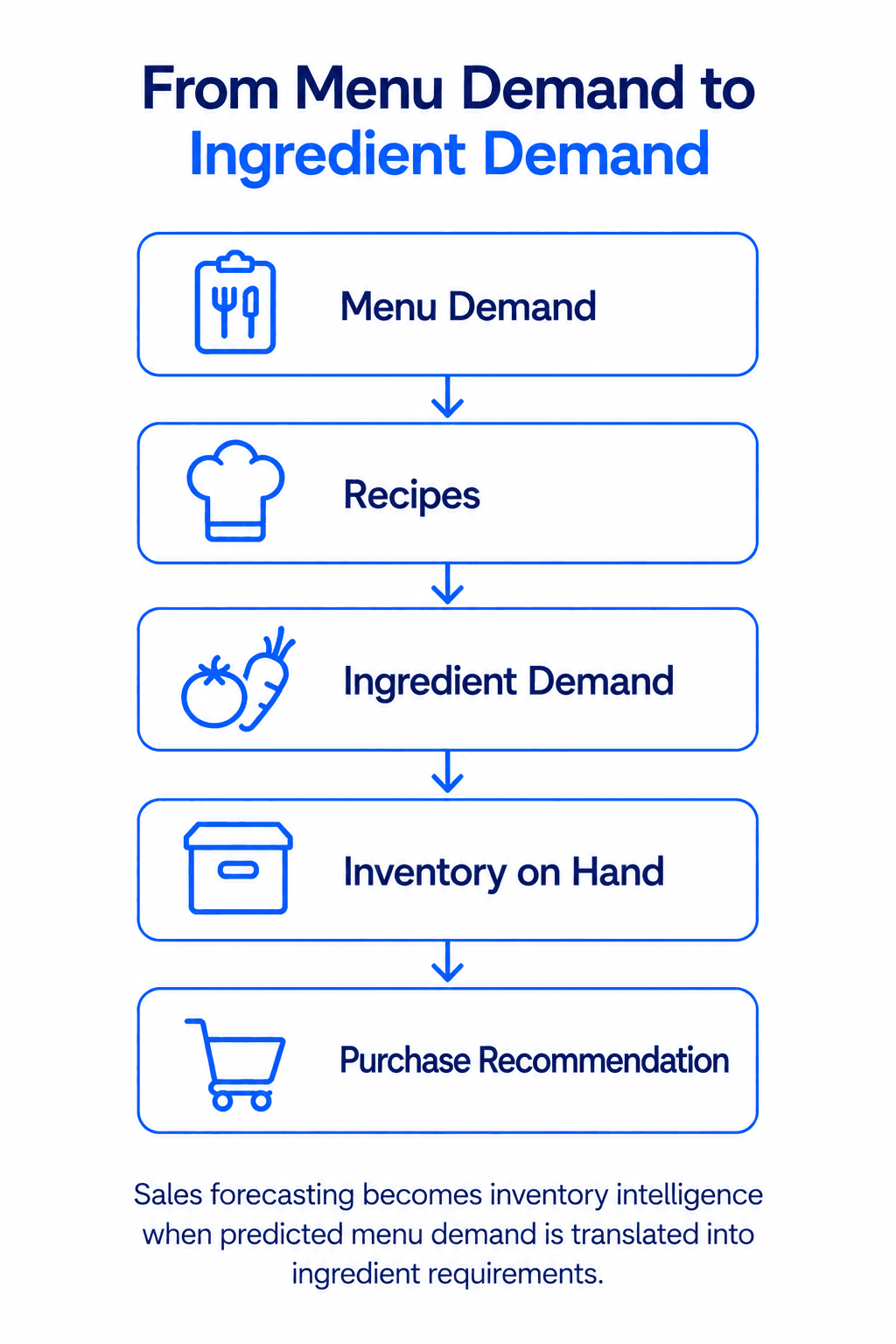
The most important input into intelligent inventory management is not inventory.
It is demand.
Before the restaurant can determine how much chicken, cheese, flour, coffee, or packaging it needs, it must estimate what customers are likely to order.
This creates a direct connection to AI Restaurant Demand Forecasting
Demand forecasting answers:
What are customers likely to buy?
Inventory intelligence translates that into:
What ingredients will we need to produce it?
For example:
AI predicts tomorrow's demand:
480 chicken sandwiches
Each sandwich requires approximately:
1 chicken portion
1 bun
2 pickle portions
1 sauce portion
The inventory model can translate menu demand into ingredient requirements.
That calculation can then account for:
inventory currently on hand
expected waste
existing purchase orders
supplier delivery schedules
safety stock
product shelf life
The result is much more useful than:
Order what we normally order on Tuesday.
From Menu Forecasting to Ingredient Forecasting
This is where restaurant inventory becomes substantially more sophisticated.
A sales forecast might predict:
450 burgers
190 chicken sandwiches
240 orders of fries
310 soft drinks
An inventory engine can use recipe definitions to convert those products into raw-material demand.
For example:
Projected burger demand creates requirements for:
patties
buns
cheese
lettuce
tomatoes
sauces
packaging
Projected fry demand creates requirements for:
potatoes or frozen fries
frying oil
seasoning
containers
Every predicted menu item therefore produces a corresponding ingredient forecast.
This connection depends heavily on accurate recipe data.
If recipe definitions are wrong, inventory intelligence will be wrong too.
That leads to one of the most important principles in the article:
AI cannot fix bad restaurant data. It amplifies it.
Predictive Purchasing
Once expected ingredient consumption is known, AI can begin supporting purchasing decisions.
Traditional ordering asks:
What are we short of?
Predictive purchasing asks:
What will we become short of before the next supplier delivery?
The system may consider:
current inventory
forecast demand
existing purchase orders
supplier lead time
shelf life
minimum order quantities
expected waste
upcoming promotions
restaurant operating schedule
For example:
Current chicken inventory: 78 kg
Forecast consumption before next delivery: 96 kg
Safety stock target: 12 kg
Recommended purchase: 30 kg
That is significantly more precise than automatically ordering back to a fixed par level.
Restaurant365 notes that effective inventory forecasting connects expected demand with purchasing decisions so operators buy appropriate quantities before products are needed.
Dynamic Par Levels
AI does not necessarily eliminate restaurant par levels.
It can make them smarter.
Instead of:
Always keep 15 cases of fries.
The system could use:
Maintain approximately 11 cases on lower-demand Mondays and 19 cases before forecast high-volume Saturdays.
Dynamic pars could respond to:
seasonality
promotions
location performance
holidays
weather
product trends
supplier timing
The result is a target inventory level that changes according to expected demand.
This becomes particularly useful for high-volume QSR brands where carrying unnecessary inventory across hundreds of restaurants creates meaningful working-capital and waste implications.
Preventing Restaurant Stockouts Before They Happen
One of the clearest applications of predictive inventory intelligence is stockout prevention.
Traditional systems often identify a shortage after inventory reaches a predefined threshold.
AI can identify the risk earlier.
For example:
Chicken inventory appears sufficient for today's normal demand.
But the forecasting system knows:
demand is currently running 14% above forecast
a promotion begins at 4:00 p.m.
delivery demand is increasing
the next supplier delivery arrives tomorrow morning
The system may predict:
87% probability of stockout before 8:00 p.m.
Recommended action:
transfer inventory from another location
increase today's emergency purchase
adjust promotional availability
prepare a substitution plan
The operational value is significant.
A stockout does not only lose the sale of one item.
It may cause:
lost orders
disappointed customers
delivery-menu problems
refunds
substitutions
staff confusion
negative reviews
Connected menu availability therefore becomes part of inventory intelligence.
Toast's 2026 AI usage data shows menu and inventory were among the most common topics operators raised with its AI assistant, with 34% of participating restaurants initiating conversations in that category. Toast IQ can also take certain actions such as marking menu items in or out of stock.
AI and Food Waste Reduction
Over-ordering creates the opposite problem.
The restaurant has more ingredients than it can sell before they deteriorate.
Food waste can come from:
over-purchasing
over-preparation
poor portion control
spoilage
menu changes
inaccurate demand forecasting
preparation mistakes
refires
AI can help identify patterns before waste becomes normal.
Toast's Canadian guidance on AI and food waste highlights inventory forecasting, waste tracking, smart menus, and back-of-house automation as potential tools for reducing common waste drivers such as over-ordering and inconsistent production.
An intelligent system might identify:
This location consistently disposes of prepared chicken between 8:00 and 9:00 p.m.
The recommendation may be:
Reduce final preparation batch by 14%.
Or:
Delay final batch by 25 minutes.
This connects inventory intelligence directly to AI Kitchen Orchestration
Kitchen orchestration determines:
What should we prepare?
Inventory intelligence helps answer:
How much should we prepare without creating unnecessary waste?
Actual vs Theoretical Inventory
One of the most important inventory concepts for restaurant operators is the difference between theoretical usage and actual usage.
Theoretical usage
What the restaurant should have consumed based on sales and recipes.
Actual usage
What inventory counts indicate the restaurant actually consumed.
The gap between the two is inventory variance.
For example:
Sales and recipes indicate:
Theoretical chicken usage: 82 kg
Inventory counts indicate:
Actual chicken usage: 97 kg
Variance:
15 kg
Something happened.
The important question is what.
Possible causes include:
over-portioning
food waste
prep mistakes
inaccurate recipes
receiving shortages
incorrect inventory counts
spoilage
unauthorized consumption
theft
AI can help identify where recurring variance occurs and which locations or ingredients deserve investigation.
Toast's inventory platform uses actual-versus-theoretical reporting to compare expected and actual consumption and help operators identify waste, shortage, and other cost variance.
AI Should Detect Variance, Not Make Accusations
This distinction matters.
An inventory system may detect that chicken usage is 18% above theoretical consumption.
It should not automatically conclude:
Employee theft.
That is only one possible explanation.
The correct AI response is closer to:
Chicken usage is materially above theoretical consumption. The variance has occurred during five of the past seven dinner periods. Review portion control, waste records, receiving accuracy, recipe configuration, and inventory counts.
AI identifies the anomaly.
Humans investigate the cause.
This is the same philosophy behind Restaurant Management by Exception
The purpose is not automated accusation.
It is faster operational investigation.
Inventory Management by Exception
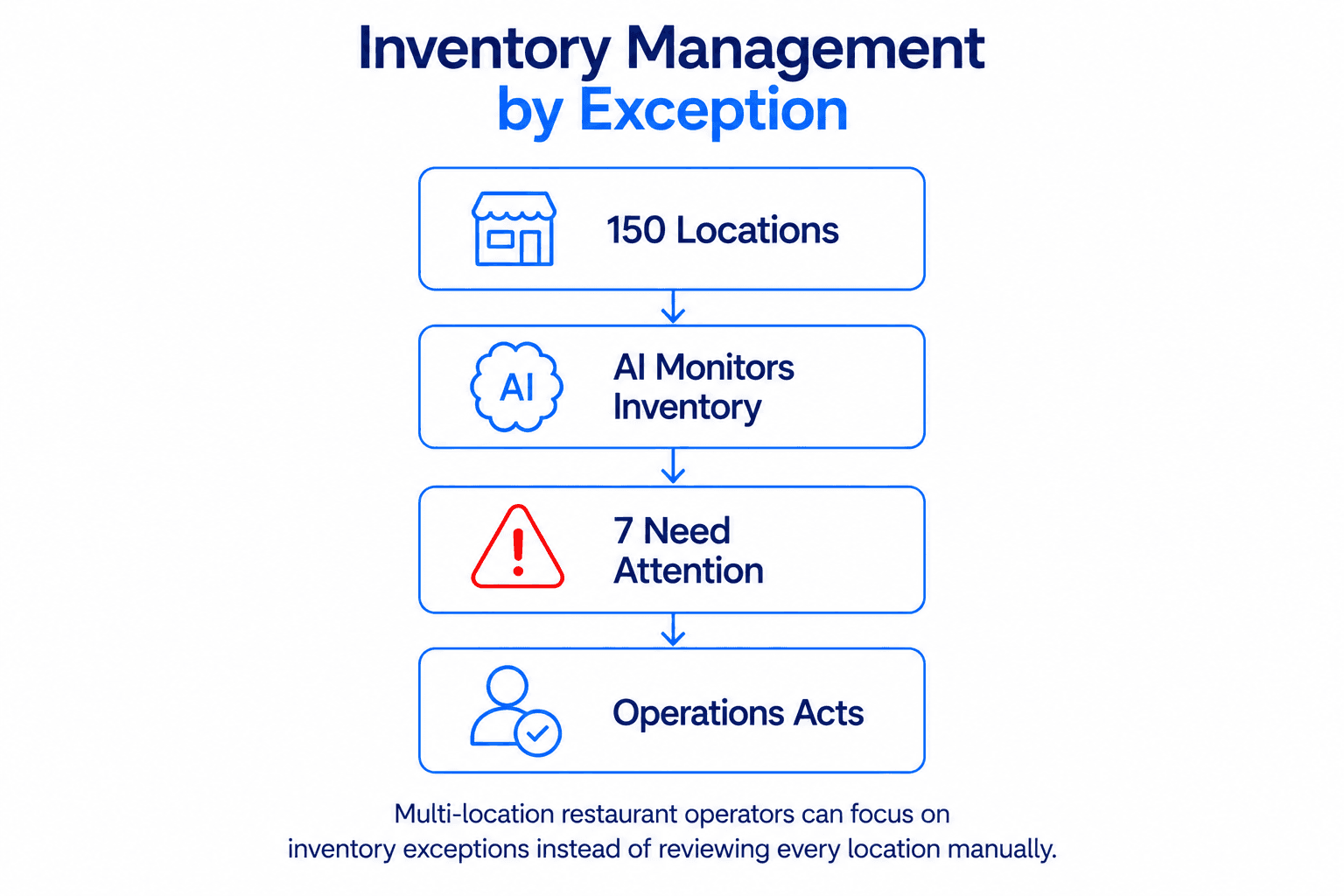
Imagine a QSR brand operating 150 restaurants.
Corporate leadership does not need 150 inventory reports every Monday.
It needs to know:
Which locations require attention?
AI can continuously monitor:
food-cost variance
ingredient usage
stockout frequency
waste
purchasing
inventory turns
receiving discrepancies
unusual product depletion
The executive briefing could say:
7 of 150 restaurants require inventory attention.
Location 18:
Chicken variance 13% above peer benchmark.
Location 52:
Repeated beverage stockouts during Friday dinner.
Location 74:
Fresh produce waste materially above expected levels.
Location 119:
Purchasing significantly above forecast consumption.
Everything operating normally remains in the background.
Leadership focuses only on the exceptions.
Multi-Location Inventory Intelligence
Inventory optimization becomes even more powerful across restaurant networks.
One location may have too much product.
Another may be approaching a stockout.
Traditionally, each restaurant may respond independently.
A network-aware system can consider inventory across multiple locations.
For example:
Location A
Projected chicken surplus: 18 kg
Location B
Projected chicken shortage: 12 kg
Distance:
7 km
Instead of:
Location B places an emergency order.
The system might recommend:
Transfer 12 kg from Location A to Location B.
That may reduce:
waste at Location A
emergency purchasing at Location B
stockout risk
supplier dependency
This creates the concept of network inventory.
For franchise organizations, business rules would need to account for ownership boundaries. Inventory transfers between different franchisees may not be operationally or financially appropriate.
But within corporate groups or multi-unit franchise portfolios, the opportunity can be significant.
Comparing Similar Locations
AI can also improve inventory benchmarking.
Comparing every restaurant against one company-wide number may be misleading.
A downtown restaurant may behave differently from:
a suburban drive-thru
a food-court unit
an airport restaurant
a delivery-heavy location
Intelligent benchmarking can compare restaurants with structurally similar peers.
That can reveal:
This restaurant's chicken usage is 9% higher than comparable high-volume drive-thru locations despite similar product mix.
That is much more actionable than:
Food cost is above company average.
Context improves the quality of the exception.
Supplier Lead Times Matter
Forecasting what the restaurant needs is only part of the problem.
The system must also understand when the product can arrive.
Supplier variables include:
lead time
delivery days
minimum quantities
case size
cutoff time
availability
substitution rules
Consider two ingredients.
Ingredient A:
Supplier delivery every day.
Ingredient B:
Supplier delivery twice per week.
The appropriate safety stock should be different.
Predictive purchasing therefore must connect:
Demand
with
Inventory
with
Supplier availability
The goal is not merely knowing that a product will run out.
It is identifying the risk early enough to do something about it.
Inventory and Menu Availability Should Work Together
Inventory problems increasingly affect digital ordering.
If an ingredient is unavailable but the menu still displays the associated products on:
the restaurant website
Uber Eats
DoorDash
other delivery marketplaces
customers can order something the restaurant cannot fulfill.
That creates:
refunds
substitutions
cancellations
poor customer experience
operational friction
Connected inventory intelligence can eventually influence menu availability automatically within approved rules.
For example:
Projected chicken inventory will support only 30 additional orders.
The system may:
notify the manager
suppress promotional placement
recommend disabling a delivery item
suggest a substitution
synchronize availability once stock reaches a defined threshold
This creates a direct link between inventory and MYR's broader order-processing capabilities.
centralizes orders from direct and third-party channels, helping create the connected order data required for more intelligent operational decision-making.
Connecting Labor, Kitchen, and Inventory Intelligence
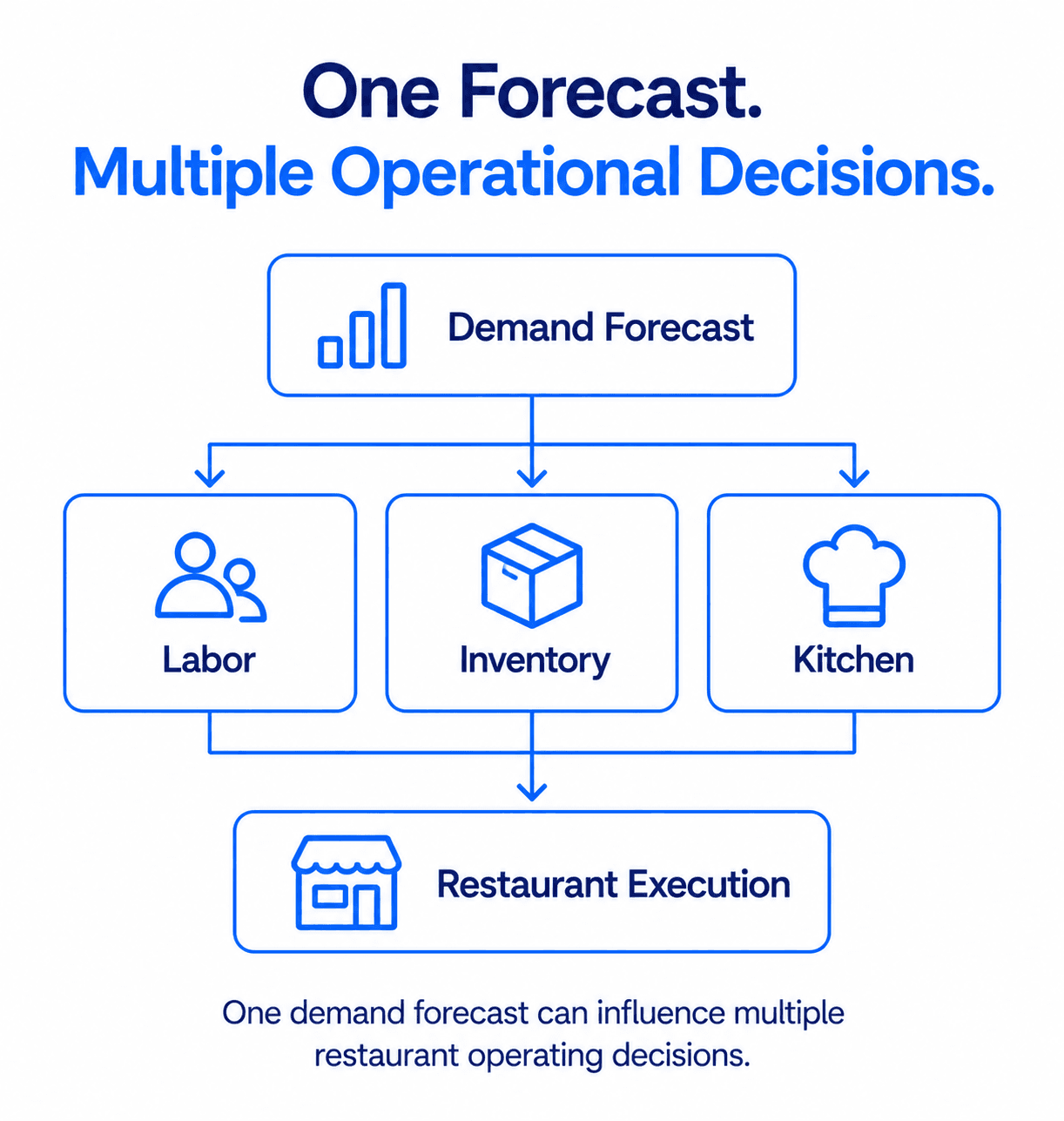
Inventory cannot be optimized in isolation.
The intelligent restaurant operating model connects multiple systems.
Demand Forecasting
What will customers order?
↓
Inventory Intelligence
What ingredients are required?
↓
Labor Optimization
What team capacity is needed?
↓
Kitchen Orchestration
How should those ingredients and employees be deployed?
↓
Management by Exception
Where does leadership need to intervene?
This is why the MYR AI cluster is becoming more powerful as each article is added.
The topics are not separate applications.
They are layers of the same future operating architecture.
Relevant supporting articles:
AI Restaurant Demand Forecasting
AI Restaurant Labor Optimization
Restaurant Management by Exception
What AI Inventory Management Means for the CFO
Inventory AI should ultimately be evaluated financially.
The CFO should focus on several outcomes.
Food cost percentage
Is the restaurant using ingredients more efficiently?
Actual vs theoretical variance
Is unexplained usage decreasing?
Waste
Are fewer ingredients being discarded?
Stockouts
Are revenue opportunities being protected?
Inventory turns
Is inventory moving efficiently?
Working capital
Is excessive cash being tied up in stock?
Emergency purchasing
Are rushed and expensive purchases decreasing?
Margin
Are improvements translating into stronger restaurant economics?
A sophisticated AI system should not simply say:
We reduced inventory.
Lower inventory can be dangerous if it increases stockouts.
The goal is better inventory productivity.
The Goal Is Not Minimum Inventory
This distinction mirrors the labor-optimization principle from the previous article.
The goal of labor optimization is not minimum staffing.
The goal of inventory optimization is not minimum inventory.
Both extremes are expensive.
Too much inventory
creates:
waste
spoilage
unnecessary cash investment
storage pressure
Too little inventory
creates:
stockouts
lost sales
menu unavailability
emergency orders
guest dissatisfaction
The target sits between the two.
Carry the minimum inventory required to reliably support forecast demand and the desired service level.
That is a much more useful operating objective.
AI Cannot Fix Bad Inventory Data
Predictive systems depend heavily on data quality.
AI cannot reliably optimize inventory when:
counts are inaccurate
recipes are wrong
receiving is not recorded
waste is ignored
ingredient units are inconsistent
products are mapped incorrectly
menu items are not synchronized
Consider this simple example.
Recipe configuration says:
One sandwich uses 120 grams of chicken.
Actual preparation standard:
One sandwich uses 150 grams.
AI may repeatedly conclude that chicken is disappearing.
The real problem is configuration.
That is why restaurant organizations should improve data discipline before introducing aggressive automation.
Human Oversight Still Matters
Restaurant inventory includes conditions that software may not fully understand.
A manager may know:
produce quality was poor
a delivery arrived damaged
refrigeration failed
a supplier substituted a product
a local event was cancelled
a promotion was changed unexpectedly
AI should provide recommendations with context.
For example:
Reduce tomorrow's tomato order by two cases because forecast usage has declined and current inventory is 23% above the target range.
The manager can then accept or reject the recommendation.
High-impact purchasing decisions should remain governed by:
approval rules
financial limits
supplier agreements
franchise permissions
human accountability
Where MYR Fits Into Predictive Restaurant Inventory
MYR is not an inventory-management platform, and the article should not suggest otherwise.
MYR's strategic role is in the operational data layer that precedes sophisticated inventory intelligence.
Accurate inventory forecasting requires accurate demand information.
MYR helps QSR operators connect several important demand signals, including:
in-store POS transactions
online orders
third-party delivery orders
menu activity
kitchen order flows
multi-location sales activity
MYR's order processing integrates delivery orders from services such as Uber Eats, DoorDash, Grubhub, Postmates, Skip, and Ritual directly into MYR's restaurant workflow.
This matters because an inventory forecast that sees only counter transactions but ignores digital demand will be incomplete.
For franchise organizations, MYR's franchise platform helps centralize menus, location performance, ordering, and multi-location operational visibility.
These connected signals help establish the data foundation upon which more advanced restaurant intelligence can operate.
This follows the principle established throughout AI for Restaurant Operations
Reliable restaurant AI begins with connected operational data.
From Inventory Counting to Inventory Intelligence
Restaurant inventory technology is evolving through several stages.
Manual Counts
↓
Digital Inventory
↓
Integrated POS Inventory
↓
Demand Forecasting
↓
Predictive Purchasing
↓
Inventory Intelligence
The count does not disappear.
Neither does the manager.
What changes is what happens between counts.
Instead of waiting for the next inventory cycle to discover a problem, intelligent systems continuously compare:
predicted demand
actual sales
theoretical consumption
actual inventory
purchase orders
waste
supplier schedules
The system identifies problems while operators can still act.
The Future of Restaurant Inventory Is Predictive
Restaurant operators have traditionally managed inventory by looking backward.
What did we sell?
What did we use?
What disappeared?
What do we have left?
AI adds a forward-looking dimension.
What will customers probably order?
Which ingredients will those orders require?
Will current inventory be sufficient?
Which location is at risk of running out?
Where are we carrying too much?
Where does usage not match sales?
What should we order next?
That shift turns inventory from an administrative task into part of the restaurant's decision intelligence layer.
And the industry is clearly moving toward this model. Toast reports that menu and inventory were among the most common topics restaurant operators raised with its AI assistant, while the National Restaurant Association specifically identifies predictive inventory and automated purchasing as practical restaurant AI use cases.
Conclusion
Restaurant inventory has always been a balancing act.
Too much creates waste.
Too little creates stockouts.
Artificial intelligence can help restaurants make that balance more precise.
By connecting demand forecasting, sales, recipes, purchasing, inventory counts, and operational performance, AI can help restaurant operators:
forecast ingredient requirements
make smarter purchasing decisions
reduce waste
prevent stockouts
identify unusual usage
improve food-cost control
optimize inventory across multiple locations
The goal is not automated purchasing at any cost.
It is better decision-making.
The restaurant of the future will not wait until an ingredient is gone to discover that it needed more.
It will increasingly know what is likely to be needed before the demand arrives.
The future of restaurant inventory is not counting what you have. It is predicting what you will need.
Build the Data Foundation for Smarter QSR Operations
Predictive inventory decisions begin with accurate restaurant demand data.
MYR helps QSR franchise owners, growing restaurant groups, and enterprise brands connect POS transactions, online ordering, third-party delivery, kitchen workflows, menus, and multi-location reporting through one cloud-based QSR platform.
Explore MYR for QSR Franchises
Book a Personalized MYR Demo
Frequently Asked Questions
What is AI restaurant inventory management?
AI restaurant inventory management uses artificial intelligence to forecast ingredient demand, analyze inventory patterns, recommend purchasing decisions, detect unusual consumption, and help restaurants reduce waste and stockouts.
How does AI forecast restaurant inventory?
AI can combine historical sales, forecast demand, recipes, product mix, current inventory, supplier lead times, promotions, weather, seasonality, and other signals to estimate future ingredient requirements.
Can AI reduce restaurant food waste?
AI can help reduce waste by improving demand forecasts, identifying over-ordering, detecting recurring waste patterns, optimizing preparation quantities, and recommending purchasing levels that better match expected consumption.
What is actual versus theoretical inventory?
Theoretical inventory represents what a restaurant should have consumed based on sales and recipes. Actual inventory represents what physical counts indicate was consumed. The difference can reveal waste, portioning problems, receiving issues, count errors, or other operational variance.
Can AI prevent restaurant stockouts?
AI can identify when forecast consumption is likely to exceed inventory available before the next delivery, allowing operators to reorder, transfer products, change availability, or take other corrective action before a stockout occurs.
Can AI automatically order restaurant inventory?
AI can generate purchasing recommendations or purchase orders based on forecast demand and inventory levels. High-impact purchasing decisions should still follow appropriate approval rules and supplier controls. The National Restaurant Association identifies automated purchase-order generation as one potential application of restaurant AI.
How does demand forecasting connect to inventory management?
Demand forecasting estimates what customers are likely to order. Inventory forecasting converts predicted menu demand into the ingredients required to fulfill those orders.
How can restaurant franchises use AI for inventory?
AI can compare inventory performance across locations, identify abnormal food-cost variance, detect stockout risk, benchmark similar restaurants, and prioritize locations requiring operational intervention.
Does AI inventory management eliminate physical counts?
No. Physical inventory counts remain important for validating actual inventory. AI makes those counts more valuable by comparing them with expected consumption and identifying meaningful variances.
What data does restaurant inventory AI need?
Useful data can include POS sales, recipes, product mix, inventory counts, purchase orders, waste records, supplier schedules, online ordering, delivery transactions, promotions, and forecast demand.


