
AI Labor Optimization for Restaurants: How Predictive Staffing Can Improve QSR Profitability
Labor is one of the most important investments a restaurant makes every day.
Too little labor and the operation slows.
Orders take longer.
Employees become overwhelmed.
Drive-thru lines grow.
Digital orders accumulate.
Guests wait.
Too much labor creates the opposite problem.
The restaurant may deliver excellent service while spending significantly more than the sales volume can support.
Quick-service restaurant operators have always tried to find the right balance.
The challenge is that customer demand does not arrive in neat, predictable shifts.
A restaurant may be quiet at 11:15 a.m. and overwhelmed 20 minutes later.
Delivery demand can spike because of rain.
A nearby school can unexpectedly close.
A promotion can perform better than expected.
One large group can suddenly change production requirements.
A team member can call in sick.
Yet restaurant schedules are often created days in advance.
That creates a fundamental mismatch:
Restaurant demand changes continuously, while restaurant labor plans have traditionally remained relatively static.
Artificial intelligence can begin closing that gap.
Instead of treating the published schedule as the final labor plan, AI can help restaurants continuously compare forecast demand, scheduled labor, actual sales, kitchen workload, and employee availability.
The goal is not simply to schedule fewer people.
It is to have:
the right people, with the right skills, in the right place, at the right time, for the demand that is actually coming.
For QSR franchise owners, growing restaurant groups, and enterprise franchise brands, that could turn labor management from a weekly administrative process into a continuously optimized operating system.
Executive Summary
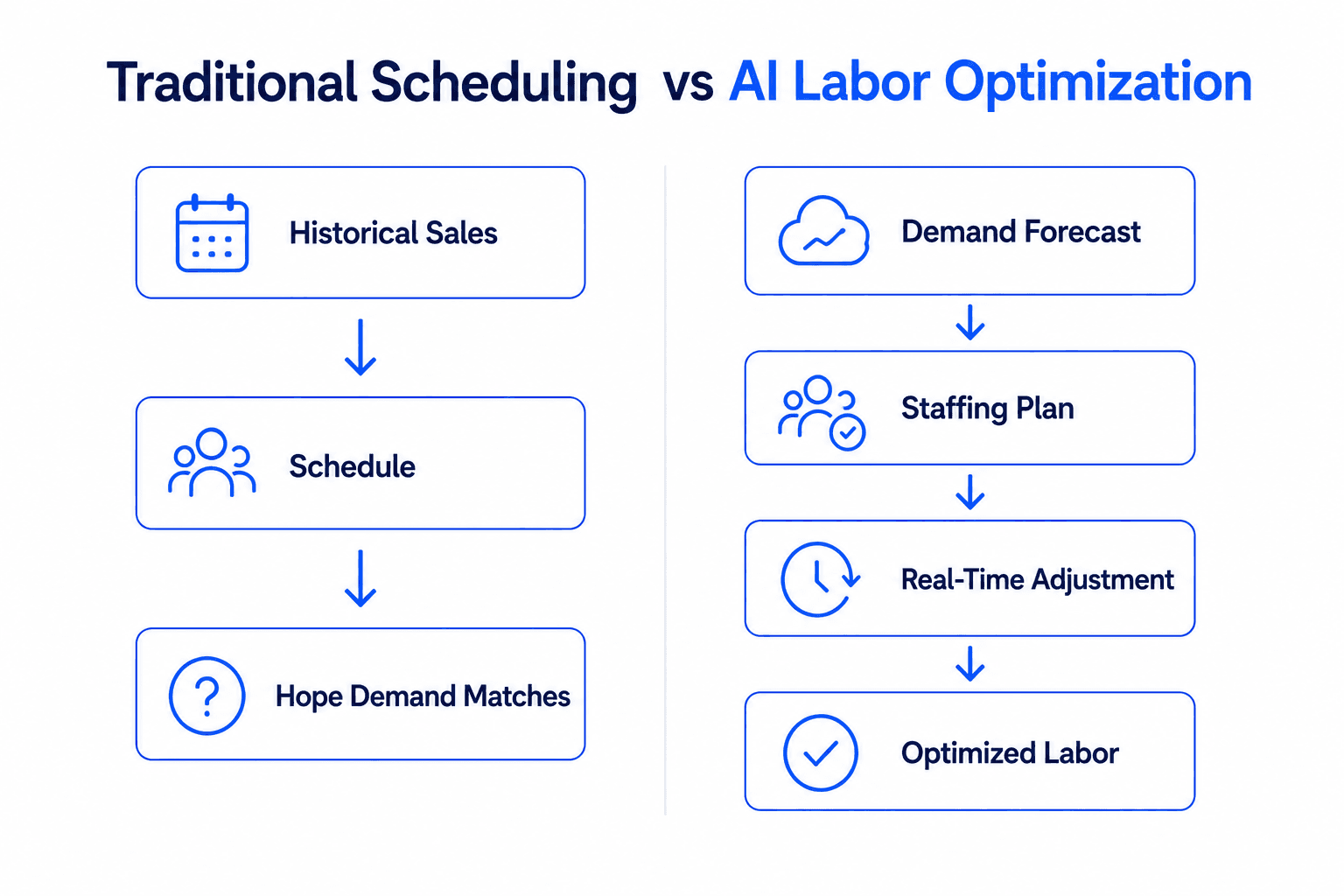
Restaurant labor management has traditionally followed a predictable process:
Forecast sales
↓
Build schedule
↓
Publish schedule
↓
Work the shift
↓
Review labor cost
That model is increasingly insufficient for modern QSR operations.
AI introduces a more dynamic cycle:
Predict demand
↓
Determine labor requirements
↓
Build staffing plan
↓
Monitor actual demand
↓
Recommend adjustments
↓
Measure results
↓
Improve the next forecast
This matters because labor pressure remains substantial.
Restaurant365's 2026 mid-year research, based on more than 420 restaurant operators representing almost 10,000 locations, found that 75% of respondents experienced increased labor costs during the first half of the year. Among restaurants already using AI, however, 62% reported reducing labor costs and 88% reported saving time each week.
Restaurant365 also reported that operators using its AI labor-management engine reduced average labor forecast error by 15%, producing an estimated annual savings of $100,000 across 10 locations.
The opportunity extends beyond cost reduction.
AI-supported labor optimization can potentially help QSR operators:
forecast staffing needs more accurately
schedule employees by expected demand
identify overtime risk before it occurs
adapt labor during the shift
improve break timing
reposition employees between stations
match skills to operational requirements
reduce administrative scheduling work
identify overstaffed and understaffed locations
compare labor efficiency across restaurant networks
The goal should not be to minimize labor at any cost.
It should be to maximize labor productivity while protecting service quality, employee experience, and restaurant throughput.
What Is AI Restaurant Labor Optimization?
AI restaurant labor optimization uses artificial intelligence to forecast staffing requirements, compare scheduled labor with expected and actual demand, and recommend how restaurant employees should be scheduled or deployed to improve productivity, service, and labor-cost performance.
AI labor optimization goes beyond creating an employee schedule.
Traditional scheduling primarily answers:
Who is working?
Predictive labor management asks:
How much labor will we need?
Operational labor optimization asks:
Where should that labor be deployed as conditions change?
Those are three different problems.
A sophisticated restaurant labor system may therefore operate across three stages:
1. Forecast
Predict the amount and type of labor required.
2. Schedule
Build employee shifts that match forecast demand, availability, skills, compliance requirements, and labor budgets.
3. Optimize
Continuously compare forecast, schedule, and reality throughout the operating day.
The third stage is where AI becomes particularly valuable.
Why Traditional Restaurant Scheduling Is Often Reactive
Restaurant schedules are usually created before the restaurant knows exactly what demand will look like.
Managers use:
previous weeks
historical sales
employee availability
manager experience
labor budgets
recurring scheduling templates
These inputs are useful.
But conditions can change after the schedule is published.
Consider a restaurant that expects a typical Tuesday lunch.
The schedule is built accordingly.
Tuesday morning arrives.
Heavy rain begins.
Walk-in traffic falls.
Delivery orders rise sharply.
Instead of one predictable lunch rush, the restaurant now has:
fewer front-counter customers
more digital orders
greater kitchen assembly demand
more courier pickups
lower dining-room activity
The correct total headcount may still be present.
But the wrong people may be working in the wrong places.
Traditional scheduling sees the restaurant as staffed.
Operational intelligence sees that labor needs to move.
This distinction becomes increasingly important as QSR demand fragments across ordering channels.
Scheduling Is a Labor Commitment, Not Just a Calendar
A restaurant schedule is effectively a financial commitment made before the revenue occurs.
Every scheduled hour represents an expected operating cost.
Restaurant365 describes QSR scheduling as directly dependent on sales forecasting and notes that even one or two employees of difference during a shift can materially affect both labor cost and guest experience.
That makes forecasting accuracy critical.
If expected demand is too high, the restaurant may overstaff.
If expected demand is too low, the restaurant may become overwhelmed.
This creates the first major connection within the MYR AI content cluster.
As discussed in our guide to AI Restaurant Demand Forecasting, restaurant intelligence becomes more useful when it can predict demand by daypart, channel, and location rather than simply predicting total daily sales.
Demand forecasting predicts:
What is coming?
Labor optimization determines:
Who needs to be there when it arrives?
How AI Forecasts Restaurant Staffing Requirements
AI labor forecasting begins with demand.
Instead of automatically scheduling the same number of employees every Friday, the system evaluates what this specific Friday is expected to require.
Inputs can include:
historical sales
transaction volume
order channel mix
weather
local events
promotions
seasonality
holidays
delivery demand
product mix
kitchen workload
restaurant format
employee productivity
The forecast can then estimate labor requirements by smaller time intervals.
Restaurant365's Smart Labor functionality, for example, supports hourly forecasting so restaurants can estimate how many employees are required for each hour rather than relying only on broad daily labor assumptions.
That level of precision matters.
A restaurant may need:
10:00 a.m.
4 employees
11:00 a.m.
6 employees
12:00 p.m.
10 employees
1:00 p.m.
8 employees
2:00 p.m.
5 employees
A schedule that uses eight employees throughout the period might appear reasonable on a daily labor report.
Operationally, however, the restaurant would be:
overstaffed early
understaffed during the peak
overstaffed again afterward
The daily average hides the actual problem.
This is why labor intelligence increasingly needs to operate at the daypart or hourly level, not only at the weekly level.
From Forecasting Headcount to Forecasting Skills
Predicting the number of employees is only the beginning.
Ten employees do not necessarily provide the same operational capacity.
A QSR team may require different combinations of:
cashier skills
kitchen preparation
grill
fry station
assembly
drive-thru
shift management
mobile ordering
delivery handoff
opening or closing experience
AI can potentially forecast not only:
We need eight employees.
But:
We need eight employees with this skill mix.
For example:
two kitchen production employees
one grill specialist
one expediter
two customer-facing employees
one drive-thru employee
one shift leader
That becomes especially important during menu promotions, seasonal demand, or periods when one kitchen station becomes the primary production constraint.
Connecting Labor Optimization to Kitchen Orchestration

Labor and kitchen capacity cannot be optimized independently.
Imagine that AI predicts an unusually busy lunch.
Demand forecasting identifies a 19% increase in expected orders.
The kitchen intelligence layer predicts that the fryer station is likely to become constrained.
The labor system then determines that the restaurant has enough employees overall, but not enough production capacity at that station.
The recommendation becomes:
Move one cross-trained employee from front counter to fryer support between 12:00 p.m. and 12:45 p.m.
That is fundamentally different from simply adding labor.
It is deploying existing labor more intelligently.
This connects directly to the operating model described in AI Kitchen Orchestration.
The relationship can be summarized simply:
Demand Forecasting
predicts customer volume.
↓
Labor Intelligence
determines required staffing.
↓
Kitchen Orchestration
determines where operational capacity is needed.
↓
Managers
deploy people accordingly.
This is where separate AI capabilities begin forming a connected restaurant operating system.
AI-Generated Restaurant Schedules
Once demand and labor requirements are forecast, AI can help construct schedules.
The system may consider:
expected demand
required roles
employee availability
employee skills
maximum hours
overtime thresholds
break rules
local labor regulations
shift preferences
payroll budgets
Instead of a manager manually solving dozens of scheduling constraints, the system generates a proposed plan.
The manager still reviews it.
That distinction is important.
Restaurant scheduling involves human realities that software may not fully understand.
An employee may:
be studying
have childcare requirements
prefer opening shifts
rely on public transportation
be training for another position
have an informal arrangement with the manager
AI can optimize the mathematical schedule.
Managers understand the people.
The strongest model combines both.
Real-Time Labor Optimization During the Shift
A schedule is a prediction.
Once the shift begins, actual demand becomes more important than the original forecast.
This is where labor optimization separates itself from scheduling.
Restaurant365's Operations Dashboard can compare forecast sales and labor against actual restaurant activity throughout the day. With intraday polling enabled, sales and labor data can update at 15, 30, or 60 minute intervals, helping managers make staffing decisions based on current conditions.
AI can build on this concept.
Imagine lunch demand was forecast at $7,500.
At 11:45 a.m., actual trends indicate the restaurant is likely to finish lunch at only $6,200.
The system could recommend:
delay an employee's start
move breaks earlier
send one employee home after the rush
redeploy someone to preparation for tomorrow
Now imagine demand is running above forecast.
The recommendations change:
delay breaks
call in approved backup staff
redeploy employees toward the bottleneck
activate line busting
adjust kitchen production
The labor plan becomes dynamic.
Break Optimization
Break timing seems operationally small.
Across hundreds of restaurants, it becomes significant.
Poorly timed breaks can cause:
slower service
production bottlenecks
stressed employees
missed regulatory requirements
AI can identify periods when predicted demand is lowest and recommend appropriate break windows.
The manager retains final control.
But instead of guessing, the manager receives context.
For example:
Order volume is expected to decline 22% between 2:10 and 2:40 p.m. This is the lowest-risk break window before dinner preparation begins.
This is a simple application of predictive intelligence with immediate operational value.
Preventing Overtime Before It Happens
Overtime often appears on financial reports after the cost has already occurred.
Predictive labor management can identify the risk before a shift is assigned.
The system can monitor:
scheduled weekly hours
hours already worked
proposed shifts
overtime thresholds
shift changes
employee call-ins
Restaurant365's scheduling platform, for example, can flag overtime and compliance risks before schedules are published.
AI could extend this by recommending alternatives.
Instead of:
Employee A will enter overtime.
The system could say:
Assign Employee B to Friday dinner instead. Required skills are equivalent and projected weekly labor cost decreases by $74.
This moves labor software from alerts toward recommendations.
AI Labor Optimization Across Multiple Restaurant Locations
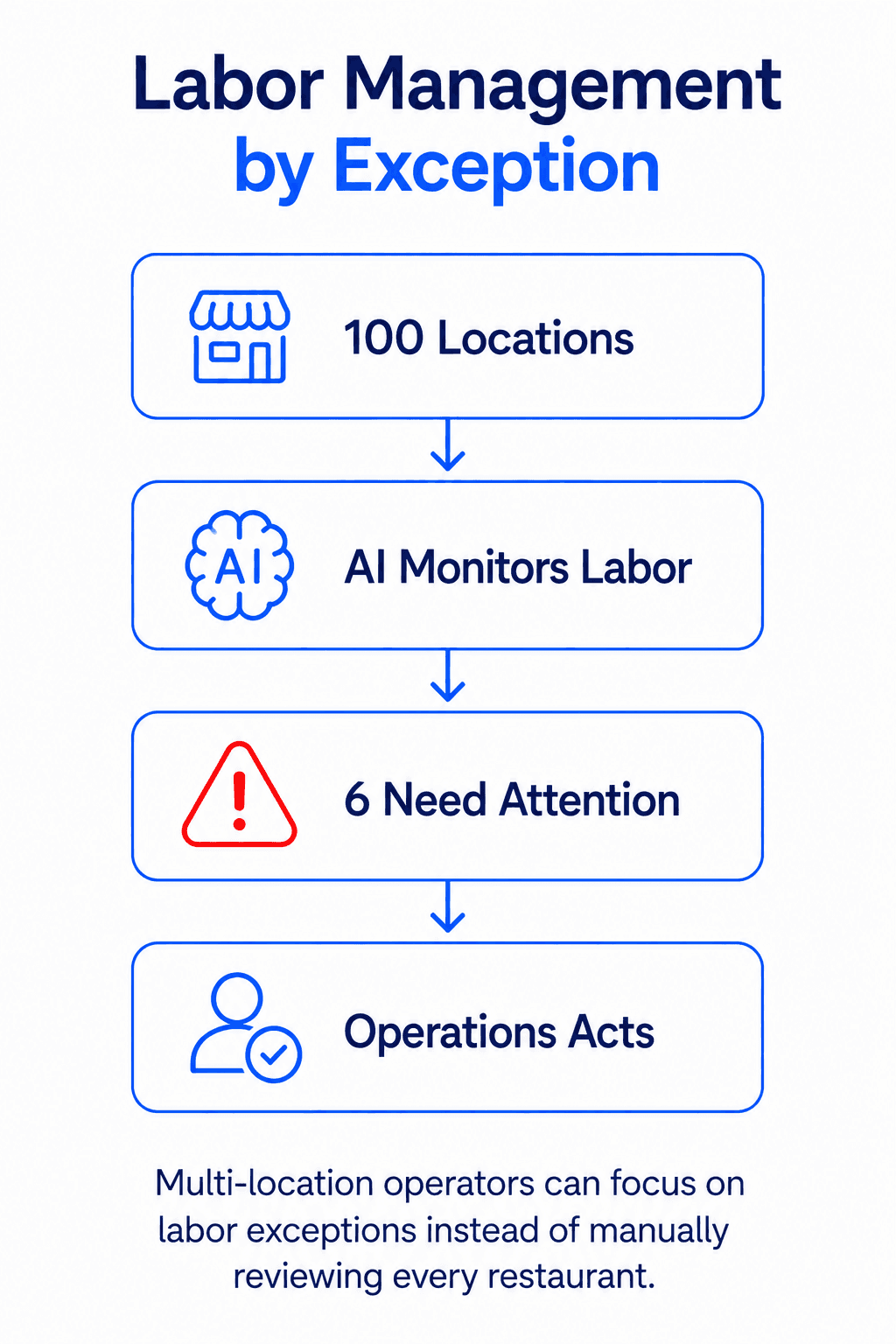
The economics become particularly interesting for multi-location restaurant groups.
A one-hour scheduling mistake at one restaurant may be relatively small.
Repeat it across:
25 locations
100 locations
500 locations
and it becomes material.
Enterprise labor intelligence can identify:
locations consistently overstaffed
locations repeatedly understaffed
managers whose forecasts are unusually accurate
excessive overtime patterns
dayparts with recurring labor problems
restaurants where service improves with different staffing models
locations whose labor percentage appears healthy only because they are understaffed
The system can also compare scheduled, forecast, actual, and optimal labor across locations.
Restaurant365's Schedule Analysis tools already provide this type of variance comparison between forecasted, scheduled, actual, and optimal labor hours.
AI adds prioritization.
Instead of giving a VP of Operations 200 labor reports, it can say:
Six locations require labor intervention this week.
That creates another natural connection to Restaurant Management by Exception.
How Restaurant Executives Should Think About Labor AI
Different leadership roles will evaluate labor optimization differently.
CEO
The CEO should focus on whether better labor intelligence allows the organization to scale while maintaining:
service quality
employee experience
franchisee economics
operating consistency
COO
The COO cares about:
staffing accuracy
throughput
location consistency
productivity
field execution
The key question is:
Are we putting enough operating capacity where demand actually occurs?
CFO
The CFO should focus on:
labor cost as a percentage of sales
overtime
forecast accuracy
productivity
labor variance
incremental savings
implementation ROI
VP Operations
The VP Operations needs to know:
which stores are overstaffed
which are understaffed
which managers consistently miss forecasts
which dayparts require intervention
which staffing practices produce better throughput
Franchise Director
Franchise Directors can use labor intelligence to identify franchisees that may require:
scheduling support
operational coaching
staffing best practices
better demand forecasts
Franchise Owner
A multi-unit franchise owner needs a much simpler answer:
Which of my restaurants is wasting labor, and which one does not have enough people to serve the demand?
How CFOs Should Measure the ROI of AI Labor Optimization
Labor optimization should not be measured only by reductions in total payroll.
That can produce dangerous incentives.
A restaurant can lower payroll significantly by understaffing every shift.
The financial report improves temporarily.
The operation deteriorates.
A better ROI framework measures labor alongside service and revenue.
Important KPIs include:
Labor cost percentage
Labor expense relative to revenue.
Sales per labor hour
How much revenue the restaurant generates for each employee hour.
Transactions per labor hour
Particularly useful in QSR operations.
Forecast labor variance
Difference between expected and actual labor need.
Scheduled versus actual hours
Whether restaurants consistently use more or less labor than planned.
Overtime
Both frequency and cost.
Service time
Did labor reduction affect throughput?
Digital order completion
Did labor decisions affect online fulfillment?
Customer satisfaction
Did service deteriorate?
Employee turnover
Did aggressive labor optimization create a retention problem?
Restaurant365's 2026 research provides useful evidence that AI-assisted labor planning can generate measurable financial outcomes. Among its surveyed AI adopters, 62% reported reducing labor costs, while its own AI labor engine was associated with a 15% reduction in average labor forecast error.
These results are promising, but every restaurant organization should establish its own baseline before implementation.
The Goal Is Productivity, Not Minimum Staffing
This distinction is essential.
Restaurant labor optimization should not become:
How few employees can we schedule?
The correct question is:
What level of labor produces the strongest combination of service, employee productivity, throughput, and profitability?
Understaffing has costs.
They may include:
slower drive-thru service
reduced transactions
delivery delays
lower customer satisfaction
manager burnout
employee turnover
increased mistakes
reduced food quality
The National Restaurant Association's 2026 workforce research emphasizes that staffing decisions should be treated as strategic business investments rather than short-term costs. It also notes that staffing remains a persistent restaurant challenge even after broader labor-market conditions stabilized.
The optimal staffing level therefore sits between two expensive extremes.
Too much labor
increases cost.
Too little labor
reduces operating capacity.
AI can help restaurants find the productive middle.
Employee Experience Must Remain Part of the Equation
Algorithms can optimize numbers.
Restaurant operations depend on people.
If AI scheduling produces technically efficient schedules that employees dislike, the system may ultimately increase:
absenteeism
turnover
shift swaps
manager intervention
recruitment costs
A responsible AI labor strategy should account for:
availability
shift preferences where feasible
predictable schedules
fair distribution of hours
employee skills
rest periods
regulatory requirements
Managers should also remain able to override recommendations.
AI should support human judgment, not eliminate it.
An AI recommendation might say:
Send one employee home at 2:30 p.m.
The manager may know that:
dinner prep is behind
the employee is training
a large order is expected
another employee feels unwell
Operational context matters.
The best AI labor systems should therefore explain recommendations and allow managers to make the final decision.
Avoiding Algorithmic Management
AI becomes problematic when employees cannot understand why decisions affecting them are being made.
Examples include:
inexplicable reduction of hours
opaque productivity scoring
automated discipline
unfair shift distribution
excessive surveillance
Restaurant brands should establish clear boundaries.
AI may be appropriate for:
forecasting
schedule recommendations
overtime alerts
staffing suggestions
break-window identification
Human managers should retain responsibility for decisions involving:
performance management
disciplinary action
promotions
conflict
employee wellbeing
exceptional circumstances
The objective is better management.
Not automated management.
What an AI-Ready Restaurant Labor Stack Requires
Predictive labor optimization depends on connected operational data.
The system needs visibility into:
POS sales
transaction counts
order channels
dayparts
kitchen performance
historical labor
employee schedules
actual clocked hours
expected demand
promotions
local operating conditions
Disconnected data creates disconnected decisions.
Restaurant365 itself identifies the lack of connection between sales forecasts, scheduling, payroll, and financial reporting as a common weakness in restaurant scheduling environments.
This reinforces a broader principle across the MYR AI series:
AI becomes more useful as restaurant operations become more connected.
As discussed in our foundational article on AI for Restaurant Operations, reliable artificial intelligence depends less on adding a visible AI feature and more on building a clean operational data foundation.
Where MYR Fits Into the Future of Restaurant Labor Intelligence
MYR is not positioned as a workforce-management or AI scheduling platform.
That distinction should remain clear.
Its strategic role sits earlier in the data chain.
Accurate labor intelligence requires high-quality demand data.
MYR helps QSR operators connect several of the operational signals that determine that demand:
in-store POS transactions
online ordering
third-party delivery
menu activity
kitchen order flows
line-busting transactions
multi-location performance
MYR Order Processing helps restaurants centralize orders from platforms including Uber Eats, DoorDash, Grubhub, Postmates, Skip, and Ritual while routing those orders into connected restaurant workflows.
That matters because delivery demand is still demand.
If a labor forecast sees only counter transactions while a significant share of customer activity occurs through digital channels, staffing recommendations will be incomplete.
MYR Rover also helps restaurants respond operationally when queues form by allowing employees to take orders directly in line and send those orders to the kitchen.
For franchise brands and growing restaurant groups, MYR's franchise platform provides centralized operational visibility across locations.
The future labor-intelligence layer depends on these types of connected operational signals.
The forecasting system needs to understand:
How much demand exists?
The kitchen layer needs to understand:
Where is capacity constrained?
The labor layer needs to understand:
Where should people be deployed?
Connected restaurant infrastructure allows those questions to eventually work together.
From Scheduling to Continuous Workforce Orchestration
Restaurant labor technology is evolving through several stages.
Manual Scheduling
↓
Digital Scheduling
↓
Forecast-Based Scheduling
↓
Real-Time Labor Optimization
↓
Predictive Workforce Orchestration
At the final stage, labor becomes part of a broader restaurant intelligence loop.
The system continuously evaluates:
predicted demand
current demand
kitchen capacity
scheduled employees
employee skills
actual labor
operational performance
It then recommends how staffing should adapt.
This connects all four major components of the MYR AI content cluster:
AI Restaurant Demand Forecasting
What demand is coming?
↓
AI Labor Optimization
What operating capacity do we need?
↓
AI Kitchen Orchestration
Where should that capacity be deployed?
↓
Management by Exception
Where does leadership need to intervene?
That is increasingly what an intelligent QSR operating environment looks like.
The Future Restaurant Schedule Will Be a Living Operating Plan
The restaurant schedule is unlikely to disappear.
But its role will change.
Instead of being viewed as a fixed weekly document, it becomes the starting hypothesis for how the restaurant expects to operate.
Reality then updates the plan.
If demand increases, the system detects it.
If demand decreases, the system detects it.
If one kitchen station becomes constrained, the system sees it.
If labor is moving above target, management knows before the shift ends.
The schedule therefore evolves from:
This is who works this week.
to:
This is our expected labor plan, continuously compared with what the restaurant actually needs.
That is a much more powerful operating model.
Conclusion
Restaurant labor management has always required balancing two competing risks.
Too much labor increases cost.
Too little labor limits the restaurant's ability to serve customers.
AI can help make that balance more precise.
By combining demand forecasting, restaurant sales, order channels, kitchen workload, employee skills, and actual labor performance, intelligent workforce systems can help operators:
predict staffing requirements
build more accurate schedules
identify overtime risk
adjust labor throughout the day
deploy employees where capacity is needed
identify location-level labor exceptions
improve labor productivity
The goal is not minimum staffing.
It is optimal operating capacity.
For quick-service restaurant brands, that distinction matters.
The future of restaurant workforce management will not simply be about creating a better schedule.
It will be about continuously matching labor to demand.
The right people. The right skills. The right place. The right time.
Build the Operational Foundation for Smarter QSR Decisions
Predictive labor decisions depend on accurate restaurant demand data.
MYR helps QSR franchise owners, growing restaurant groups, and enterprise brands connect in-store ordering, online ordering, third-party delivery, kitchen workflows, and multi-location reporting through one cloud-based QSR platform.
Explore MYR for QSR Franchises
Frequently Asked Questions
What is AI restaurant labor optimization?
AI restaurant labor optimization uses artificial intelligence to forecast staffing requirements, compare scheduled labor with expected and actual demand, and recommend how employees should be scheduled or deployed to improve productivity and service.
How can AI reduce restaurant labor costs?
AI can help restaurants reduce unnecessary labor by improving demand forecasts, identifying overstaffed periods, preventing overtime, optimizing shift timing, and adjusting labor as actual demand changes.
What is restaurant labor forecasting?
Restaurant labor forecasting estimates how many employees and labor hours a restaurant will need based on expected sales, transactions, order channels, dayparts, operational workload, and other demand factors.
Can AI create restaurant schedules?
AI can generate proposed restaurant schedules using demand forecasts, employee availability, skills, labor budgets, overtime limits, and scheduling rules. Managers should still review schedules and retain the ability to override recommendations.
Can AI adjust staffing during a restaurant shift?
Yes. When real-time sales and operational data are available, AI can compare actual demand with forecast demand and recommend actions such as moving breaks, redeploying employees, delaying starts, or adding operational support.
Does AI labor optimization mean reducing restaurant employees?
Not necessarily. The goal of labor optimization is to match staffing with actual operating requirements. Understaffing can reduce throughput, customer satisfaction, food quality, and employee retention, making it financially counterproductive.
How does restaurant demand forecasting improve labor scheduling?
Demand forecasting estimates when customers and orders are likely to arrive. Labor scheduling uses that forecast to determine the number and types of employees required during each operating period.
How does AI labor optimization connect with kitchen orchestration?
Kitchen orchestration identifies where production capacity is required. Labor optimization helps determine which employees can be deployed to those stations to prevent bottlenecks and maintain throughput.
How can multi-location restaurant groups use AI for labor?
AI can compare labor performance across locations, identify overstaffing and understaffing, detect overtime patterns, benchmark comparable restaurants, and prioritize the locations that require intervention.
What data does restaurant labor AI need?
Useful inputs can include POS sales, transaction volume, order channels, historical schedules, actual labor hours, kitchen workload, employee availability, skills, promotions, weather, events, and forecast demand.


