Franchise Reporting Dashboards: The Operational Command Center Modern QSR Brands Need to Scale
Why the Best Franchise Brands Are Winning With Visibility, Not Just Great Operations
Every franchise executive wants the same outcome:
More profitable locations
Stronger franchisees
Consistent execution
Predictable growth
Better customer experiences
Yet as restaurant brands expand from 10 locations to 50, 100, or even hundreds of restaurants, something unexpected happens.
Visibility disappears.
What once felt manageable becomes increasingly difficult to control.
Regional managers struggle to identify underperforming stores.
Franchisees submit reports in different formats.
Operations teams spend hours reconciling spreadsheets.
Finance teams question the accuracy of revenue data.
Executives find themselves making multi-million-dollar decisions using information that is days or sometimes weeks old.
Ironically, the larger a franchise network becomes, the harder it becomes to understand what is actually happening inside the business.
This is why leading QSR franchise organizations are making a fundamental shift.
They are moving away from fragmented reporting systems and toward centralized franchise dashboards that provide real-time visibility across every location.
For modern franchise brands, reporting is no longer a back-office function.
It has become a strategic growth advantage.
And increasingly, it is becoming the difference between brands that scale successfully and those that struggle under the weight of their own growth.
Executive Summary
Most franchise organizations don't have a reporting problem.
They have a visibility problem.
As brands grow, leadership teams often lose the ability to see what is happening across the network in real time.
Sales reports arrive too late.
Labor issues go unnoticed.
Inventory waste compounds.
Regional trends emerge long before anyone identifies them.
The result?
Executives spend more time searching for answers than acting on them.
The highest-performing franchise organizations solve this challenge through centralized reporting dashboards that provide a real-time view of operations, franchise performance, profitability, compliance, and growth opportunities.
The Real Challenge Isn't Reporting. It's Managing a Franchise Network at Scale.
Many franchise organizations begin their search believing they need better reporting.
What they eventually discover is that reporting is only one symptom of a much larger challenge.
As franchise systems grow, leadership teams must maintain visibility and consistency across dozens or hundreds of independently operated locations.
That means ensuring:
Franchisees follow operational standards
Menu changes are deployed consistently
Promotions launch correctly
Pricing remains aligned
Performance expectations are understood
Support is delivered where it's needed most
The challenge is not collecting more data.
The challenge is creating a connected franchise ecosystem where corporate leadership, regional managers, and franchise operators are all working from the same information.
The strongest franchise organizations don't simply measure performance.
They actively manage it.
Why Growing Franchise Brands Lose Visibility
Growth creates complexity.
Complexity creates blind spots.
Blind spots create risk.
At 10 locations, leadership can often identify issues through conversations and manual reviews.
At 100 locations, that's impossible.
The challenge isn't collecting data.
The challenge is transforming data into actionable intelligence.
Common Symptoms of Poor Franchise Visibility
Different locations reporting different numbers
Franchisees using separate spreadsheets
Delayed operational reporting
Inconsistent KPI definitions
Labor reports that don't reconcile
Inventory variances across locations
Difficulty benchmarking franchisees
Limited visibility into store-level performance
The result is a fragmented view of the business.
And fragmented businesses rarely scale efficiently.
Executive Insight
The fastest-growing franchise brands don't necessarily have better operators.
They have better visibility.
The Cost of Flying Blind
Poor reporting doesn't just create inconvenience.
It creates financial consequences.
Consider a 100-location QSR chain.
If each location loses only $50 per day due to inventory waste, labor inefficiencies, or missed opportunities, that's:
$5,000 per day
$150,000 per month
$1.8 million per year
And that's before considering:
Poor staffing decisions
Lost sales opportunities
Compliance issues
Franchisee underperformance
Delayed corrective action
Inventory shrinkage
Inefficient promotional execution
Most executives underestimate the cost of poor visibility.
From Reports to Real-Time Operational Intelligence
Traditional reporting systems focus on historical information.
Modern franchise dashboards focus on operational intelligence.
The difference is significant.
Traditional reporting tells you what happened.
Modern dashboards help you understand:
What is happening now
Why it is happening
Which locations are affected
Which franchisees need support
What actions should be taken
This transformation allows leadership teams to move from reactive management to proactive decision-making.
Instead of discovering problems after financial statements arrive, executives can identify issues while they are still manageable.
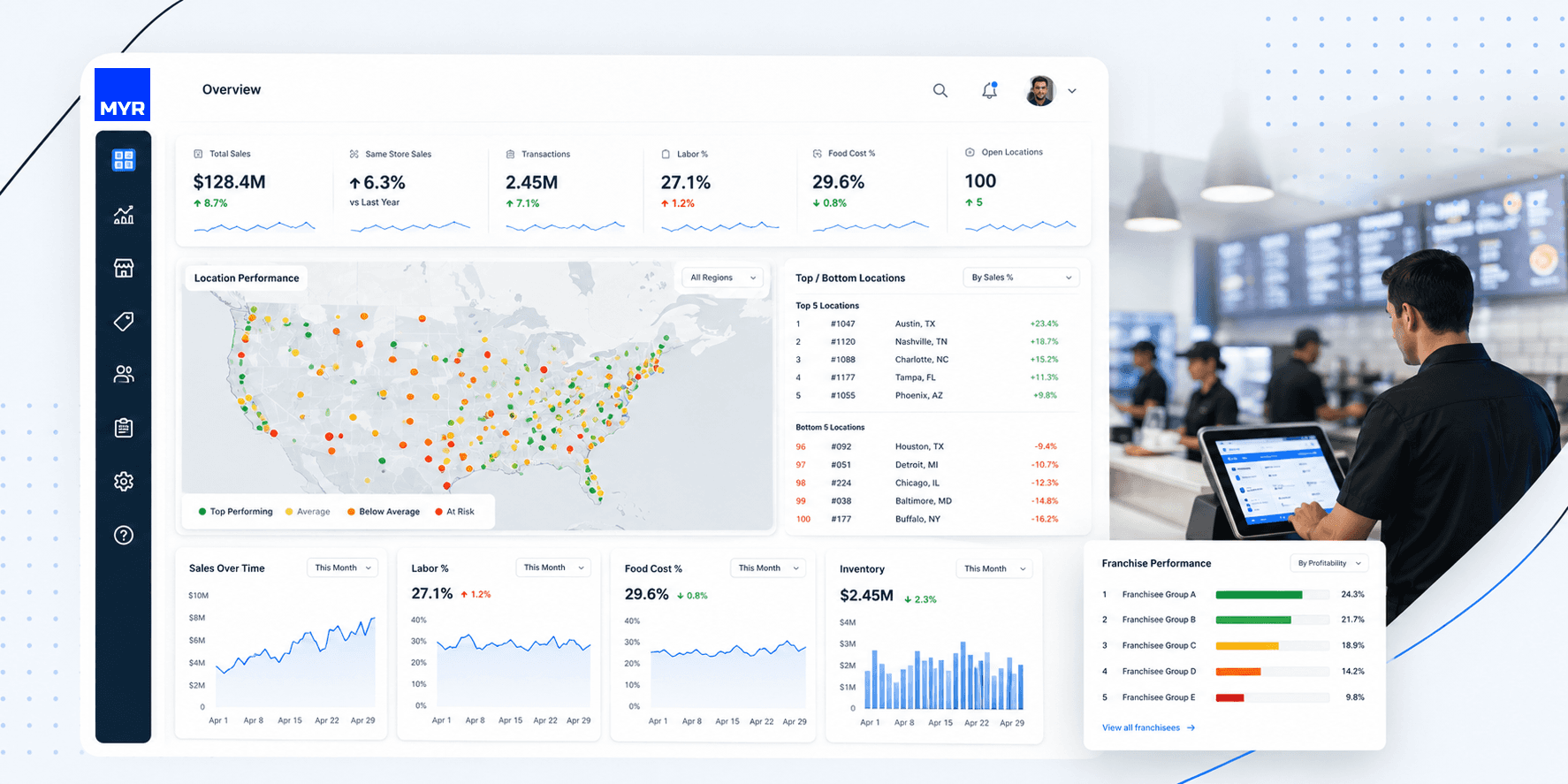
What a Modern Franchise Dashboard Should Deliver
The best franchise dashboards don't simply display data.
They create operational clarity.
A modern dashboard should answer four questions:
1. How Is the Business Performing?
Network-wide sales
Same-store sales growth
Average ticket
Transaction volume
Revenue trends
2. Which Locations Need Attention?
Bottom-performing stores
Sales declines
Labor overruns
Inventory anomalies
Compliance issues
3. Which Franchisees Are Winning?
Top performers
Highest margins
Best labor efficiency
Lowest waste
Strongest growth
4. Where Should Leadership Focus Next?
Emerging risks
Expansion opportunities
Operational bottlenecks
Regional challenges
The Executive Dashboard: A Single Source of Truth
One of the defining characteristics of high-performing franchise organizations is the presence of a centralized operational command center.
A single source of truth.
A platform where executives, operations teams, finance departments, regional managers, and franchisees can access trusted information in real time.
The purpose is simple:
Everyone should be working from the same numbers.
The same KPIs.
The same operational realities.
Without multiple spreadsheets.
Without conflicting reports.
Without endless reconciliation.
The Five Dashboards Every Franchise Executive Needs
1. Executive Performance Dashboard
The franchise CEO's cockpit.
Key metrics:
Total network revenue
Same-store sales growth
EBITDA trends
Revenue by region
Revenue by franchise group
Growth versus target
This is the dashboard leadership should review daily.
2. Operations Dashboard
Designed for COOs and operations teams.
Key metrics:
Order volume
Service speed
Labor productivity
Customer throughput
Store rankings
Operational issues become visible immediately.
3. Labor Dashboard
Labor remains one of the largest controllable expenses in restaurant operations.
Track:
Labor %
Labor dollars
Overtime
Hours worked
Productivity metrics
Small improvements here often generate significant profitability gains.
4. Inventory & Food Cost Dashboard
Margins are won and lost in inventory management.
Monitor:
Food costs
Waste
Variances
Stock shortages
Supplier performance
The goal isn't inventory reporting.
The goal is margin protection.
5. Franchise Performance Dashboard
One of the most powerful tools in a growing franchise system.
Track:
Franchise rankings
Compliance scores
Profitability comparisons
Promotional participation
Operational benchmarks
This turns reporting into a franchise support system.
Visibility Creates Accountability Across the Franchise Network
One of the biggest frustrations franchisors face is the gap between what they believe is happening and what is actually happening at the store level.
Without visibility, corporate teams often rely on:
Periodic audits
Phone calls
Franchise meetings
Spreadsheet submissions
By the time problems become visible, they are often already impacting profitability and customer experience.
A centralized franchise dashboard changes this dynamic.
Instead of waiting for information to arrive, leadership gains ongoing visibility into operational performance across every location.
This creates greater accountability while strengthening relationships between franchisors and franchisees.
The conversation shifts from assumptions to facts.
Helping Franchisees Succeed, Not Just Measuring Them
The best franchise systems understand an important truth:
Franchisee success drives brand success.
Reporting should not be used simply to identify problems.
It should help operators improve performance.
When franchisees gain access to meaningful operational insights, they can:
Improve labor management
Reduce waste
Increase profitability
Improve scheduling
Optimize inventory
Compare performance against network benchmarks
The result is a stronger franchise system where corporate teams spend less time policing operations and more time supporting growth.
Franchise Compliance Without Micromanagement
Maintaining consistency across a growing franchise network has always been challenging.
Customers expect the same experience regardless of location.
Modern franchise dashboards help organizations monitor:
Menu compliance
Pricing compliance
Promotional participation
Operational standards
Labor policy adherence
Inventory procedures
Instead of relying solely on audits and periodic reviews, leadership gains continuous visibility into franchise performance.
Problems can be identified early.
Support can be provided proactively.
Relationships improve because conversations become data-driven rather than opinion-driven.
Why Spreadsheet-Based Reporting Eventually Fails
Almost every growing franchise organization reaches the same conclusion.
Spreadsheets do not scale.
Initially they work.
Over time they become a bottleneck.
Common challenges include:
Manual data entry
Version control issues
Delayed reporting
Human error
Lack of real-time visibility
Limited scalability
As the organization grows, reporting complexity grows exponentially.
What worked at ten locations becomes unsustainable at fifty.
What worked at fifty becomes nearly impossible at two hundred.
Modern franchise organizations are replacing spreadsheet-driven reporting with centralized dashboard environments that automate data collection and reporting.
Exception-Based Management: Finding Problems Before They Become Crises
One of the most valuable capabilities of modern dashboards is automated exception management.
Instead of reviewing hundreds of reports manually, leadership can focus only on what requires attention.
Examples include:
Sudden sales declines
Labor overruns
Inventory anomalies
Margin deterioration
Delivery disruptions
Technology failures
Compliance issues
Automated alerts help organizations identify risks early.
This proactive approach dramatically improves operational control.
Why Leading Franchise Brands Are Moving Toward Centralized Franchise Management Platforms
Historically, franchise organizations invested in separate tools for:
Reporting
POS
Accounting
Franchise communication
Operational oversight
This often created disconnected systems and fragmented information.
Today, leading franchise brands are consolidating visibility, reporting, operational oversight, franchise support, and multi-location management into centralized franchise platforms.
The benefits are substantial.
Greater Visibility
A single view across the entire franchise network.
Faster Decision Making
Real-time information instead of delayed reporting.
Stronger Franchise Support
Identify struggling locations earlier and provide assistance before issues escalate.
Improved Consistency
Ensure menus, pricing, promotions, and standards are executed consistently.
Better Growth Readiness
Open new locations without losing operational control.
This shift is changing how franchise organizations scale.
The focus is moving from managing individual locations to managing an entire network as a connected ecosystem.
From Reporting Platform to Franchise Growth Platform
As franchise organizations mature, reporting evolves into something much larger.
It becomes the foundation for:
Operational excellence
Franchise support
Expansion planning
Strategic decision-making
Network-wide consistency
The strongest franchise brands increasingly view reporting, operational oversight, and franchise management as interconnected capabilities rather than separate systems.
This shift creates alignment across the organization.
Corporate teams gain visibility.
Regional teams gain accountability.
Franchisees gain support.
Leadership gains confidence.
Everyone operates from the same source of truth.
What Franchise Decision Makers Should Look For
Before selecting a reporting solution, ask:
Can I see every location in real time?
Can I benchmark franchisees?
Can I identify problems automatically?
Can I drill from corporate view to store view?
Can franchisees access meaningful insights?
Can regional managers monitor their territories?
Does the system integrate with POS, accounting, payroll, inventory, loyalty, and delivery platforms?
Will this support growth over the next 5 years?
If the answer to any of these questions is no, visibility gaps will eventually emerge.
The Future of Franchise Growth Is Visibility
The most successful franchise organizations don't simply collect more data.
They create alignment.
Alignment between:
Head office and franchisees
Operations and finance
Regional managers and store managers
Strategy and execution
That alignment starts with visibility.
Modern franchise management platforms combine:
✓ Real-time reporting
✓ Franchise performance dashboards
✓ Multi-location oversight
✓ Operational consistency tools
✓ Franchise support capabilities
✓ Network-wide visibility
into a single system.
When leadership can see the entire network clearly, they can make better decisions, support franchisees more effectively, and scale with confidence.
For growing QSR franchise brands, reporting is no longer just about understanding the business.
It's about creating a stronger, more connected franchise system.
Because in modern franchise operations:
Visibility creates accountability.
Accountability improves execution.
Execution drives profitability.
And profitability fuels growth.