For most of QSR history, franchise expansion followed a simple script: find a corner with traffic, sign a lease, open a box. It worked when real estate was cheap, labor was stable, and the only threat was the competing brand across the street.
That script is no longer working. And the QSR franchises finding genuine growth in 2026, in Canada and the U.S., are following a fundamentally different playbook.
They are opening inside airports. They are running mobile kiosks on university campuses. They are embedding in hospital corridors and military bases. They are launching ghost kitchens in delivery-dense urban neighborhoods without a single customer-facing storefront. And they are connecting all of it to a single POS system for restaurant franchises that gives them visibility across every format, every location, and every channel simultaneously.
This article breaks down exactly how that expansion works, which brands are doing it, what the unit economics look like, and what technology infrastructure makes it viable, particularly for operators in Canada navigating their own compliance requirements alongside all of it.
Why the Traditional QSR Location Model Is Breaking Down
Before mapping the opportunity, you need to understand the pressure driving franchisors and operators toward alternative formats.
The numbers are stark. The International Franchise Association projects QSR franchise establishment growth at just 0.5% in 2026, a dramatic deceleration from 2.2% in 2025. In the U.S., approximately 217,000 QSR locations are already operating, and suburban and secondary markets in core categories (burgers, coffee, sandwiches) are saturated. New units in traditional locations increasingly cannibalize existing franchisee revenue rather than generating genuinely new sales.
In Canada, the QSR segment accounts for more than 53% of the country's total foodservice industry — a market valued at over $37 billion, yet 75% of Canadians report dining out less due to cost-of-living pressures. Only 11% of Canadians now say they eat fast food because they believe it offers good value, an erosion that threatens the sector's core demand proposition.
The real estate math has also deteriorated. A standard Tim Hortons franchise in a major Canadian city now requires total investment of $1.2 to $2.5 million CAD, with build-out costs of $600,000 to $1.5 million just for leasehold improvements and equipment. A traditional McDonald's franchise unit in the U.S. now requires $1 to $2.3 million in liquid capital. Construction costs are up. Financing costs are elevated. And 42% of U.S. restaurant operators reported not being profitable in 2025.
Non-traditional restaurant locations solve several of these problems at once. They require smaller physical footprints, sometimes as little as 400 square feet. They embed the brand inside venues where a built-in customer base already exists and visits on a predictable schedule. They reduce construction costs dramatically. And for franchise operators building multi-unit portfolios, they diversify revenue streams in a way that a collection of identical street-level units simply cannot.
What "Non-Traditional" Actually Means: A Taxonomy
The term covers a wide spectrum. Before evaluating fit for your franchise system, it helps to categorize the major venue types and understand what makes each one distinct.
Transit Infrastructure
Airports, train stations, bus terminals, ferry hubs. High dwell time, limited consumer alternatives, and demonstrated premium willingness-to-pay. The airport QSR market alone was valued at $36.8 billion in 2024 and is projected to reach $56.1 billion by 2034 at a 4.5% CAGR.
Institutional Campuses
Universities, colleges, hospitals, corporate headquarters. Predictable daily traffic from a resident or rotating population with limited off-site access during core hours. Students, healthcare workers, and office employees represent high-frequency repeat-visit customers with structured daily routines.
Government & Military Installations
Federal buildings, military bases, correctional facilities. Controlled environments with guaranteed foot traffic, essentially zero direct competition, and institutional procurement processes that produce long-term, defensible contracts.
Retail Embedding & Co-Location
Grocery stores, big-box retailers, gas stations, convenience chains, travel centers. Co-location strategies convert existing retail traffic into food revenue without requiring new customer acquisition investment.
Leisure & Entertainment Venues
Stadiums, arenas, theme parks, movie theaters, casino floors. Event-driven traffic with high per-visit spend and strong brand association opportunities.
Ghost Kitchens & Delivery-Only Formats
Delivery-first operations with no customer-facing storefront, optimized entirely for off-premise volume through third-party apps and direct digital ordering. The U.S. ghost kitchen market reached $98.28 billion in 2025.
Micro-Format Drive-Thru-Only
Sub-1,500 sq ft units with no dine-in, positioned in highway nodes, travel centers, and suburban locations where a full-footprint build would not pencil financially.
The Airport Opportunity: Premium Capture at Scale
Airports represent one of the most financially attractive non-traditional formats available to QSR franchise expansion, and on a per-square-foot revenue basis, they consistently outperform comparable street-level units.
The structural logic is compelling: travelers in an airport have already committed to spending. They cannot leave the terminal for a lower-cost alternative. They are time-pressured, which plays directly into QSR's core value proposition of speed. And premium pricing, typically 20 to 40% above street-level menu prices, is accepted as normal by the traveling public.
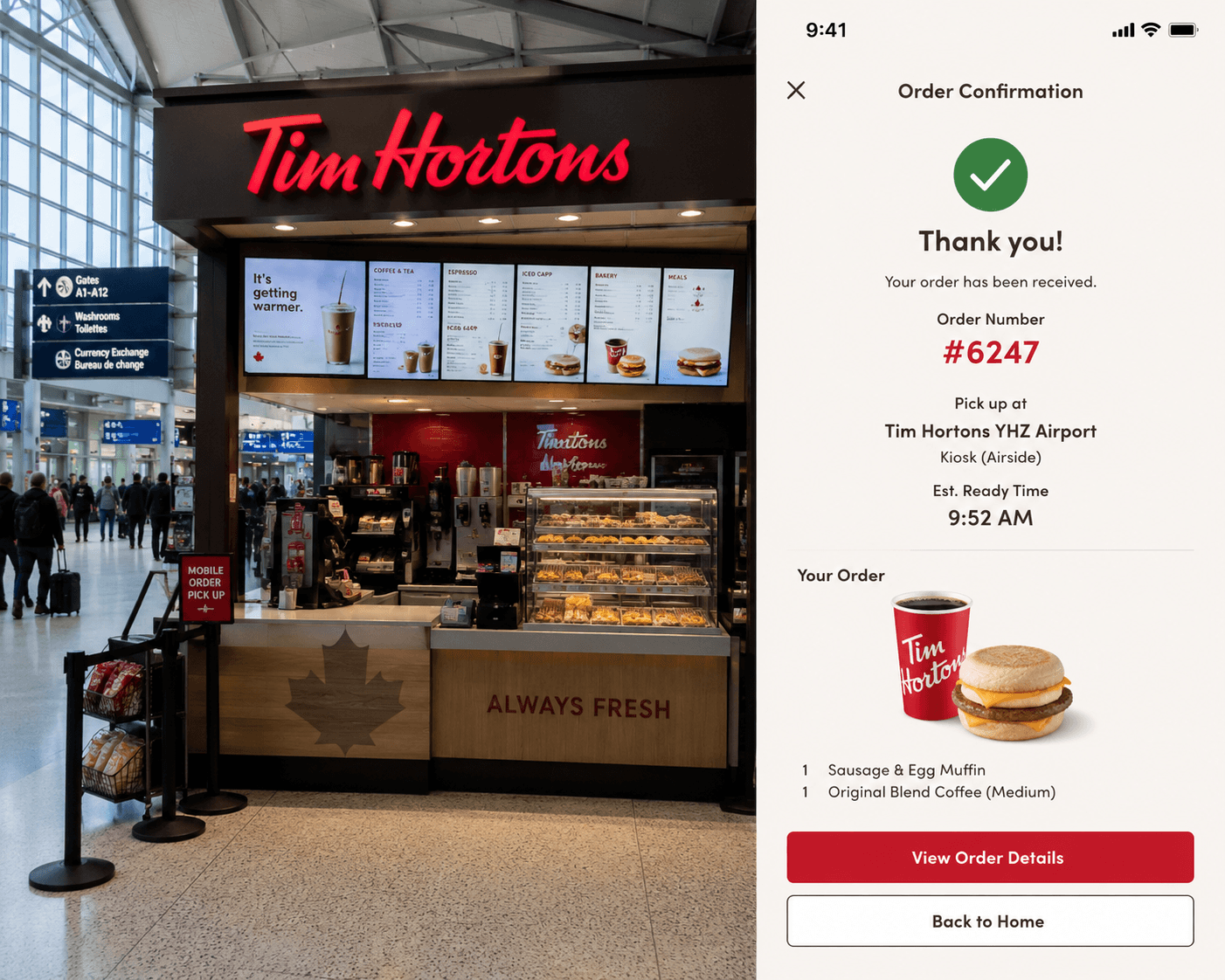
In Canada, major hubs including Toronto Pearson (YYZ), Vancouver International (YVR), Montréal-Trudeau (YUL), and Calgary International (YYC) have become priority expansion targets. Tim Hortons, which operates non-standard modular kiosk and cart formats specifically designed for transit environments, has built a significant portion of its institutional presence in exactly this space. The brand's modular kiosk format was engineered to fit locations where a traditional 2,300 sq ft footprint is simply not available.
In the U.S., Smashburger committed to opening five airport locations in 2026 as part of a broader push into non-traditional formats. The International Air Transport Association projects global air passenger numbers could double to 8.2 billion by 2037, a demand signal that brands with scalable QSR operating systems cannot ignore.
Airport concession agreements differ fundamentally from standard commercial leases. Rather than fixed monthly rent, most airport authorities use revenue-sharing arrangements, typically 10 to 15% of gross sales, which means the operator's ability to drive throughput becomes the critical metric. This is where POS infrastructure becomes a competitive differentiator: brands with integrated mobile ordering, kitchen display systems, and real-time sales visibility can optimize throughput at every peak window; brands operating on fragmented or legacy technology cannot.
Operator note: Airport placements typically require simplified menus (top 20 to 30% of SKUs by volume), extended operating hours (often 18 to 20 hours daily), and mobile pre-ordering integration to reduce queue length at peak boarding windows. The site selection and concession RFP process is typically longer than a standard commercial lease. Budget 12 to 18 months from initial outreach to opening.
University and Campus: The Captive Repeat Customer
If airports offer high-margin transient customers, university campuses offer something arguably more valuable from a long-term brand-building perspective: repeat customers on completely predictable schedules who are forming lifelong brand preferences during their most brand-receptive years.
The demographics align precisely with QSR's core target consumer: 18 to 24 year olds, high-frequency visitors, heavy mobile app users, and disproportionately influenced by loyalty programs and digital engagement. A student who visits a campus Tim Hortons twice daily for four years is not just a customer. They are a brand anchor for the next 40 years of purchasing behavior.
Canada's campus opportunity is underexplored. Over 1.3 million full-time undergraduate students attend Canadian universities. Campus food service contracts are typically multi-year arrangements negotiated with the institution. The first QSR brand to secure a meaningful campus presence in a growing university market effectively locks out competitors for the duration of that contract.
Tim Hortons has long understood this, with campus locations embedded at institutions across Ontario, Quebec, and British Columbia. But the sophistication of campus execution has evolved considerably: leading operators now deploy micro-format walk-up windows, self-ordering kiosks calibrated to handle surge demand during class changes, and mobile app ordering integrated with campus ID payment systems.
In the U.S., Chick-fil-A's campus network generates some of the highest per-unit volumes in its entire system — precisely because the captive customer base creates a density of visits that street-level locations cannot replicate. Jersey Mike's, backed by Blackstone's $8 billion investment since 2024, is aggressively targeting campus and institutional venues as part of its rapid unit expansion strategy.
The key operational challenge with campus locations is surge management. A campus unit may see 60% of its daily volume in three 20-minute windows coinciding with class changes. A multi-location restaurant POS that cannot absorb these spikes without service degradation will destroy the captive customer relationship that makes the location valuable in the first place. This is a non-negotiable technology requirement, not an optional enhancement.
Hospitals and Healthcare: The 24/7 Format Most Brands Are Ignoring
Hospital campuses are, counterintuitively, among the most reliable non-traditional QSR environments available to franchise operators willing to navigate the institutional sales process.
They operate 24 hours daily, 365 days per year. They house a resident population of healthcare workers, often on 12-hour shifts with limited break time and zero mobility to find alternatives, alongside a visitor population that is stressed, time-constrained, and seeking familiar, trusted brands in a high-emotion context.
Tim Hortons' presence at SickKids Hospital in Toronto is a frequently cited case study in Canadian institutional venue development. The format demands specific adaptations: simplified menus executable with small teams in compact footprints, formats that do not require purpose-built kitchen infrastructure, and operating hours that cover overnight nursing shifts. Tim Hortons' modular kiosk format was architecturally suited to exactly this environment.
In the U.S., Subway has been the most aggressive hospital-venue operator of any major QSR brand, leveraging its 400 sq ft minimum format to embed in spaces where no competitor can fit. The brand's hospital network spans hundreds of locations and provides a defensible competitive position that took years to build. Competitors now struggle to replicate it because the best sites are already contracted.
The pitch to hospital administration is not about food. It is about institutional partnership: a professionally managed food service operation that reduces burden on internal facilities staff, serves employees and visitors at consistent quality standards, and generates lease or revenue-sharing income for the institution. Operators who frame the conversation this way advance through the RFP process; operators who lead with menu quality do not.
Military and Government: Guaranteed Traffic, Zero Competition
Military installations, over 800 in the United States and dozens across Canada — share a set of characteristics that make them logically perfect for embedded QSR operations: consistent daily foot traffic from a captive resident population, extended operating hours demand, and institutional contracts that, once secured, produce multi-year stable revenue with essentially no competitive threat.
Subway has built the most extensive military base QSR network of any major brand, using formats as small as 400 square feet to place locations inside mess hall complexes, recreational facilities, and administrative buildings on U.S. and Canadian installations.
For Canadian franchise operators, Department of National Defence installations, from CFB Gagetown in New Brunswick to CFB Cold Lake in Alberta, represent a largely unconsolidated opportunity that regional operators with strong institutional relationship skills could enter ahead of the major national brands. The procurement process is slow and relationship-intensive. The contracts that result are long-term and structurally protected.
Ghost Kitchens: The Format That Changes the Location Calculus
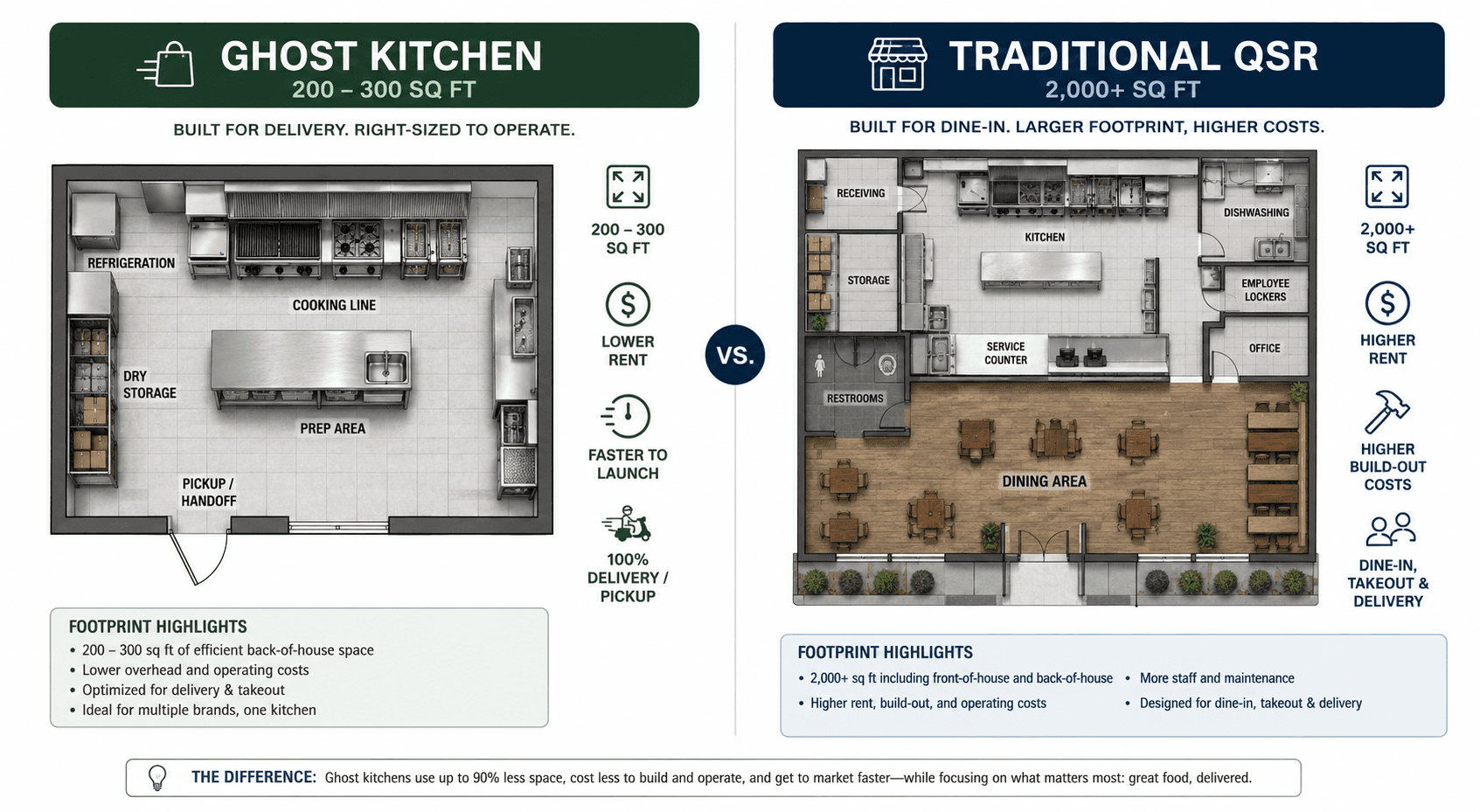
Ghost kitchens, delivery-only operations with no customer-facing storefront — represent the most disruptive format in the non-traditional expansion taxonomy because they effectively eliminate the location constraint. A ghost kitchen franchise is a bet that the brand relationship lives in the app and the food, not the physical space.
The U.S. ghost kitchen market reached $98.28 billion in 2025. Canada's delivery-focused food economy is tracking the global cloud kitchen CAGR of 16.78% closely. Wendy's partnership with REEF Technology to establish ghost kitchen presences across the U.S. and Canada demonstrates that mainstream QSR brands, not just tech-native startups, are integrating delivery-only operations into their expansion portfolios.
For QSR franchise operators, ghost kitchens provide three specific strategic advantages:
Market entry without real estate risk. A brand can test consumer demand in a new geography before committing to a full-footprint lease. If delivery volume supports a traditional unit, the physical location follows. If it does not, the brand exits with minimal sunk cost, far less than the cost of a failed street-level franchise.
Multi-brand revenue from single kitchen infrastructure. One properly configured ghost kitchen can operate two to four virtual brands simultaneously from the same physical space, multiplying revenue per square foot while keeping fixed costs constant.
Delivery surge capacity for existing franchise locations. A traditional QSR franchise with a functioning drive-thru can add a ghost kitchen pod, sometimes 200 to 300 sq ft of additional prep space, to absorb delivery volume without compromising in-store throughput or service times.
Canadian compliance note: Quebec's WEB-SRM digital sales reporting requirement mandates real-time transaction data reporting for all food service operations. Ghost kitchen operators launching in Quebec must ensure their POS and order management systems carry the appropriate certification before opening. This applies equally to delivery-only formats as to traditional storefronts. Non-compliance triggers significant financial penalties. This is not a detail to handle post-launch.
The Micro-Format Drive-Thru: Asset-Light Expansion at Highway Speed
Between the full-footprint traditional unit and the delivery-only ghost kitchen sits a format that many franchise operators are beginning to treat as their primary expansion vehicle: the micro-format drive-thru-only unit.
At 900 to 1,500 square feet, with no dine-in seating and a streamlined menu, these units can be placed on parcels as small as a quarter-acre. They dramatically reduce construction costs and leasehold improvement requirements. They focus the entire operational model on throughput, orders per hour, which aligns with where QSR consumer behavior is clearly heading.
Tim Hortons introduced its 900 sq ft drive-thru-only prototype in 2021. McDonald's has been developing smaller restaurant footprints focused exclusively on drive-thru, takeaway, and delivery with limited or no dine-in since 2020. Del Taco's "Fresh Flex" concept varies from 1,200 to 2,400 sq ft and includes drive-thru-only configurations for high-traffic highway and suburban nodes.
For franchise operators evaluating expansion in secondary Canadian markets, mid-sized cities in Ontario, the Prairies, or suburban Quebec, the micro-format drive-thru represents a unit economics model that can work where a full traditional build cannot justify the investment.
The technology requirement for micro-format drive-thru is specific: AI-driven drive-thru ordering systems are moving from competitive advantage to table stakes. Eleven major QSR chains have deployed AI-enabled drive-thru systems as of 2026. Wendy's FreshAI improved speed of service by 22 seconds per transaction. Checkers and Rally's Hi Auto voice AI across 350 locations reported shorter order times and improved upsell performance. For a drive-thru-only unit where revenue is entirely determined by throughput, 22 seconds per transaction is a material margin improvement across thousands of transactions per week.
The Technology Stack That Makes Non-Traditional Expansion Work
Non-traditional venue expansion is inseparable from technology investment. Managing a distributed portfolio of small-format locations, each with its own throughput profile, operating hours, menu subset, lease structure, and customer behavior pattern, is operationally far more complex than managing a portfolio of identical freestanding units.
The QSR franchises winning in non-traditional locations share a common technology architecture. Understanding each component explains why the wrong QSR POS system choice becomes a bottleneck that limits how many formats and locations you can realistically manage.
Unified POS Across All Formats
Whether a unit is a 400 sq ft kiosk in a hospital lobby or a 1,600 sq ft drive-thru-only format at a highway travel center, the POS must be the same platform feeding the same data layer. Fragmentation across format types creates analytical blind spots that make it impossible to compare unit economics across a portfolio, identify underperforming locations before they become problems, or push centralized menu changes without a manual update process at every format type.
Chains that have consolidated their technology stack report 30 to 40% reductions in IT overhead and significantly faster onboarding of new locations. This advantage compounds as portfolio size grows.
Looking to manage multiple formats from one platform? MYR POS for franchise operators is built specifically for multi-location QSR and fast-casual franchise systems, with centralized menu management, royalty reporting, and real-time performance visibility across locations, whether they are traditional storefronts, kiosks, drive-thru-only units, or delivery-first formats.
Mobile Ordering as a Revenue Channel
Non-traditional locations, particularly those serving captive populations like campus students or hospital workers, benefit disproportionately from mobile pre-ordering because it decouples order volume from queue length.
A student who pre-orders via mobile during their last class arrives at the pickup point and exits in under 60 seconds. The same student standing in line during a class-change rush creates a service failure event that damages the repeat-visit relationship that makes the location valuable in the first place.
Integrated mobile ordering tied to a loyalty program that incentivizes pre-ordering is not an optional feature for campus or healthcare venues. It is the operational mechanism that unlocks the full revenue potential of the captive-audience format.
AI-Driven Demand Forecasting
Non-traditional locations are characterized by sharper demand peaks than traditional street-level QSR units. A hospital location may do 40% of its volume in a 90-minute lunch window. An airport gate-area unit may process 200 orders in 45 minutes before a departure and then go quiet for two hours.
AI-driven demand forecasting, which 89% of Canadian restaurant leaders planned to invest in as of the 2025 Future of Restaurants survey, enables kitchen staffing and prep schedules to anticipate these peaks rather than react to them after service quality has already deteriorated. Operators who pre-stage prep for a predictable 11:45 AM surge are profitable; operators who react to it are behind.
Self-Ordering Kiosks for Revenue, Not Just Labor Reduction
The self-service kiosk market is projected to reach $37.2 billion in 2025, with restaurant installations doubling to 700,000 by 2028. In non-traditional locations, the value proposition of kiosks shifts from labor replacement toward throughput enablement and ticket size optimization.
PDQ Chicken reported a 25% increase in average ticket size after implementing kiosks, driven by the behavioral reality that customers at kiosks order more because they have privacy and time to consider their choices without social pressure from a queue. In a campus or hospital location where every transaction matters to the unit economics, a 25% ticket lift is transformative.
The 2026 trend in kiosk deployment is integration: kiosks talking to mobile apps and kitchen display systems as a single unified system, rather than operating as siloed hardware. Brands without this architecture in place are building operational complexity into every additional location they open.
Brand-by-Brand: Who Is Executing Non-Traditional Expansion in Canada and the U.S.
Tim Hortons
The most instructive Canadian case study. With nearly 6,000 locations globally and a dominant Canadian position, Tim Hortons has operated non-standard formats, including airport kiosks, modular carts, hospital locations, and campus placements, as a portfolio component for years. Its 900 sq ft drive-thru-only and 1,600 sq ft "Welcome Image" prototypes introduced in 2021 were explicitly designed for format diversification. The brand committed to 480 restaurant projects across Canada in 2026. In the U.S., it ended 2025 with 693 restaurants, its largest U.S. fleet ever, and is targeting markets from New York City walk-up venues to expansion across Texas, Georgia, Virginia, and the mid-Atlantic.
Subway
The most aggressive non-traditional operator globally. Subway has committed that up to 2,500 of its next 10,000 global restaurant openings will be in travel hubs, campuses, and institutional venues. Its 400 sq ft minimum format is the smallest viable footprint of any major QSR brand, giving it access to physical spaces that competitors cannot enter. The brand's military base, hospital, and travel center networks are the most extensive in the industry, representing a competitive moat that took decades to build.
McDonald's
Pursuing smaller-footprint configurations built around mobile pickup and drive-thru-only operations. Its CosMc's spinoff concept, beverage-and-snack focused with a smaller footprint and drive-thru-only format, is a structural bet that specialty format units can generate strong returns where a full McDonald's build would not pencil. The brand is also deploying AI and edge-computing systems across its 43,000-restaurant global network to bring operational consistency to non-standard format deployments.
Smashburger
Explicitly targeting airport and university locations in 2026, with five airport placements committed as part of a 10 to 12 unit expansion plan that combines traditional and non-traditional formats. For a mid-size brand with strong awareness but lower market penetration than the top-five chains, non-traditional venues provide access to high-value customer segments without the capital commitment of a full traditional build program.
Firehouse Subs (Restaurant Brands International)
Projected to deliver 150 to 200 net new units per year in the U.S. and Canada by 2028, with average payback periods under four years. As an RBI brand sharing infrastructure and learnings with Tim Hortons, Burger King, and Popeyes, Firehouse's non-traditional expansion strategy will benefit from the parent company's institutional relationship network.
PizzaForno (Canadian)
A Canadian company offering fully automated pizza ovens that bake pizzas in under three minutes, available 24/7, remotely monitored via dashboard, and placeable anywhere with a power connection and minimal floor footprint. PizzaForno represents the logical extreme of non-traditional location strategy: the brand is the format, and the format can go almost anywhere. As automated food technology matures, expect similar concepts to challenge traditional QSR non-traditional placements in the same venues.
The Unit Economics: What the Numbers Actually Look Like
Abstract arguments for non-traditional expansion require concrete financial comparison. Here is what the economics look like across format types:
Format | Total Investment (CAD est.) | Customer Acquisition Cost | Payback Period | Key Risk |
Traditional freestanding | $1.5M–$2.5M | High (marketing + foot traffic) | 4–7 years | Real estate + competition |
Airport kiosk | $300K–$700K | Near-zero (airport provides traffic) | 2–4 years | Revenue share, airport authority negotiations |
University campus | $200K–$500K | Near-zero (captive population) | 3–5 years | Semester seasonality, contract renewal |
Hospital/healthcare | $150K–$400K | Near-zero (captive staff + visitors) | 3–5 years | Institutional procurement timeline |
Ghost kitchen | $150K–$350K | Platform-dependent (delivery app fees) | 2–3 years | Delivery margin compression |
Micro-format drive-thru | $500K–$900K | Moderate (highway/retail node traffic) | 3–5 years | Throughput-dependent model |
The portfolio implication is clear: a franchise operator building only traditional freestanding units is concentrating 100% of their real estate risk in the most expensive, most competitive, and most saturated format category. A portfolio that combines two traditional units with one airport kiosk, one campus placement, and a ghost kitchen pilot is structurally diversified. Each format serves different customer needs, operates at different hours, and draws from entirely different traffic sources.
What Multi-Format Expansion Demands from Your Operations
Executing a multi-format portfolio requires deliberate investment in systems, training, and support infrastructure that a single-format operator does not need.
Menu engineering across formats. A full menu designed for a 2,000 sq ft restaurant does not translate to a 400 sq ft kiosk. Non-traditional locations require purpose-built menu subsets, typically the top 20 to 30% of SKUs by volume and margin, that can be prepared at high speed with minimal labor and minimal equipment complexity. Brands that have done this well (Tim Hortons' modular kiosk menu, Subway's assembly-line simplicity) built their non-traditional playbooks around menu discipline. Brands that try to offer the full traditional menu in a non-traditional format create service failure and operational chaos.
Centralized menu management. When you operate four format types across twelve locations in three provinces, the ability to push a menu price change or LTO from one central dashboard, rather than manually updating twelve separate POS terminals, is not a convenience. It is a structural requirement for maintaining brand consistency and operational control. This is a primary reason why choosing the right franchise restaurant POS system before you open your second non-traditional location matters far more than most operators realize until they have already committed to the wrong platform.
Compliance integration from day one. In Canada, operators must ensure every format is integrated into the appropriate provincial reporting framework before opening. In Quebec, this means WEB-SRM certification , applicable to every food service format, not just traditional restaurants. In Ontario and other provinces, health code and food safety requirements apply to non-traditional venues just as they do to standalone locations, though the permitting process differs by venue type. Build the compliance infrastructure before the lease is signed, not after the unit is open.
What Franchisors and Multi-Unit Operators Should Do Now
If you operate 10+ traditional QSR units and are evaluating growth formats:
Map your current portfolio against the non-traditional venue opportunity in your existing markets before pursuing new geographic expansion. The cities you are already in likely have hospitals, universities, transit hubs, and institutional campuses you have not penetrated. Entry cost is lower, brand familiarity is already established, and franchise support infrastructure is already in place.
Build or designate a development resource with specific mandate for institutional venue penetration. These deals require relationship management and patience that differs from commercial real estate transactions. Pipeline takes longer to build, but the resulting contracts are longer-term and structurally more defensible than any street-level lease.
Develop a "Growth Format Playbook" with unit economics models for at least three format types: flagship traditional, micro-format (kiosk or drive-thru-only), and delivery-only. Each should have a defined CAPEX/ROI threshold and a ramp timeline calibrated to the specific customer behavior pattern of that venue type.
If you are evaluating individual non-traditional venue opportunities:
Do not benchmark non-traditional locations against the revenue expectations of traditional freestanding units. Evaluate them on risk-adjusted return, accounting for lower capital outlay, more predictable traffic, lower customer acquisition cost, and the portfolio diversification benefit of non-correlated revenue streams.
Before signing any institutional venue agreement, verify that your POS provider has direct experience with the operational requirements of that specific venue type — particularly mobile ordering integration, surge-demand throughput capacity, and reporting compliance for your province or state.
Considering a non-traditional location for your QSR franchise? MYR POS for franchises is purpose-built for multi-format QSR operations in Canada and the U.S., supporting everything from traditional storefronts to drive-thru-only micro-formats, ghost kitchens, and kiosk deployments, with centralized multi-location management, royalty tracking, and Quebec WEB-SRM compliance built in. See how it works
Frequently Asked Questions
What is a non-traditional QSR location? A non-traditional QSR location is any food service placement outside a standard freestanding or strip-mall storefront. This includes airports, university campuses, hospitals, military bases, ghost kitchens, travel centers, stadiums, and corporate campuses. These formats typically feature smaller footprints, captive customer bases, and lower construction costs than traditional builds.
Do I need a different POS system for a non-traditional restaurant location? Not necessarily a different system, but you need a POS system for restaurant franchises that is specifically designed for multi-format, multi-location operations. The platform must support centralized menu management (so you can push changes across all format types from one dashboard), mobile pre-ordering, surge-demand throughput, and compliance reporting for your relevant province or state. A POS built only for traditional storefronts will expose its limitations quickly when you add an airport kiosk or campus walk-up to your portfolio. MYR POS is built for exactly this use case
What are the best non-traditional QSR formats for Canada? University campuses and healthcare venues are the most underexplored formats in Canada relative to their revenue potential. Airport locations at major Canadian hubs offer premium pricing power. Ghost kitchens work well in delivery-dense urban markets. Micro-format drive-thru-only units are strong performers in secondary Canadian cities where a full traditional build cannot justify the investment.
How do ghost kitchens work for QSR franchise expansion? A ghost kitchen franchise operates from a delivery-optimized kitchen with no customer-facing storefront. Orders come through mobile apps, third-party delivery platforms, or branded digital ordering channels. The format enables market entry at 30 to 50% of the capital cost of a traditional unit, with faster payback periods and lower fixed cost exposure. The primary risk is margin compression from delivery platform fees (typically 15 to 30% of order value).
What POS system do QSR franchises use in Canada? Canadian QSR franchises use a range of platforms, but operators managing multi-location or multi-format portfolios increasingly consolidate onto systems with native Canadian compliance features, particularly Quebec's WEB-SRM digital reporting requirement. MYR POS is purpose-built for the Canadian QSR market, with WEB-SRM certification, multi-location management, and franchise-specific features like royalty reporting and centralized menu control. Learn more about MYR POS for franchises
The Competitive Clock Is Running
The QSR brands moving aggressively into airports, campuses, hospitals, and institutional venues in 2026 are not doing so because non-traditional locations are easy. They are doing it because the traditional location model is getting harder, more expensive, and less differentiated with every passing quarter — and the brands that move first into the best institutional venues effectively lock out competitors for the duration of multi-year contracts.
A campus food service contract that runs five to seven years blocks competitors for its entire term. An airport concession agreement with brand exclusivity in a terminal is a structural moat, not just a revenue line. A healthcare campus relationship that begins with one hospital frequently expands to the full system as the institutional relationship deepens.
The customers are in the terminals, on the campuses, in the corridors, and in the apps. The formats and technology to serve them efficiently exist and are maturing rapidly. What is finite is the window to secure the best institutional placements before a competitor does.
The brands, and the operators, that lead the next decade of QSR growth in Canada and the U.S. will be the ones who built their portfolios to go where customers already are, and who built the technology infrastructure to manage it all from one place.
This article was produced by the MYR POS editorial team. MYR POS is a cloud-based point-of-sale platform built for Canadian QSR and multi-location franchise operators, supporting traditional storefronts, kiosks, drive-thru-only units, ghost kitchens, and every format in between from one unified dashboard. Explore franchise solutions at myr.io/franchise.
Related Reading
Guide to Restaurant POS Systems (2026 Edition) - MYR POS Blog
Future of QSR 2026: Trends & Priorities for Franchise Leaders - MYR POS Blog
Multi-Location Restaurant Management with MYR - MYR POS Product