Something fundamental is changing in the quick-service restaurant industry across North America.
For decades, the model was simple: place restaurants where people already gather. Inside retail stores. Inside malls. Inside high-traffic buildings. The logic made perfect sense in a world built around foot traffic and impulse purchases.
Today, that model is slowly fading.
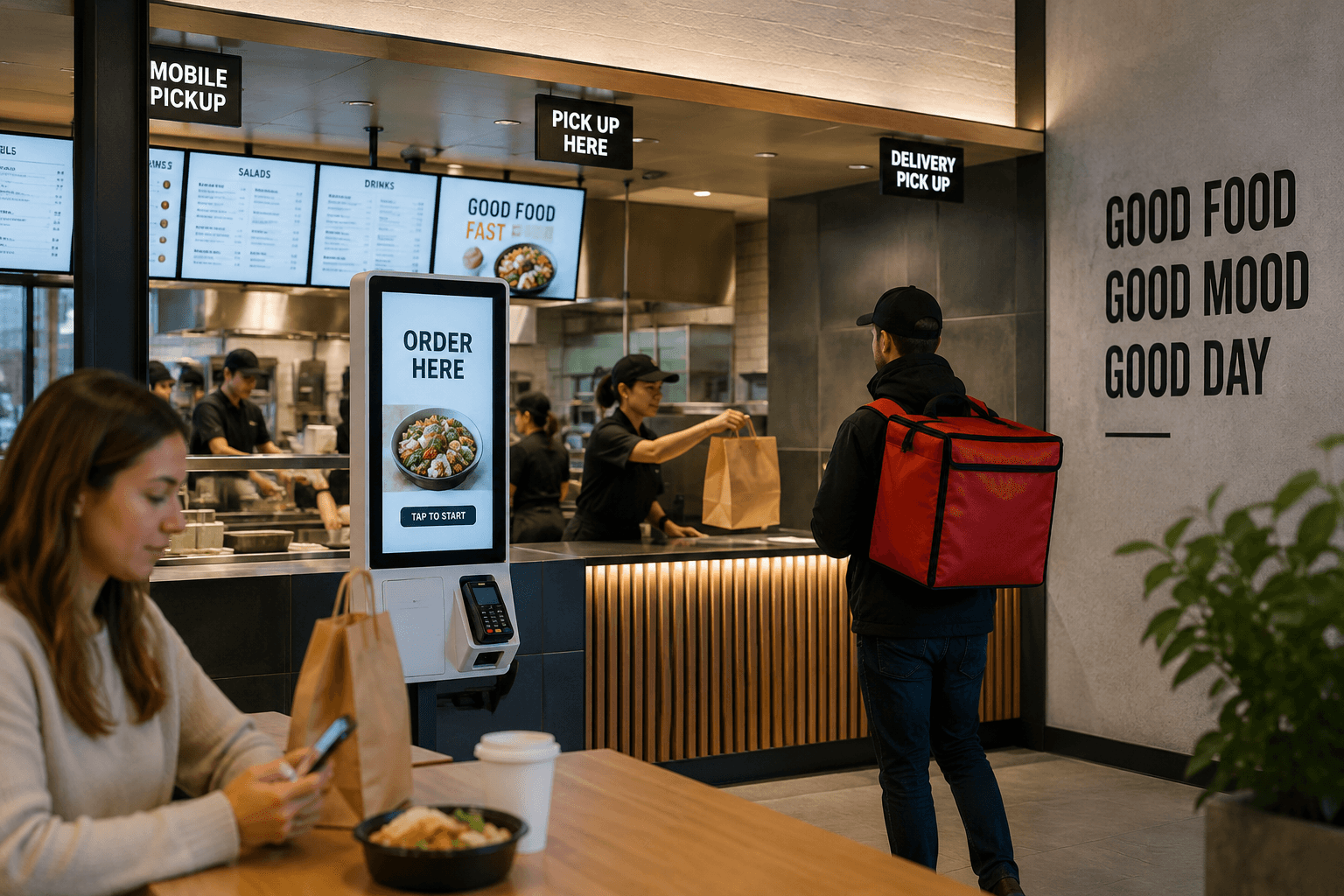
Instead, the industry is reorganizing itself around something completely different: digital demand, drive-thru efficiency, mobile ordering, and speed of fulfillment.
And the data now clearly shows this shift is real.
Customers no longer order food the same way
The biggest change is behavioural.
Customers are increasingly deciding what they want before they ever arrive at a restaurant.
According to recent QSR industry research, digital orders now represent roughly 42% of total quick-service restaurant sales, up dramatically from just 15% in 2019. Mobile apps alone account for nearly a quarter of all QSR sales today.
Another 2026 industry report found that:
57% of adults now use mobile ordering
More than 60% of consumers are ordering off-premise more often than they were a year ago
94% of customers say speed is one of the most important parts of the restaurant experience
That changes everything about how restaurants are designed.
The old model depended on customers discovering food while shopping or walking through a building. The new model depends on capturing demand digitally and fulfilling it quickly.
Drive-thru and off-premise have become dominant
Drive-thru is no longer just an added convenience. For many brands, it has become the operational core of the business.
Industry research shows:
Drive-thru accounts for approximately 55% to 68% of QSR transactions in North America
In burger-focused QSRs, drive-thru historically represented as much as 57% of all visits
Delivery platforms contributed nearly 47% of total QSR sales in some North American markets according to recent industry analysis
At the same time, delivery and mobile ordering continue to grow aggressively:
Third-party delivery increased nearly 30% year over year
Mobile app sales increased more than 57% year over year
In-store kiosk sales increased nearly 67% year over year
This is important because embedded restaurant locations inside larger retail environments often cannot fully support these high-growth channels.
Most cannot efficiently handle:
drive-thru demand
high-volume delivery staging
optimized pickup flow
multi-channel kitchen coordination
That creates a growing performance gap between older formats and newer standalone locations.
Foot traffic is no longer enough
For years, restaurant success was tied closely to physical traffic.
If enough people walked past your location, sales followed.
But today, convenience is increasingly digital rather than physical.
Customers now prioritize:
app ordering
fast pickup
delivery access
drive-thru speed
order accuracy
Not simply proximity inside a building.
This is why many older embedded restaurant formats are quietly disappearing across North America. The economics are becoming harder to justify compared to modern standalone formats built specifically for off-premise demand.
Industry analysts now describe the QSR industry as entering a period of “bifurcation,” where operators built around digital infrastructure and operational speed are separating themselves from slower legacy models.
Restaurants are being redesigned around throughput
One of the clearest signs of this transition is how new restaurants are being built.
Modern quick-service locations increasingly prioritize:
dual-lane drive-thrus
dedicated mobile pickup areas
self-service kiosks
smaller dining rooms
faster kitchen workflows
real-time digital order management
According to industry reports:
54% of major U.S. chain operators implemented dual-lane drive-thrus by the end of 2024
59% of urban QSR locations now use self-service kiosks
61% of chains use cloud-based POS systems for real-time operations tracking
This is no longer just a restaurant trend. It is an operational transformation.
The industry is moving from a “location-first” mindset to a “system-first” mindset.
Success increasingly depends on how efficiently orders move through the operation rather than simply where the restaurant is located.
Canada is seeing the same shift
The Canadian market reflects many of the same patterns.
Canada’s QSR sector generated approximately CAD $44.8 billion in annual sales in 2024 and now represents nearly half of all foodservice revenue nationally.
But growth is increasingly tied to convenience and off-premise ordering behavior.
Industry analysis shows:
Canadian QSR traffic growth is outperforming full-service restaurants
Cold-weather ordering patterns continue driving strong reliance on drive-thru, takeaway, and delivery
Value perception and operational convenience are becoming major competitive advantages
In other words, Canadian operators are adapting to the same reality:
customers want faster, more convenient, digitally connected experiences.
The technology behind the counter now matters more than ever
As ordering channels multiply, restaurant operations become more complex.
A single location may now handle:
in-store orders
drive-thru traffic
mobile app orders
delivery platform integration
kiosk ordering
loyalty programs
real-time kitchen coordination
All at the same time.
That’s why modern POS systems are evolving far beyond payment processing.
Today, the POS increasingly acts as the operational hub of the restaurant, connecting ordering channels, kitchen workflows, reporting, and staff coordination into one system.
Platforms like MYR POS help quick-service restaurants manage this complexity by centralizing orders from multiple channels while keeping service fast and operations organized during peak periods.
In a market increasingly defined by speed and operational efficiency, the systems behind the counter are becoming just as important as the menu itself.